
Ranking the Friendliest/Most Polite States
Every region in the U.S. has its own communication style, from drawling Southern hospitality to spitting your words out in a New York minute. We know the stereotypes, but what does this look like in everyday digital writing?
While digital writing lacks the communication cues that come from body language and oral intonation, the written word still carries tone. And tone matters. It’s the personality, character, and attitude behind words and—when assessed—can say a lot about both message and messenger.
To close out the year, QuillBot analyzed the tone of user input—or text that a user put into a QuillBot tool during a specific use—to identify which states are the friendliest and the most polite when writing online. This analysis revealed some clear patterns, a few contradictions, and one particularly surprising finding: Washington is both the friendliest and the least polite state in the nation.
The friendliest and most polite states in the U.S.
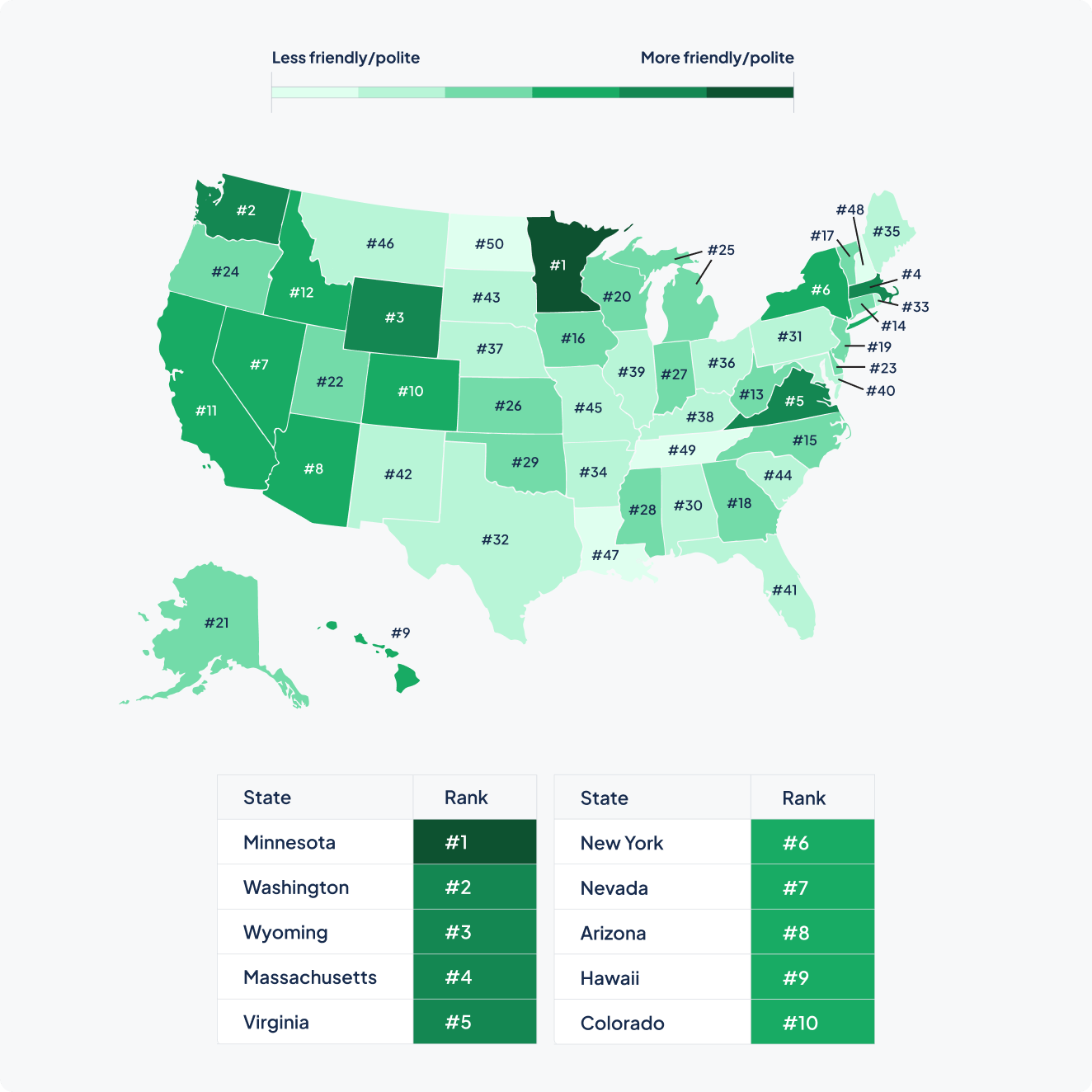
When taking an aggregate of friendliness and politeness into account, these states ranked highest:
Defining “friendly” and “polite”
QuillBot’s tone analyzer—a type of AI model—doesn’t “understand” friendliness or politeness in a human sense. The model is nondeterministic, meaning it learns from examples rather than following fixed definitions. The model is trained to recognize linguistic patterns in language labeled by human annotators as “friendly” or “polite,” but it’s not trained to understand intent or meaning.
Generally speaking:
- “Friendly” refers to the level of warmth and openness in language
- “Polite” refers to the level of respect and formality
These two tones often overlap but are not identical: A message can be polite without being particularly friendly, or it can be friendly without being formally polite. In QuillBot’s analysis, these were treated as complementary dimensions of how “nice” or socially positive a message sounds.
The Washington paradox
The most surprising finding by far was that Washington State tops both positive tone categories—friendliest and most polite—yet paradoxically has the highest concentration of inputs with lower levels of politeness.
This contradiction mirrors one of the region’s well-known stereotypes: the Seattle Freeze. Transplants have described Seattleites as “nice but distant”—warm in phrasing but standoffish and distant in intent. QuillBot’s tone analysis mirrors that duality: plenty of positive, friendly messages alongside a disproportionate number of curt or lower-politeness phrasings.
This doesn’t mean Washington writers are contradictory people. Instead, it may reflect two coexisting communication norms: an openly friendly written tone paired with a more detached in-person way of relating to others.
Minnesota is truly nice
“Minnesota Nice” is real, at least according to QuillBot’s analysis. Minnesota had the highest proportions of friendly and polite inputs. This finding correlates with the stereotype of Minnesotans being polite, conflict-averse, and humble in how they communicate.
Were New Yorkers unfairly stereotyped?
New York is famous for its fast-paced, direct communication style, often seen as blunt or rude. Locals see it differently: In such a busy and diverse city, efficiency, honesty, and respect for others’ time and space are precious. New Yorkers also value camaraderie, and QuillBot’s data shows this mix of directness and cooperation in writing, producing higher-than-expected friendliness and politeness scores.
Inputs were filtered by users’ current location at the state level, so results may reflect New York’s diverse population and the more relaxed tone of upstate residents. Or have we just been unfairly stereotyping New Yorkers all along?
The Southern surprise: lower-than-expected scores
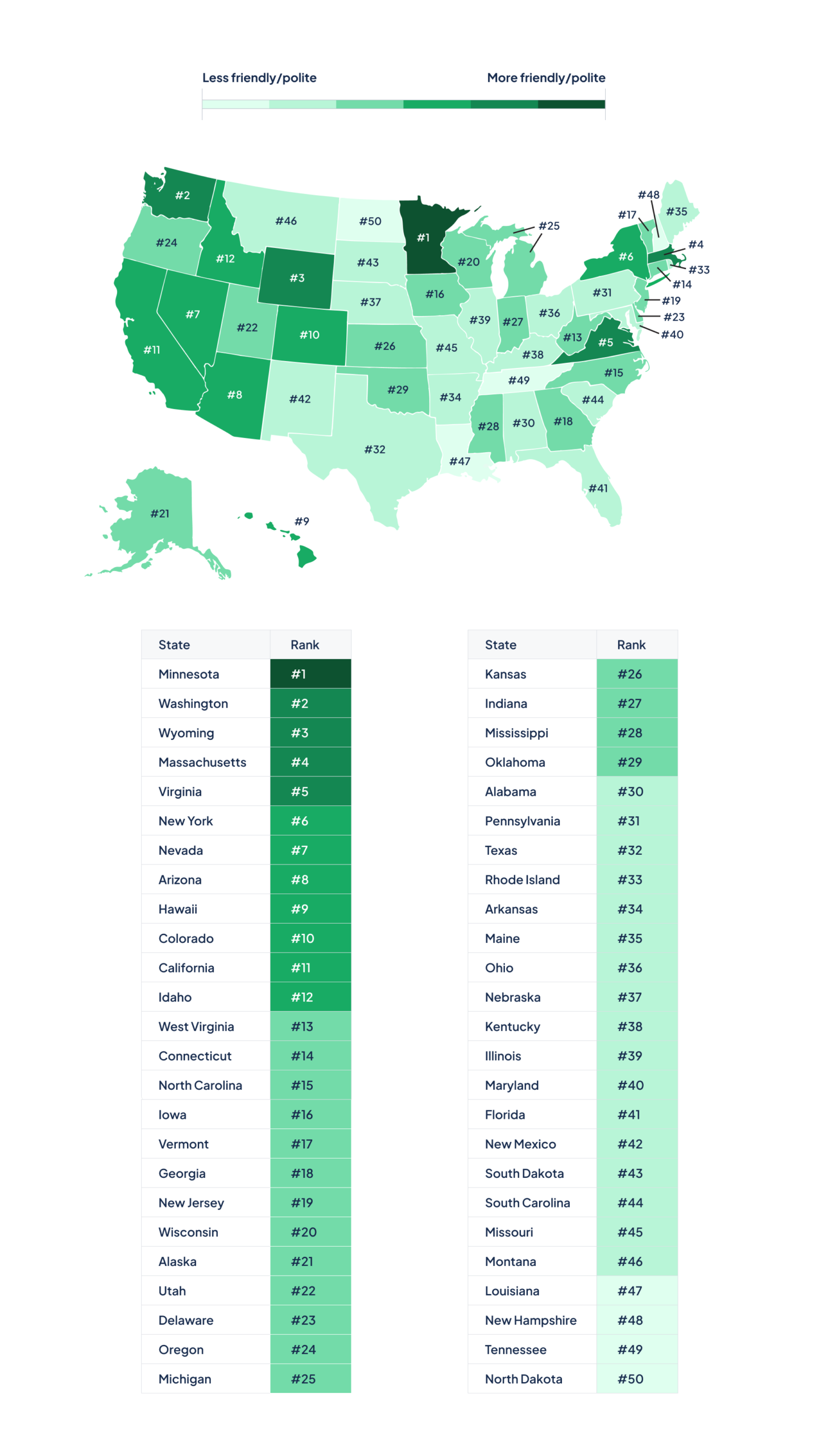
Another unexpected finding was that Deep South states—often associated with warmth, hospitality, and easy conversation—ranked lower than expected on combined friendliness and politeness. The list below shows how each state ranked; the “averaged ranking” shows the combined scores, ordered as rankings out of 50, with one being the highest.
- Georgia: #18
- Mississippi: #28
- Alabama: #30
- Texas: #32
- Arkansas: #34
- South Carolina: #44
- Louisiana: #47
- Tennessee: #49
So what might this mean? There are two possible explanations:
- Southern politeness leans heavily on in-person cues—tone of voice, pacing, and body language—qualities that don’t carry into text.
- The tone analyzer wasn’t trained on regional communication styles. Culturally specific markers of respect, like honorifics (“sir,” “ma’am”) or indirect phrasing (“if you don’t mind”), may not score as particularly friendly or polite in the model’s framework.
It’s also worth noting that QuillBot users may not reflect the broader Southern population. Overall, the data suggests that Southern warmth remains intact in everyday life, even if it doesn’t always appear—or register—as such in digital writing.
The tone analyzer data might reveal which states use friendly tones most frequently, but the bigger picture is that—no matter where QuillBot looked—it found friendly user inputs everywhere.
Kindness and connection show up in many ways—in tone, in phrasing, and most of all, in intent—and that’s something no tone analyzer can fully capture. Whether someone’s style is more direct or more warm, what truly matters is the intention behind their words.
A note about tone by region
Research in sociolinguistics shows that politeness and friendliness are not universal standards. People understand these concepts based on upbringing, culture, region of origin, and the specific context they’re communicating in.
For example, in New York, people value directness; New Yorkers consider this communication style polite because it doesn’t waste their time. But in Minnesota, more formal and indirect phrasing is seen as polite, as it is less aggressive and imposing.
Those patterns appear in digital communication as well. People unconsciously bring their local norms into email, chat, and text-based writing. The goal of this analysis wasn’t to decide who’s “nicest.” It was to reflect how different parts of the country tend to express friendliness or politeness on the page.
How QuillBot can help you with finding the right tone
If you want your writing to come across as clearer, friendlier, or more concise, QuillBot tools can help you adjust your tone:
- Paraphraser offers multiple preset tone options as well as a custom tone input, so users can target a specific communication goal (e.g., “make this text more polite and approachable”).
- Grammar Checker provides proactive grammar and style correction suggestions to ensure your message lands as intended. Premium users also get suggestions related to politeness and delivery, supporting more collaborative or considerate communication. What’s more, Grammar Checker’s AI commands allow users to ask the tool to rewrite the text in a particular tone (e.g., “make this sound polite but direct”).
- AI Chat can analyze existing text and give feedback on its tone, clarity, and warmth. It’s useful for users who want a deeper understanding of how their writing might be perceived.
- QuillBot’s extensions and integrations for these tools (e.g., the Chrome browser extension) can be used wherever the user writes with the extension.
Try out these tools for free today to see how QuillBot can help you express yourself exactly how you want to come across.
Methodology: How QuillBot analyzed tone across 50 states
QuillBot used AI to analyze 125,000 samples of user inputs filtered by user location in September 2025. Due to variation in how users use the tool, the length of user inputs can vary.
QuillBot’s Paraphrasing Tool has an AI component that analyzes the tone of user input (the text that users write or paste into the tool). QuillBot used this “tone analyzer” to gauge the friendliness and politeness of users from different states.
How was the tone analyzer built, and how does it work?
QuillBot’s tone analyzer was built and trained with a “human-in-the-loop” approach. This means that although it was trained on some synthetic data (text generated by AI), it was primarily trained using sentence data labeled by humans to mark a range of emotions. Several human linguists review the same text to reduce individual bias in how they’re labeled.
These “emotion labels” are based on how humans intuitively recognize emotional tone in communication, and with a large enough dataset, individual judgment differences tend to balance out. A sentence may have multiple emotion labels (e.g., “gratitude” and “approval”). QuillBot aggregated these fine-grained emotion labels into broader “friendly” and “polite” categories. For example, the labels “admiration,” “approval,” and “caring” contribute to the “friendly” category.
As language is constantly evolving and concepts like “good writing” and “friendly tone” are subjective, QuillBot is constantly reviewing its model to make sure it reflects real, timely, and diverse ways of communicating.
Cite this QuillBot article
We encourage the use of reliable sources in all types of writing. You can copy and paste the citation or click the "Cite this article" button to automatically add it to our free Citation Generator.
Schindelwig, H. (2025, December 10). Ranking the Friendliest/Most Polite States. Quillbot. Retrieved March 19, 2026, from https://quillbot.com/blog/writing/friendliest-most-polite-states/