Creating an engaging slide deck doesn’t have to be complicated. Thanks to the latest online presentation tools, you can build polished slides without spending time learning complex software. If you want a fast way to generate a complete set of slides from a short prompt, try QuillBot’s free AI presentation maker.
Confident and clear presentation skills are essential for students, professionals, and anyone looking to communicate ideas effectively. Yet for many people, public speaking and presenting in front of an audience feel intimidating. The good news is that effective presentation techniques—and helpful tools like QuillBot’s AI presentation maker—can make the process far less overwhelming.
In this article, you’ll discover essential skills, tips, and strategies to help you master the art of presentation, whether you’re preparing for a classroom project or a business pitch.
Creating a visually appealing presentation deck is an essential skill for students and professionals alike. AI presentation makers—such as QuillBot’s free AI presentation maker—simplify the process by generating a set of slides based on a short prompt, so you can focus on communicating your information and messages rather than formatting.
In this article, you’ll learn about prompts for an AI presentation maker and how to use a free tool to create your slides.
A troubleshooting guide is a document that lists common problems and step-by-step solutions. These guides allow customers or consumers to quickly solve problems quickly, without waiting for support.
Creating a clear troubleshooting guide is an art—it should be simple enough for the general public to understand, detailed enough to actually solve a problem, but not so long that it becomes overwhelming. A good guide will reduce support tickets, speed up resolution, and improve customer satisfaction.
Thankfully, AI tools like QuillBot’s free AI troubleshooting guide generator allow you to generate clear and well-formatted troubleshooting guides with the click of a button. Read on to learn more about writing effective guides and using AI to expedite the process.
3D models can make your project or presentation come alive and look very modern. Producing them used to take lots of time, skill, and expensive computer software. Now, with tools like QuillBot’s AI-powered 3D model generator, you can bring your documents or brochures up to date in no time!
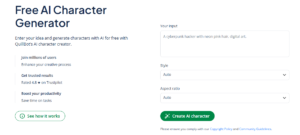
Every great story begins with its characters—but imagining what they look like or how they carry themselves can take time. Whether you’re a writer visualizing a protagonist, a game master designing an NPC for a DnD campaign, or a teacher running roleplaying and interactive storytelling exercises, turning abstract ideas into something tangible is often the hardest part.
With an online AI character generator, a few descriptive words can become detailed visuals that reflect a character’s personality, style, and presence. It’s a creative way to brainstorm and refine ideas, giving you a clearer picture of who your characters are and how they fit into your story.
In this article, we’ll explore how to create an AI character, share tips for crafting effective prompts, and show how QuillBot’s free AI character generator can bring your ideas to life.
Coming up with new story ideas can feel harder than writing the story itself. A story prompt generator gives you a way out, offering a wide range of story writing prompts for you to experiment with. You might discover love story prompts that explore complex emotions, mystery story prompts with unexpected twists, fantasy short story prompts filled with magic, or dystopian story prompts imagining grim futures.
In the following sections, you’ll find creative story prompts across genres and learn how Quillbot’s AI story prompt generator can help transform scattered ideas into captivating story starters.
Book ideas often begin as a spark: a few intriguing words overheard in conversation, the impression left by a painting, or a dilemma at the heart of a news story. The next step is to take that fleeting spark and shape it into a fully formed story idea, which is where an AI book idea generator—such as QuillBot’s free AI book generator—can help.
A startup team crowds around a whiteboard, trying to name a product that won’t sound like everything else on the market. In a university library, a student stares at a blank page, searching for a research question that hasn’t been done to death. During a budget review, a team leader must figure out how to stretch limited resources without derailing key projects. What all three have in common is brainstorming: the practice of generating and refining ideas to solve problems, drive innovation, and move projects forward.
In the next sections, we’ll answer what brainstorming is, share effective brainstorming techniques, including how to brainstorm business ideas, and show you how QuillBot’s AI idea generator can transform scattered thoughts into a set of strong, well-defined ideas.
Choosing the right name for your character is a vital part of storytelling. Authors have used all sorts of methods to find names for their characters. If you drive through Cheshire in the UK you will find Cholmondley and Malpas within a few miles of each other, both of which are character names in Evelyn Waugh’s Decline and Fall. A couple of hours’ drive south, and you’ll see the Gloucestershire town of Dursley—a name familiar to Harry Potter fans.
Other authors might make up names to reflect the characteristics of the person being named. Perhaps the best-known author for this was Charles Dickens. In his novel Hard Times, not much imagination is needed to perceive the characteristics of the schoolmaster Mr. Gradgrind, the mean, selfish Mrs. Sparsit, or the school inspector Mr. M’Choakumchild!
A good name not only helps readers remember the character but also conveys personality, cultural background, or even hints at the role they play in the plot.
There’s no one correct method for naming characters, but there are some tried-and-true approaches that can spark inspiration. One option is to use an AI name generator like QuillBot’s AI character name generator.