
How to Study Smarter, Not Harder | 7 Study Tips for Better Grades
Knowing how to study is one of the most important and misunderstood skills for academic success. Effective studying involves more than rereading the textbook, reviewing your notes, and putting in long hours. It requires intentional strategies, such as a consistent schedule and active recall techniques that strengthen your focus, memory, and motivation.
The strategies that make studying more effective are based on decades of research on how the brain stores and retrieves information.
This article explores how to study smarter with research-based study tips for making a schedule, setting up your environment, learning the material, and practicing for the test.
Make a study schedule
One way to study smarter is by making a study schedule as soon as you find out about an upcoming test. A technique called backwards planning helps you cover all of the material you need to learn by the day of the test. It’s one of the main techniques that project managers and teachers use. Here’s how it works:
- Look at the end goal: Make a list of all the information that the test will cover by surveying the lecture topics on your course syllabus and the chapter and heading titles in your textbook for that unit of study.
- Determine your timeline: How many days or weeks do you have until the day of the test? How many study sessions can you fit into that timeline? Plan for a day or more between study sessions, which improves your brain’s ability to put the information in your long-term memory.
- Divide the material: Decide what information you’ll cover during each session. Plan to review material you studied previously and material that you haven’t studied yet.
- Make adjustments along the way: After your first session, reflect on how much you were able to cover, and adjust your plan as needed.
By spreading out your studying over several different sessions, you’ll be more likely to remember what you learned on the day of your test. This also gives you more time to meet with a tutor or your instructor if any of the material is especially difficult.
Try spaced repetition (1-3-7 study schedule)
Spaced repetition is a type of study schedule that involves testing yourself on three or more different days with increasingly longer intervals between each self-test. A self-test can be a practice test, flashcard review, or a similar form of active recall (giving information from memory instead of passively rereading it). According to research, spaced repetition helps your brain get increasingly better at retrieving the information.
The most common approach is a 1-3-7 schedule.
- 1 day after learning: First practice test or flashcard review
- 3 days later: Second practice test or flashcard review
- 7 days later: Third practice test or flashcard review
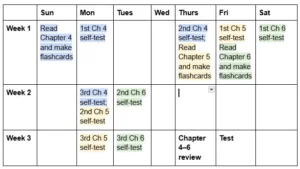
Let’s say that you have a test on Chapters 4, 5, and 6 in 3 weeks. A 1-3-7 spaced repetition schedule would look like the example below.
Spaced repetition example
Eliminate distractions
Everyone knows that a study area should be free of distractions. The real challenge is figuring out what distracts you, which is different for everyone. Start by taking note of when and how you tend to get distracted while you’re doing schoolwork. Then, review the list below to find the solutions that are most relevant.
- Put your phone, video game consoles, and other digital distractions in a different room. Turn smartphones on silent. If you need to be available for emergencies, use advanced “do not disturb” settings that only allow certain people to get through.
- If you’re using a computer to study, close all of the browser tabs that you aren’t using (e.g., group chats, shopping sites, or games). You may even need to unpin games and chat sites from your taskbar so that they’re completely out of sight.
- Gather water and any other necessary supplies before you start studying so you aren’t tempted to leave your study area.
- Keep your desk free of clutter and any objects that you don’t need, such as mail, photos, or art supplies.
- If you live in a full house with a lot of background activity, study at a library or coffee shop in a quiet area or during a time of day that isn’t busy. A quiet restaurant (but not a sports bar or place with big TVs) between 2:00 and 4:00 p.m. is a great option!
- Keep a pad of paper or similar at your side so that when mental distractions creep in, you can quickly jot them down and refocus. For example, if you suddenly remember you need to pick up dry cleaning later, write it down, and let it go.
- If you’re studying at home, and house chores are too tempting or distracting, take care of them before your study sessions begin.
Use active learning strategies
Your performance on the test depends on how effectively you learn the information for the first time. Active learning techniques boost your ability to remember the information during the test (and later for a final exam or a career). Use active learning techniques before, during, and after reading a textbook chapter:
- Before: Consider what you already know or think about the topic in order to activate prior knowledge. This step shows your brain where to store the information.
- During: Pause at natural stopping points (e.g., the end of a chapter section) to relate the information to what you already know, and/or write down any questions or points of confusion.
- After: Do something active with the information you learned, such as:
- Write a study guide or chapter summary.
- Make flashcards (either on notecards or with a flashcard app).
- Make a visual representation of the information, such as a mind map, chart, timeline, or Venn diagram.
- Discuss what you learned with a classmate.
- The main topic goes in a circle in the center of the page.
- Major subtopics (e.g., the main subsections of a chapter) branch out from the center circle.
- Each subtopic has additional branches for key terms, steps, details, etc.
- Survey: Before you read the chapter from start to finish, scan the introduction, headings, bolded keywords, and conclusion to activate your prior knowledge and get a “big picture” view of the content. Make a list of the major headings to use during a later step.
- Question: Read the questions at the end of the chapter, and write down any questions of your own that you expect to answer. Another approach to this step is to write a question for each major heading.
- Read the chapter from start to finish, pausing at the end of paragraphs or sections to check your understanding and relate the information to what you already know.
- Recite: After you read the chapter, recite what you learned by using one or all of these methods.
-
- Write answers to the questions at the end of the chapter. See how many you can answer without looking back through the chapter.
- Make a chapter outline or notes with the section headings you wrote during the “survey” step. Beneath each heading, list the concepts and vocabulary words that the section covered, which are usually emphasized with bold font, subheadings, or other special formatting.
- Make flashcards for all of the concepts and vocabulary words you need to know for the test (e.g., question on one side and answer on the other or vocabulary word on one side and definition on the other).
- Review: On the days leading up to your test, review your study notes, and test your knowledge by taking practice quizzes or going through your flashcards.
Use active recall
After you learn new information, focus your study sessions on active recall (testing how well you know the material). One of the most common pitfalls is to passively reread your lecture notes and textbooks. Instead, try one or more of these active recall techniques:
- Review flashcards by giving the answer or definition from memory, and place the cards you answered incorrectly in a pile to review again later.
- Write a summary of what you learned without looking at your notes or textbook. Compare your summary to the textbook chapter or lecture notes, and make a list of the information you need to review further.
- Take a practice quiz, and use an answer key to find out which questions you missed (and what you need to review).
- Teach the information to a friend or family member. While you’re explaining, pay close attention to when you feel “less sure” about what you’re saying. Afterwards, compare what you said to the explanations in your textbook.
Take a 5-minute break every 25 minutes
One of the most popular study techniques today is the Pomodoro method of one 5-minute break for every 25 minutes of studying. Short, frequent breaks prevent cognitive overload and improve motivation when you’re studying (or doing homework and writing essays). Here’s how to get the maximum benefit.
- Look for one of the many Pomodoro apps or websites. Some of them even have gamification (some sort of reward for each successful session).
- If you’re using a phone app or timer, turn up the volume so you can keep it in another room. If a phone app is too distracting, try a kitchen timer or a website.
- Decide in advance what you’ll accomplish during each 25 minutes, such as writing 20 flashcards or practicing two short-answer questions.
- Decide how you’ll use each break (e.g., grab a snack, step outside for some fresh air). Avoid social media, email, or other rabbit holes during your breaks.
- If your mind starts to wander during the 25 minutes of work, remind yourself that your break is coming soon, and refocus on the task at hand.
Use self-reflection to make adjustments along the way
Self-reflection helps you identify what’s working and what needs to change so you can study more effectively over time. At the end of each study session, take a few minutes to:
- Assess your focus: Identify when your attention was strongest and when it dropped. Note any distractions (e.g., noise, phone, fatigue), and choose one specific way to reduce them next time.
- Pinpoint difficult material: List the concepts that were hardest to understand or remember. Schedule when you’ll review them again, or decide whether you need to add more study sessions to your plan.
- Evaluate your strategies: Consider which study methods helped you learn most effectively and which ones weren’t quite right for you. Plan one adjustment to try in your next session.
- Set a clear next step: Write down one concrete change for your next study session, such as changing your environment, shortening your study blocks, or tackling challenging material earlier.
Consistently reflecting turns each study session into an opportunity to learn more about which techniques work best for you and which study tips you could try next time.
Frequently asked questions about how to study
- How do you study for a math test?
-
In most cases, to study for a math test, you need to memorize formulas and practice solving math problems. Practice doing these things from memory (active recall) instead of passively rereading your textbook or lecture notes.
- To study math formulas, try making flashcards. For example, you could write “quadratic equation” on one side and the formula on the other side.
- To practice solving math equations, look for practice quizzes or chapter review exercises in your textbook.
Plan to study at least a few times before each test. Research shows that most people need 20 hours of practice to learn a new skill. Also, strive for a day or more between each study session to help your brain put the information in long-term memory.
Have you tried QuillBot’s AI Chat for help with how to study for a math test? You can prompt the AI to make a practice test or share math study tips.
- How do you study for final exams?
-
A great way to study for final exams is by using active recall and the process of elimination to identify which areas you need to review or re-learn.
- Schedule several study sessions with at least one day in between to create repetition and mental breaks, which will both improve your testing performance.
- Make a list of everything that will be on the exam, and make flashcards or practice questions for all of the important terms and concepts you need to remember.
- Go through your flashcards and practice questions without looking at your textbook. Each time you answer correctly, cross that item off your study list.
- Use active learning strategies to review what you missed. For example, take notes while you reread the textbook, draw a chart or mindmap, or write more flashcards.
- During the next final exam study session, answer questions or flashcards for the concepts you missed last time, and repeat the other steps until you’ve crossed everything off your study list.
- On the day before your test, go back through your flashcard pile or practice questions one more time from start to finish.
QuillBot’s AI Chat can help you with how to study by making practice tests for a final exam. You can also prompt the AI to review your answers and give feedback.
- How should I take notes from a textbook?
-
The best way to take notes from a textbook depends on why you’re reading it.
If you’re reading to answer specific questions for an assignment or paper, structure your notes around those questions. Use clear headings for each one to record the information that helps you address them.
For more general reading, keep these principles about how to take notes in mind:
- You don’t need to write down everything. Aim to record enough information to understand your notes later, but not so much that it interferes with actively engaging with the text.
- Review and expand your notes on the same day—or the next day—while the material is still fresh. This helps reinforce understanding and improve retention.
- Writing a short summary during review can clarify main ideas and support the learning process.
If you return to your notes later and find parts of them unclear, QuillBot’s free AI Chat can help you interpret and clarify ideas you no longer fully understand.
Cite this QuillBot article
We encourage the use of reliable sources in all types of writing. You can copy and paste the citation or click the "Cite this article" button to automatically add it to our free Citation Generator.
Routh, N. (2026, February 06). How to Study Smarter, Not Harder | 7 Study Tips for Better Grades. Quillbot. Retrieved March 27, 2026, from https://quillbot.com/blog/education/how-to-study/