
Ballet Terms | Glossary of 50+ Terms & Definitions
Ballet is a highly technical form of dance and has its own vocabulary that allows dancers to communicate precisely and consistently, regardless of their language or origin.
This guide will teach you essential ballet terms—for positions, movements, equipment, and more—to help you better understand the discipline and follow along in class, rehearsals, and performances.
Why are ballet terms in French?
Ballet originated in Italy and soon after spread to France. The art form was formalized in 17th-century France under the patronage of King Louis XIV, who established the first formal ballet academy. Because of this, French became the language used to codify ballet terms.
French continues to be used to describe ballet terms. English speakers often pronounce these terms differently from standard French. Despite these variations, the original French spelling is preserved.
Basic ballet terms for beginners
If you are new to ballet, learning a small set of foundational terms can make it much easier to follow. You’ll hear these basic ballet terms used in most ballet contexts.
| Term | Definition | Example |
|---|---|---|
| Arabesque | A position in which one leg supports the body and the other stretches back | She held an arabesque at the center of the floor, focusing on balance and alignment. |
| Barre | A horizontal, wall-mounted bar used in ballet practice | The class began with warm-up exercises at the barre. |
| Demi-plié | A shallow bending of the knees where the heels remain on the floor | The teacher asked the dancers to start with a demi-plié before jumping. |
| Leotard | A close-fitting bodysuit that covers from the tops of the thighs to the shoulders | Students are required to wear a leotard and tights for class. |
| Plié | A bending of the knees | Every combination starts with a plié to prepare the legs. |
| Port de bras | Coordinated movement of the arms through different positions | The exercise focused on smooth port de bras and controlled breathing. |
| Pointe | The tips of the toes | Advanced dancers practice balancing on pointe. |
| Relevé | Rising onto the balls of the feet or toes | He moved into a relevé and held the position steadily. |
| Tendu | A movement where the foot stretches along the floor until the leg is fully extended | The combination included several tendus to warm up the feet. |
Ballet terms A-Z
Below find more ballet terms, their definitions, and the pronunciation for each. The ballet terms are organized by category, allowing you to learn more about a specific aspect of the art form:
Ballet terms for people
There are a few specialized terms in ballet vocabulary for people:
- Ballerina: Principal female ballet dancer
- Ballerino: Italian term for a male ballet dancer
- Balletomane (bah-lay-oh-mahn): Ballet enthusiast
- Danseur (dahn-sur): Male ballet dancer
- Danseur noble (dahn-sur noh-bul): Principal male ballet dancer who is particularly suited to princely roles
- Danseuse (dahn-suhz): Female ballet dancer
- Étoile (ay-twahl): The leading ballet dancer in a company; the French word for “star”
- Virtuoso (vur-choo-oh-soh): Dancer with great technical ability and skill
Ballet terms for positions of the feet
There are five traditional positions of the feet in ballet, which serve as the foundation for most ballet movements. These terms can be used in French or English by referring to their ordinal number.
| Position | Pronunciation | Definition |
|---|---|---|
| Première (First) | preh-myer | Heels together with toes turned outwards |
| Seconde (Second) | suh-kond | Feet turned out and separated |
| Troisième (Third) | troh-zyem | One foot placed in front of the other, heel to instep |
| Quatrième (Fourth) | kah-tree-em | Feet turned out with one foot in front of the other and space between. Fourth can be ouvert (open) or croise (closed). In open, the heels are aligned, while in closed, the heel of the front foot is aligned with the toe of the back foot. |
| Cinquième (Fifth) | san-kyem | Feet turned out and tightly crossed, heel to toe |
Ballet terms for positions of the arms
Likewise, there are standardized ballet terms for the positions of the arms. Note that bras means “arm” in French.
| Position | Pronunciation | Definition | ||
|---|---|---|---|---|
| Bras bas (preparatory) | brah bah | Arms are gently rounded and held low in front of the body, with fingertips close but not touching | ||
| Bras arrondis devant (First) | brah ah-ron-dee duh-vahn | Arms are rounded in front of the torso as if holding a large ball, held at about navel height | ||
| Á la seconde (Second) | ah lah suh-kond | Arms are out to the sides at more or less shoulder height and angled down and forward, with palms facing forward | ||
| Bras Croisé (Third) | brah kwah-zay | One arm is held in First while the other is extended in Second | ||
| Quatrième (Fourth) | kah-tree-em | One arm is extended in Second while the other is held overhead in a position similar to Fifth | ||
| En Couronne (Fifth) | ahn koo-ron | Both arms are rounded and held overhead, forming a crown shape above the head |
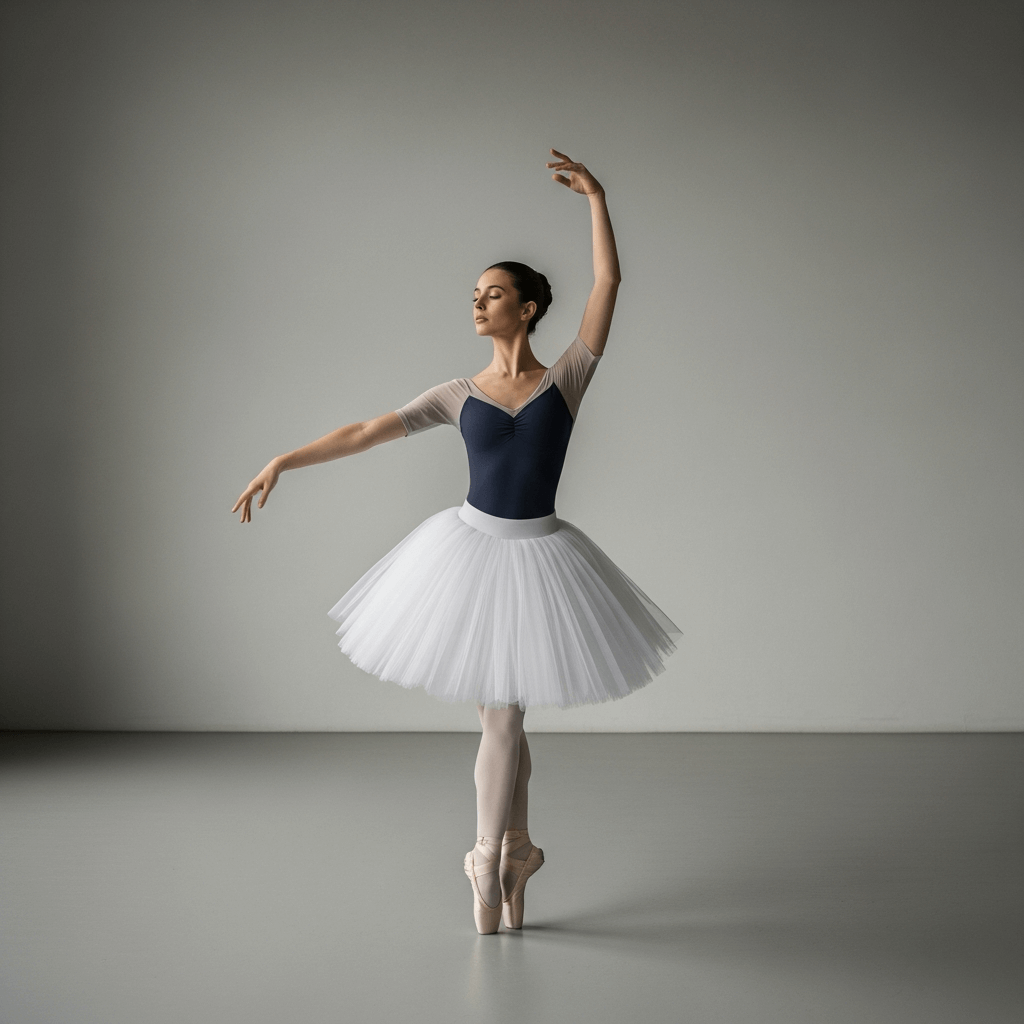
In the above image, you can see the ballerina’s arms and feet in fourth position. She’s also en pointe, or on her toes.
Ballet terms for movements and actions
These ballet terms describe how the body travels, turns, jumps, or transitions between positions. The French en (“in”) is used in many terms describing movement:
- En avant (ahn ah-vahn): Moving forward, towards the audience
- En arrière (ahn ah-ryair): Moving backwards, away from the audience
- En cloche (ahn klosh): Swinging movement of the leg that passes forward and backward like a pendulum (translates literally as “like a bell”)
- En croix (ahn kwah): Movement pattern performed—typically during barre exercises—to the front, side, back, and side again, forming a cross (translates as “like a cross”)
- En dedans (ahn duh-dahn): Turning inward, toward the supporting leg
- En dehors (ahn duh-or): Turning outward, away from the supporting leg
- En face (ahn fahss): Facing something—usually the audience—straight on
- En pointe (ahn pwahnt or ahn point): Performed on the tips of the toes, usually referring to pointe work
Some other ballet terms for movements are:
- Adagio (ah-dah-jee-oh): Slow tempo; slow and graceful movements
- Allégro (ah-leg-roh): Brisk tempo; fast, energetic movements
- Allongé (ah-lohn-zhay): An adjective used to describe poses that are stretched and elongated, like an arabesque
- Arabesque (ah-rah-besk): Position in ballet in which the dancer stands on one leg while extending the other leg straight behind the body, creating a long, graceful line
- Assemblé (ah-sahn-blay): Jump where one foot brushes into the air and joins the other before landing
- À terre (ah tair): On the ground
- Attitude (ah-tee-tewd): Position in which the dancer stands on one leg while the other is lifted and bent, either in front of or behind the body
- Ballon (ba-lawn): Quality of lightness and elasticity in a dancer’s jump, giving the appearance of floating in the air
- Battement (bat-mahn): Beating movement of the extended or bent leg
- Battu (bah-too): Step or jump that includes a quick beating action of the legs in the air
- Bravura (brah-voo-rah): Style of dancing that emphasizes speed, power, and technical virtuosity, usually performed during a solo
- Brisé (bree-zay): Small beaten jump in which the legs cross and beat together in the air before landing.
- Cabriole (kah-bree-awl): Fast-paced jump where one leg is thrown into the air and beaten by the other before landing
- Chaînés (sheh-nay): Series of fast, linked turns performed in a straight line or circle; French word for “chain”
- Changement de pieds (shanj-mahn duh pyay): Jump in which the dancer switches the position of the feet in the air
- Grand jeté (grahn zhuh-tay): a large, traveling leap that splits the legs in the air
- Jeté (zhuh-tay): a jump from one foot to the other
- Sauté (soh-tay): a basic jump that takes off and lands on both feet
Ballet terms for equipment
Ballet training and performance require specific equipment designed to support technique, alignment, and safety.
- Barre (bar): Horizontal bar used for balance and warm-up exercises
- Ballet shoes: Soft shoes that allow flexibility and articulation of the feet
- Pointe shoes: Reinforced shoes worn to dance on the tips of the toes
- Rosin (rawz-in): Sticky substance applied to shoes to prevent slipping on the floor
- Leotard: Close-fitting garment worn during practice
- Tights: Stretchy garment worn to support the legs and allow instructors to see alignment
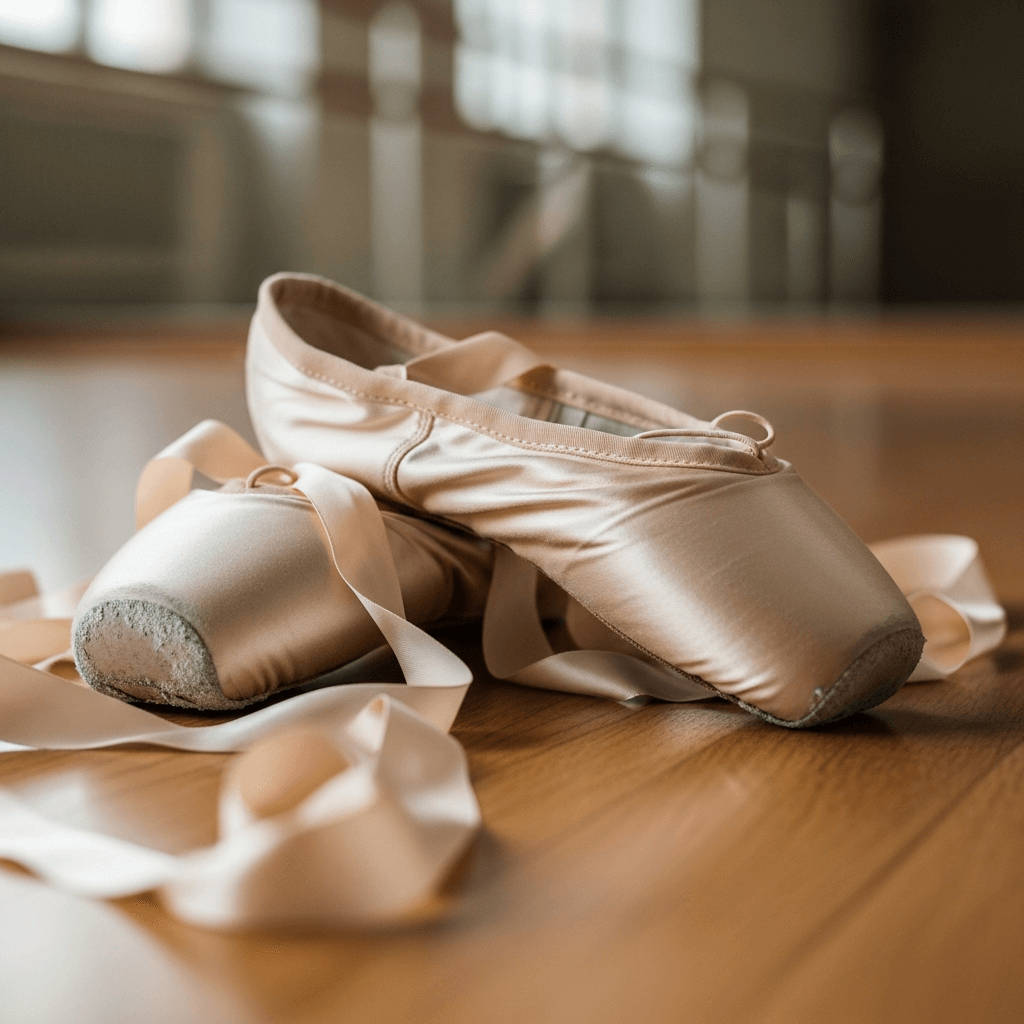
In the image above, you can see how the toe boxes of pointe shoes are reinforced to support dancers when they dance en pointe.
Ballet originated in the 15th century in the courts of the Italian Renaissance. With help from Catherine de’ Medici—who married the King of France—ballet spread from Italy to France. This is why the majority of ballet terms are French and some are Italian. If you want to learn more about the origins of ballet, ask QuillBot’s AI Chat. “Ballet” comes from French. The French adapted the word from the Italian balleto, or “little dance,” when ballet spread from Italy to France. It was the French who formalized ballet, so many ballet terms we still use today are French words. To learn more about the origins of the word “ballet,” ask QuillBot’s free AI Chat.Frequently asked questions about ballet terms
Cite this QuillBot article
We encourage the use of reliable sources in all types of writing. You can copy and paste the citation or click the "Cite this article" button to automatically add it to our free Citation Generator.
Santoro, K. (2026, March 08). Ballet Terms | Glossary of 50+ Terms & Definitions. Quillbot. Retrieved March 19, 2026, from https://quillbot.com/blog/sports-terms/ballet-terms/