Knowing how to take notes effectively is a core academic skill, but it’s one that we’re sometimes never explicitly taught. Good note-taking isn’t about writing down everything you hear or read—it’s about selecting, organizing, and engaging with information in a way that supports understanding and long-term learning.
This article discusses how to take notes in school or college and introduces the popular Cornell note-taking method.
TipOnce you’ve used your notes to plan and write an assignment, use QuillBot’s free Grammar Checker as part of your final proofreading step before you submit it.
The word around can mean “surrounding,” “along the outside of,” and “to different places.” It functions as a preposition or an adverb and is a particle of phrasal verbs like “come around” and “turn around.”
QuillBot’s free AI chat can help you identify the part of speech of “around” in a sentence.
Around in a sentence examplesPut some bubble wrap around it.
A subject complement is the word or phrase that completes the meaning of a linking verb by describing or identifying the subject of the sentence. QuillBot’s free AI Chat can help you identify subject complements in sentences.
Subject complement in a sentence examplesThe roomwascold. [Subject complement: an adjective describing the subject]
Her favorite sportis soccer. [Subject complement: a noun identifying the subject]
That doesn’tsoundright. [Subject complement: an adjective describing the subject]
The boysbecamefriends. [Subject complement: a noun identifying the subject]
The problemisthat we’re running out of time. [Subject complement: a noun clause identifying the subject]
Professional email sign-offs are the fixed phrases you put before your name at the end of an email for work or business. They often come after a closing line like “Please don’t hesitate to contact me if you have any questions.”
TipQuillBot’s free AI Chat can help you select the most appropriate sign-off for your professional email.
Choosing the right professional email sign-off is part of good email etiquette and can be tricky—especially when you’re emailing someone for the first time (e.g., introducing yourself in an email) or starting a job in a new industry where you’re not yet sure how formal the communication style should be.
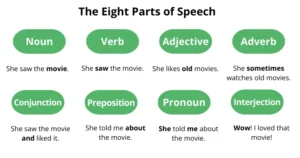
Being able to identify parts of speech is important if you want to understand how English works. QuillBot’s free AI Chat can help you practice identifying parts of speech in a sentence.
The word over can be a preposition of place or time, an adjective, an adverb, or the particle of a phrasal verb. It is part of many idiomatic phrases, like “over the top” and is the opposite of “under” in many contexts.
Need to figure out how “over” is being used in a sentence (i.e., its part of speech)? Ask QuillBot’s free AI Chat for help?
Over in a sentence examplesThere used to be a sign over the door.
Published on
November 4, 2025
by
Tom Challenger, BA.
Revised on
November 20, 2025
Cricket is one of the world’s most popular sports, with its most high-profile matches drawing crowds of over 100,000 spectators and huge TV audiences. If you’re from a country where cricket isn’t widely played but want to understand the game, learning a few basic cricket terms will help you join in conversations about cricket and follow match commentaries.
Here’s a list of 22 cricket terms to get you started.
TipYou can ask QuillBot’s free AI chat questions about the rules, traditions, and history of the sport of cricket.
Cricket terms list
The stumps
The three “sticks” behind the player who is trying to hit the ball—there are two sets of stumps on a cricket pitch, one at either end
The field
The entire area on which the game is played
The pitch
The rectangular area of shorter grass in the middle of the field where the stumps are
The boundary
The edge of the field marked by a rope on the ground
A run
The word for a point in cricket
To run
To try and score runs by running to the other end of the pitch after you’ve hit the ball
A bat
The thick piece of wood with a handle that you use to hit the ball
Batting
Hitting or blocking the ball with your bat in order to score points (runs) or stop the ball hitting the stumps behind you
A batsman, batswoman, batter
The batsmen or batswomen are the two players who are standing in the middle of the field on the team that is currently batting—batter is a widely used alternative gender-neutral term.
Out
When a batter is out, it is the end of their “chance” to bat—you can get out by letting the ball hit the stumps behind you or by hitting the ball so a player on the other team can catch it in the air before it touches the ground, for instance
Bowling
Throwing the ball in a special way in the direction of the stumps to try and get the batter out (e.g., by hitting the stumps)
The bowler
The player who is bowling the ball in the direction of the batter
Fielding
Stopping, throwing, and catching the ball when you’re on the team that isn’t currently batting
A fielder
One of the players on the field who is not currently batting
The wicketkeeper
The player on the fielding team who stands behind the stumps and whose job is to stop or catch the ball if the batter misses it
An innings
A team’s “turn” to bat rather than field
The wicket
The wicket can refer to:
The stumps, including the two smaller “sticks” balanced on top of them (the bails) (e.g., “The batter hit the wicket with his foot”)
The pitch area (“The grass on the wicket is quite long”)
A wicket
When the fielding team get a batter out (e.g., “India have taken three wickets this morning”)
An over
Bowlers bowl in “sets” of six “bowls” (six balls) called an over
Leg before wicket (LBW)
A way that the batter can get out by missing or deliberately not hitting the ball but letting it hit their legs
A spin bowler
A bowler who specialises in bowling the ball relatively slowly using a technique that makes the ball change direction when it hits the pitch in front of the batter
A run out
A way of getting out when you’re running and fail to reach the stumps you are running to before someone on the fielding team hits them with the ball
Pickleball is great fun for all ages and is very easy to learn—especially if you’ve played other racket sports like tennis, squash, badminton, or table tennis.
Learning a few basic pickleball terms for the rules, court layout, and common shot types will help you get off to a flying start if you’re thinking of giving it a try. The table below lists 20 essential pickleball words and phrases every beginner should know.
When you’re left scratching your head over a piece of pickleball vocabulary, QuillBot’s free AI Chat can explain it to you in an instant.
List of 20 essential pickleball terms
A dink
A very common shot used by advanced pickleball players. When playing this shot:
The player is typically positioned quite close to the net
They typically let the ball bounce
They “tap” the ball softly over the net using a “punching” rather than a “swinging” motion
The ball passes over the net at a low height.
The ball lands close to the net on the other side
The kitchen
A slang term for the non-volley zone—the box at the front of the court on each side of the net. You can only volley the ball (hit it before it bounces on your side of the court) when neither of your feet is touching this area.
A side out
When the serving player or doubles team loses their serve and the serve passes to the other side of the net (e.g., “If you lose the rally after your second server has served, it’s a side out”).
It can also refer to a player or team’s complete “serving turn”—also sometimes called a “possession” (e.g., “You always start a new side out by serving from the left”).
A paddle
A pickleball “racket”
The double bounce rule
Also called “the two bounce rule,” this refers to the rule that:
You have to let a serve bounce before you hit it (you can’t volley the serve before “bounce one”)
Your opponent has to let your return bounce before they hit it (your opponent can’t volley your return of serve before “bounce two”).
A drop serve
A way of serving where you drop the ball out of your hand, let it bounce, and then hit your serve (rather than hitting your serve directly out of your hand)
The one, the two
Alternative terms for the “first server” and the “second server” during a side out in a game of pickleball doubles (e.g., “I’m the one because I’m on the right side of the court”)
A drop
A softly hit shot that you hit when you’re standing near the baseline or mid-court into your opponent’s kitchen, allowing you to move forward to your kitchen line
A drive
A powerful shot hit with a backswing, a long follow-through, and some top spin
A banger
A slang term for a player who likes to hit a lot of drive shots
An overhead
A shot that you hit when the ball is high in the air, above the height of your head
A speed up
When a player decides to hit a fast drive shot after an exchange of dink shots
A pancake volley
A powerful forehand “block” volley hit using a grip similar to holding a frying pan (a western or “pancake” grip). This grip keeps the paddle face open and is very effective when you’re standing near the kitchen line.
A chicken wing
A defensive shot where the ball is coming quickly toward your body or head, so you have to awkwardly bend your arm and stick your elbow out
A scorpion
A shot where you bend your knees and raise your paddle to about head height with the paddle face pointing forward—often used to block a fast shot near the body and avoid an awkward chicken wing
A twoey
A slang term for a shot you hit with two hands on the paddle instead of one (typically a backhand)
An Erne
When you jump outside the court so you can volley the ball very close to the net without your feet touching the kitchen (named after the player Erne Perry)
An ATP (around the post)
A legal shot you hit after your opponent plays a dink at an extreme cross-court angle and you hit the ball back around the outside of the net post instead of over the net
The third shot
The shot in a rally after the serve and the return
A paddle tap
When you touch paddles with your opponent at the end of a game to thank them for the game
Tennis, like all sports, has its own unique vocabulary to describe its rules, scoring system, and shots. The game is thought to have originated in 12th-century France, which explains why some English tennis terms are particularly unusual, as they come from Old French. If you’re new to tennis, the table below contains a list of 20 essential terms to help you follow TV commentaries and join in conversations about the sport.
TipIf you’re confused about the meaning of a tennis term, why not ask QuillBot’s free AI chat for a definition?
List of 20 essential tennis terms
Tennis term
Definition
Game
In tennis, you play points to win games; you need at least four points to win a game.
Set
You have to win at least six games to win a set. The first player to win an agreed number of sets is the winner of the whole match; in professional tennis, this is usually two or three sets (i.e., “best of three sets” or “best of five sets”).
Love, 15, 30, and 40
You don’t count points in the usual way in tennis: Zero points is called “love,” one point is 15, two points is 30, and three points is 40.
All
You can say that the score in a game is equal by saying “15 all,” “30 all,” etc.
Deuce
When both players reach 40, the score is “deuce.” From deuce, a player must win one point to gain the “advantage” and then win the next point to take the game.
Advantage
At deuce, the player who wins the next point has the advantage. If they win the following point (a game point), they take the game. If they lose it, the score returns to deuce. Play continues until one player wins a game point.
Tiebreak
If the score in a set reaches “six all” (6-6), you play a special game called a “tiebreak” (or “tiebreaker”). The winner of the tiebreak game wins the set. The points are counted normally in a tiebreak. You win the tiebreak if you have at least seven points and two more than the other player (e.g., 7-3, 7-5, 8-6, or 13-11). In some tennis tournaments, if there is a tiebreak in the final set—which therefore decides the whole match—you have to win at least 10 points.
Serve (service)
The player with the “serve” (or “service”) starts all the points in a game. The serve then switches to the other player for the next game and continues to alternate like this.
Break serve
If you “break serve,” you win a game when the other player has the serve.
First serve (first service), second serve (second service)
The player with the serve has two chances to start the point by hitting it into the correct box on the other side of the net. These chances are called “first serve” (or “first service”) and “second serve” (or “second service”). If the server misses a second serve, they lose the point.
Double fault
It’s a “double fault” when you lose the point because you make mistakes on both your first and second serves (e.g., hit the serves “out” or into the net).
Ace
An “ace” is a serve that the other player is not able to hit (e.g., because the serve is very fast and difficult to reach).
Rally
A “rally” is a series of shots. For instance, if each player hits the ball two or three times during a point, this is considered a “short rally.” If they each hit it ten times, then it’s considered a “long rally.”
Forehand
A “forehand” is a shot hit with the front of the racket, where the ball is to the right of a right-handed player or to the left of a left-handed player.
Backhand
A “backhand” is a shot hit with the back of the racket, where the ball is to the left of a right-handed player or to the right of a left-handed player.
Volley
A shot where the player hits the ball before it bounces, typically played when a player is near to the net.
Topspin
If you hit a “topspin” shot, then the top of the ball is spinning in the same direction as the shot. Topspin lets you hit the ball hard while keeping control because the spin makes the ball dip quickly after it goes high over the net.
Backspin (slice)
If you hit a “backspin” (or “slice”) shot, then the ball is spinning in the opposite direction to the shot. Backspin shots are typically slow and low and don’t bounce as high as topspin shots.
Baseline
The “baselines” are the two lines at either end of the court.
Smash
A “smash” is a powerful shot where a player hits the ball when it is high in the air above their head.
Language proficiency levels—such as “Intermediate High,” “B1,” or “Professional Working Proficiency”—describe your practical abilities in a language on a clearly defined scale. They’re used by employers and educational institutions to specify language requirements for jobs and academic programs. You can take a standardized test to certify your proficiency level in a language and include the result on your resume.
TipQuillBot’s free AI cover letter generator can help you craft a cover letter that includes clear and compelling descriptions of your language proficiency levels.