
Surfing Terms | Slang & Phrases
Surfing has its own language—part ocean science, part insider slang, and influenced by the native languages of the places that made this sport popular. If you’ve ever heard surfers talking about barrels, carving, or getting rag-dolled and had no idea what they were saying, these surfing terms will help you get caught up.
Whether you’re gearing up for your first lesson, obsessively watching surf clips, or just curious about what makes a wave “perfect,” this glossary covers essential surfing terms—equipment, wave types, technique, etiquette, slang, and even Hawaiian terminology rooted in the sport’s origins.
Have a specific question about surfing? Ask QuillBot’s AI Chat.
Table of contents
Surfing terms
These surfing terms are organized by category so you can learn about different aspects of the sport more easily.
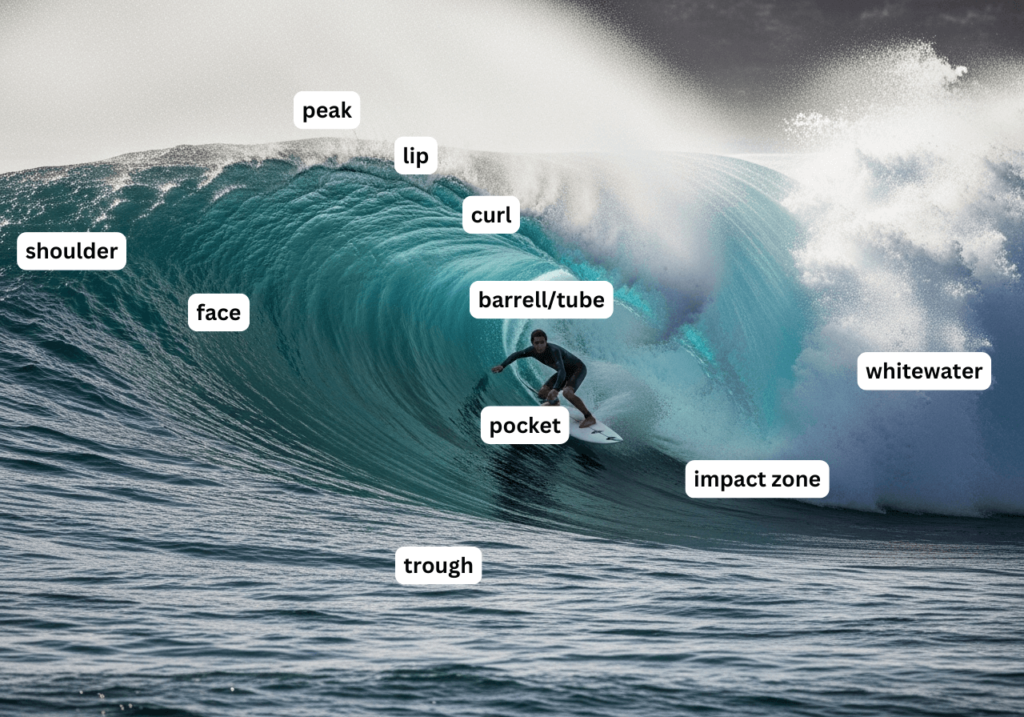
Surfing terms for waves and water
These surfing terms refer to water conditions and types, parts, and behavior of waves.
- A-frame: a wave that breaks equally left and right, creating the perfect shape
- Backwash: returning surge of water caused by waves rebounding off the shore
- Barrel (or tube): the hollow space formed by a wave that curls over on itself; a “barrel” or “tube” of air in the middle of a wave
- Bathymetry: the study of the depths of the ocean
- Beach break: waves that break over a sandbar
- Caught inside: when a surfer is trapped between breaking waves and the shore
- Channel: deep-water gap where waves break less; often used to paddle out
- Chop (or choppy): waves that have a rough surface and do not break cleanly, often due to currents or winds
- Close-out: when a wave collapses all at once with no open shoulder (and therefore can’t be surfed)
- Crest: the peak of a wave just before it begins to break
- Curl: the part of the wave that is curling over as it breaks
- Face (or wall): the smooth, unbroken forward-facing surface of a wave to the side of its peak
- Impact zone: zone where waves break with maximum force
- Lip: the curling tip of the wave
- Offshore and onshore: wind directions; onshore blows from the ocean to the shore; offshore blows from the shore to the ocean, smoothing out waves and creating ideal surfing conditions
- Party wave: a wave shared by various surfers at the same time
- Peak: highest and steepest breaking point of a wave
- Point break: an area where an underwater rocky point causes waves to break
- Pocket: steepest and most powerful part of the wave near the curl
- Ramp: a launch point—typically at the lip of a wave—for aerial maneuvers
- Reef break: a wave breaking over rock or coral
- Reformer: a wave that breaks once, gathers momentum, and breaks again
- Rip current (or riptide): strong flow of water moving back out to sea
- Set waves: a group of powerful waves that come in groups of 2+
- Shoulder: the horizontal, unbroken part of a breaking wave
- Shorebreak: wave that breaks directly onto the sand
- Swell: energy traveling across the ocean that turns into breaking waves
- Swell period (or wave period): the time between the crests of two consecutive waves
- Trough: the bottom part of the wave; the opposite of the crest
- Undertow: underwater pull beneath breaking waves
- Whitewater (or whitewash): broken, foamy water caused by a collapsed wave
Surfing terms for equipment
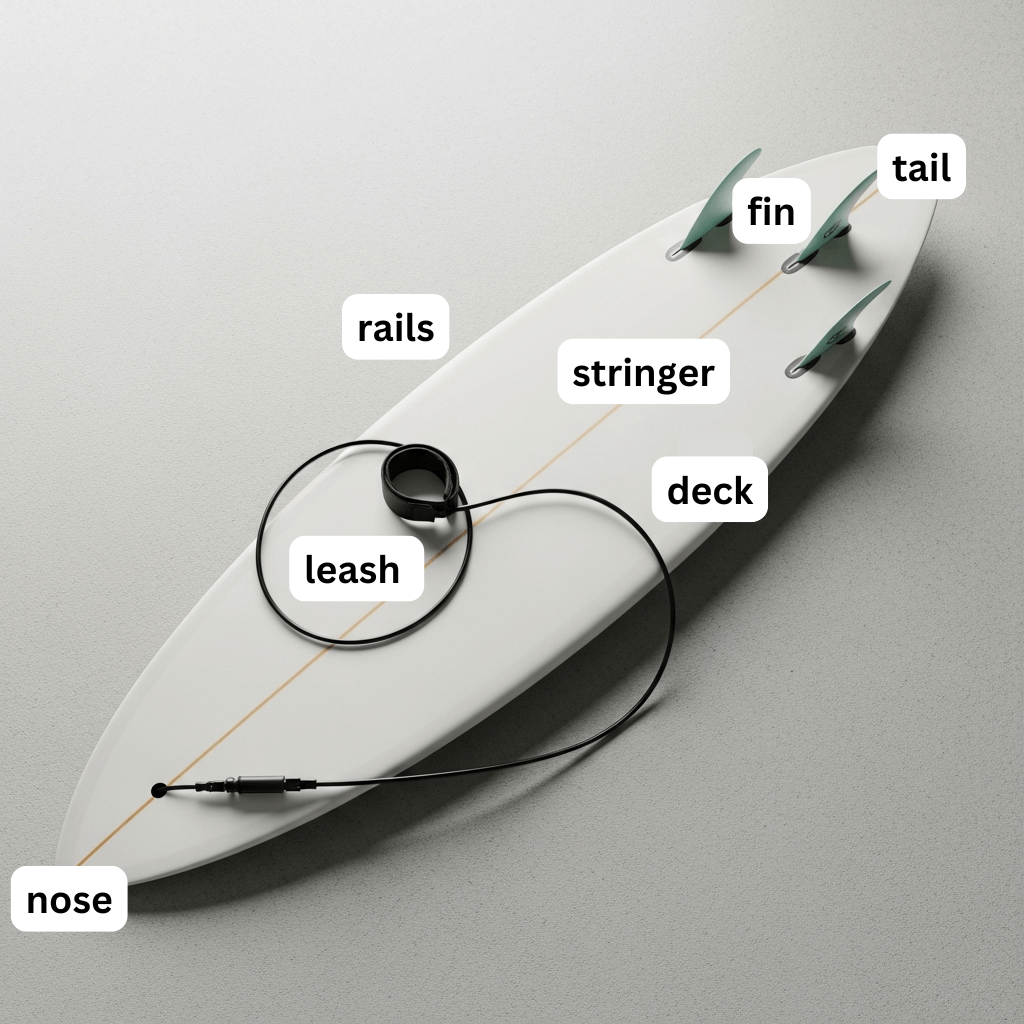
These surfing terms deal with equipment, primarily surfboards.
- Deck: the upper surface of a surfboard
- Ding: a dent, hole, or scratch on a board
- Fin: an attachment to the underside of the surfboard that allows it to be steered
- Leash: the cord that attaches a surfboard to a surfer’s ankle
- Longboard: a longer surfboard, usually with one fin, that is more buoyant and usually easier to use for beginners
- Nose: the forward tip of the surfboard
- Quiver: a surfer’s collection of boards, each tailored to specific conditions
- Rails: the edges of a surfboard
- Rash guard: a shirt that protects surfers from sunburn and abrasion
- Rocker: the concave curve of a surfboard between nose and tail
- Stringer: a line of wood or carbon fiber that runs down the middle of the board to give it strength
- Tail: the back end of a board
- Thruster: a surfboard with three equally sized fins (the most common setup in modern surfing)
- Twin fin: a surfboard with two fins (has largely been replaced by the thruster)
- Wax: a special type of wax designed to stop surfers from slipping off boards
- Wetsuit: a neoprene suit that keeps surfers warm while wet
Surfing terms for technique and etiquette
The below surfing terms talk about techniques surfers use in their sport and the etiquette that exists between surfers.
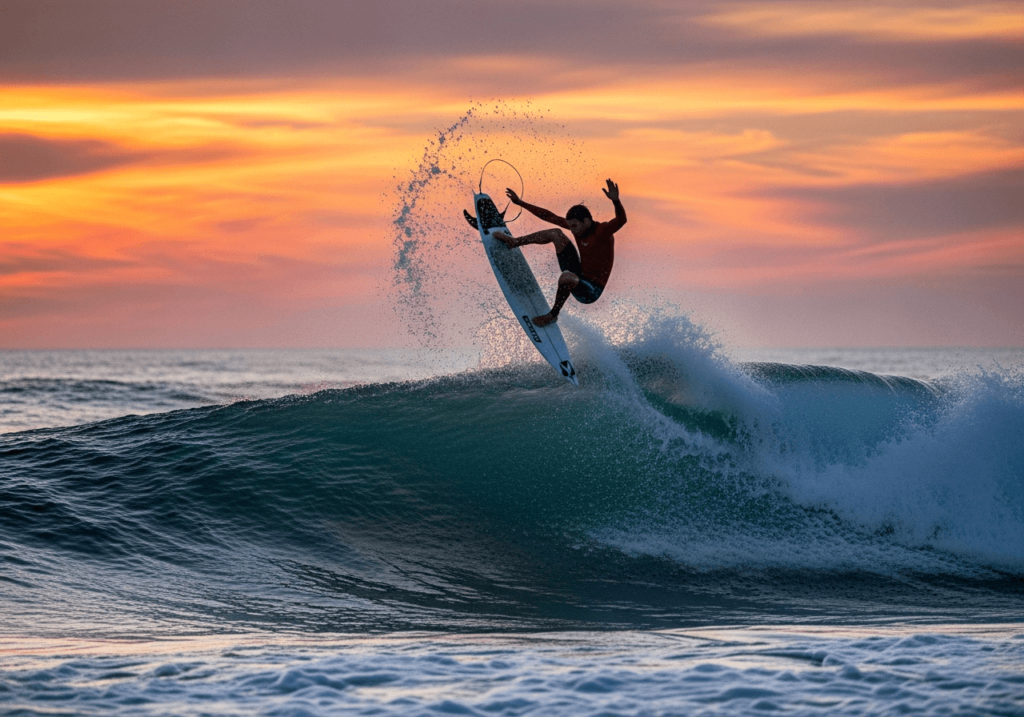
- Aerial: a maneuver in which the surfer propels the board over the lip of a wave and into the air
- Backhand or forehand: the body’s position relative to the wave; surfing backhand means your back is to the wave, and surfing forehand means you’re facing the wave
- Bail: to step off a board to avoid a wipeout
- Bogging: when the surfboard’s nose lifts up because the surfer has shifted their weight too far backward
- Bottom turn: a turn (usually the first) at the bottom of a wave
- Carve: a sharp turn on the face of the wave that uses the rails (sides) of the board
- Cutback: a maneuver that carves the face of an oncoming wave and swivels the board back toward the breaking part
- Drop in: to take a wave that is already being ridden; a serious violation of surf etiquette
- Duck dive: to push the board underwater to dive under an incoming wave
- Goofy foot: a stance where the right foot is forward and the left foot is towards the back of the board; less common than regular foot
- Hang ten: to put ten toes over the nose of the board (usually a longboard)
- Lineup: a space beyond the breaking waves where surfers gather and wait to catch waves
- Nose ride: to ride the front end of a surfboard
- Off the top: a sharp or carving turn on the top of a wave
- Pop up: to go from lying on the board to standing in one jump
- Pump: an up-and-down carving movement that creates speed along a wave
- Regular foot: a stance where the left foot is forward and right foot is towards the back of the board; more common than goofy foot
- Right of way: priority given to the surfer who is closest to a breaking wave
- Snap: a quick, sharp turn off the top of a wave
- Soul arch: an arched standing posture—usually on a longboard—that demonstrates cool confidence
- Snaking: paddling around someone aggressively to gain the right of way
- Switchfoot: ambidextrous; equally able to ride goofy or regular foot
- Take off: the start of a ride
- Tandem surfing: when two surfers ride the same board
- Turtle roll: a longboard move to get under a wave in which the surfer flips under their board, submerges the board and themself, lets the wave pass over them, and then flips back up
Surfing slang
Surfing lingo is full of slang words, and some surfing slang has made it into the mainstream (e.g., “gnarly,” “off the hook,” and “stoked”).
- Bommie: slang for bombora, an Indigenous Australian term for reef break, or a wave that breaks over a shallow area of reef, rock, or sand
- Dawn patrol: an early morning surf session that takes advantage of fewer surfers at first light
- Froth: a surfer’s feeling of ambition to take their skills to the next level; to feel that excitement (e.g., “I’m frothing to get barreled.”)
- Getting barreled: when surfers find themselves inside a barrel or tube wave
- Going over the falls: getting pulled up and over by a breaking wave and falling with it towards the ocean floor
- Gnarly: large, difficult, and dangerous (usually of a wave); awesome
- Grommet: a young surfer
- Hang loose: relax, chill, or be laid back; often accompanied by the shaka sign
- Indo: short for Indonesia, one of the best spots in the world for learning to surf
- Leggie: another word for leash, the cord on a surfboard
- Kook: a clueless or disruptive surfer who may endanger others through foolish behavior
- Malibu (or Mal): surf slang for a longboard
- Nica: short for Nicaragua, great for consistent waves and warm water
- Off the hook: an adjective phrase meaning the waves are perfect
- Punt: another term for aerial, an airborne maneuver
- Ragdolled: when a surfer gets thrown around underwater like a “rag doll”
- Shorey: slang for shorebreak, a wave that breaks on the shore
- Soup: slang for whitewater, foam caused by breaking waves
- Stoked: very happy or excited; euphoric
- Twinny: slang for a twin fin, a surfboard with two fins
- Waxhead: Australian slang for “surfer”
- Wettie: slang for wetsuit
- Wipe out: to fall off or be knocked off a surfboard
“That kook is always dropping in, but that grommet is respectful.”
“I’m frothing for a gnarly wave today!”
Hawaiian terms for surfing
The very first surfers are believed to have been from Peru or Polynesia, but modern surfing as we know it is said to come from Hawaii. Therefore, it’s only natural that there are many Hawaiian terms for surfing, or—in Hawaiian—heʻe nalu. Below, find a few of them.
Hawaiian terms for surfing
| Hawaiian term | Pronunciation | Translation |
| Aloha | ah-loh-hah | A greeting that means “hello” or “goodbye” and transmit love and community |
| Heʻe nalu | hey-eh nah-loo | Surfing (literally, “wave sliding”) |
| Hokua | hoh-koo-ah | Crest or tip of a wave |
| Kahakai | kah-hah-ky | Beach, shore, coast |
| Kahuna | kah-hoo-nah | Expert, master, or priest of a specific field (for example, surfing) |
| Kai | ky | Sea, ocean, or tide |
| Lalahalaha | lah-lah-hah-lah-hah | The rising and swelling of a wave before it breaks |
| Moana | moh-ah-nah | Ocean |
| Nalu | nah-loo | Wave |
| Papa heʻe nalu | pah-pah hey-eh nah-loo | Surfboard |
| Papa nui | pah-pah nwee | Longboard |
| Poʻi | poh-ee | To break (of a wave) |
| Oma | oh-mah | To stroke or paddle |
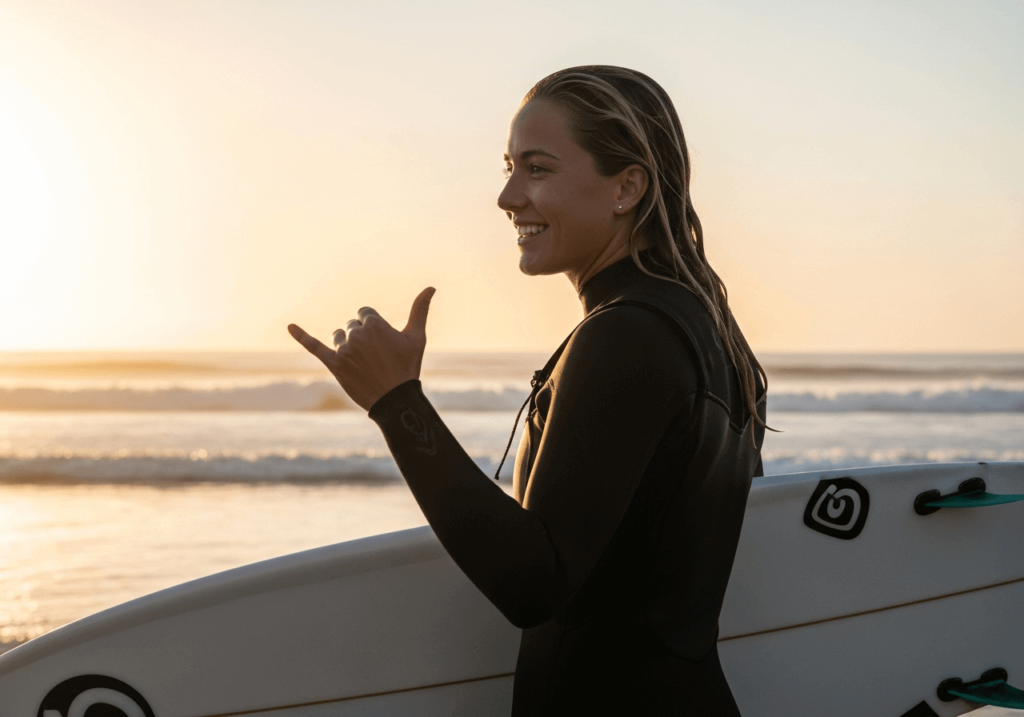
| Shaka | shah-kah | A gesture used to say “aloha” or “hang loose” and convey good vibes (see image below) |
| Wahi nalu | wah-hee nah-loo | Surf spot |
Frequently asked questions about surfing terms
- What does hang ten mean?
-
“Hang ten” is a classic surfing term that refers to riding a longboard in such a way that all ten toes are placed over the nose of the board.
It’s considered one of the most stylish and technically difficult maneuvers in longboarding, so when someone “hangs ten,” it signals control, finesse, and confidence on a wave.
Learn more about hanging ten with QuillBot’s AI Chat.
- What does the shaka sign mean?
-
The shaka sign means friendliness, goodwill, and a laid-back attitude. In surfing culture and in Hawaii, where it originated, the gesture is used to say “hang loose,” “thank you,” “everything’s good,” or simply to acknowledge someone in a positive way.
To make the shaka sign, extend your thumb and pinky while curling the three middle fingers inward.
Learn more about the shaka sign, Hawaiian culture, or surfing terms with QuillBot’s AI Chat.
- What does gnarly mean?
-
“Gnarly” means “gnarled and knotted,” or—as a surfing term—”extreme, impressive, or challenging,” especially when referring to waves.
As a slang word, “gnarly” can also mean “awesome or amazing.” So, it’s important to pay attention to the specific context of this word to understand its meaning.
To learn more about the meaning of “gnarly,” ask QuillBot’s AI Chat.
- What is a kook in surfing?
-
A kook in surfing is someone who lacks experience, judgment, or awareness in the water and often disrupts other surfers. A kook might paddle into waves out of turn, drop in on people, block the takeoff zone, or use equipment improperly.
This surfing term doesn’t necessarily refer to a beginner but rather a surfer who behaves recklessly or who ignores etiquette.
QuillBot’s AI Chat can give you more information about kooks in surfing.
Cite this QuillBot article
We encourage the use of reliable sources in all types of writing. You can copy and paste the citation or click the "Cite this article" button to automatically add it to our free Citation Generator.
Santoro, K. (2025, December 10). Surfing Terms | Slang & Phrases. Quillbot. Retrieved March 19, 2026, from https://quillbot.com/blog/sports-terms/surfing-terms/