Dialogue Prompts | 105 Examples & Tips for Writing
Dialogue prompts inspire writers to write conversations between their characters. Even the best writing can fall flat without good dialogue, so experimenting with how your characters’ voices interact with each other is an important exercise for any writer.
This article includes 105 dialogue prompts
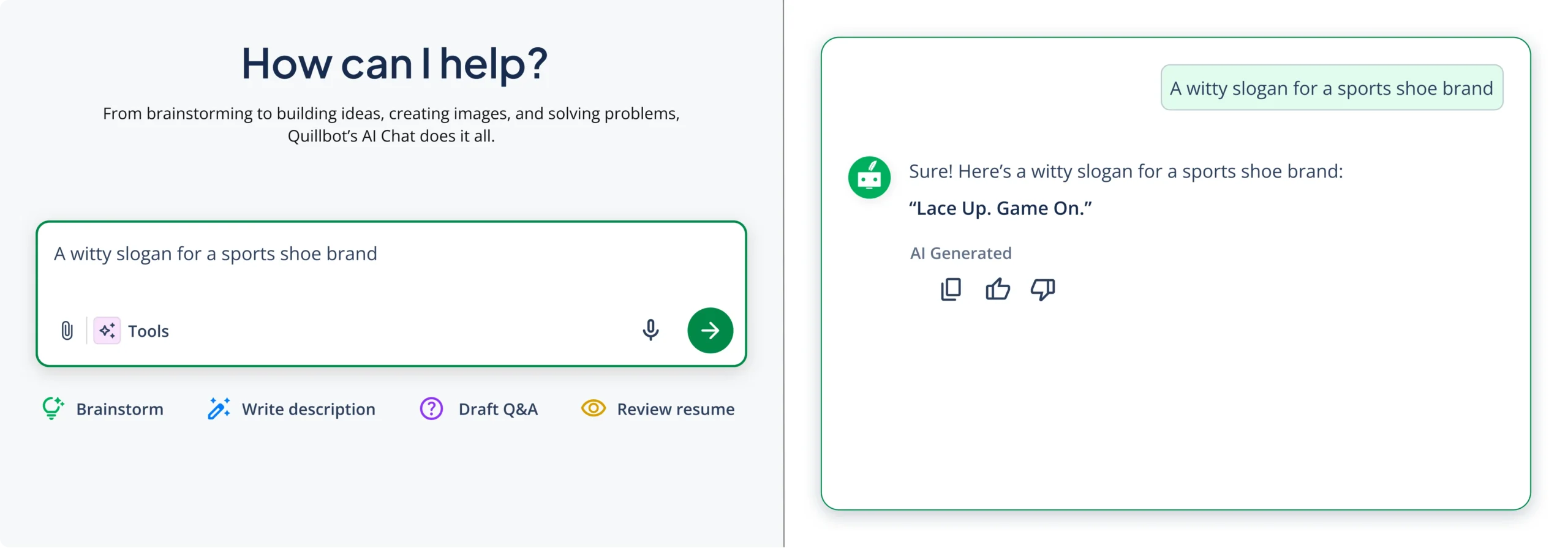
Need more help writing dialogue? Try QuillBot’s free AI dialogue generator. You can also use the tool to create conversation-style dialogue prompts tailored to your characters.
Dialogue prompts
These dialogue writing prompts will help inspire you to explore your characters’ motivations, moods, and reactions. The prompts are divided into subcategories so you can more quickly find what appeals to you.
General dialogue prompts for writing
Create tension, reveal character motivation, and jump-start scenes with these dialogue prompts. They work well when you need a flexible starting point for developing conflict or emotional depth.
- “You weren’t supposed to hear that.”
- “I didn’t lie. I just didn’t tell you everything.”
- “If you walk away now, don’t come back.”
- “Why do you always assume I’m the problem?”
- “That’s not what the note said last night.”
- “Someone has been in this house.”
- “We keep repeating the same argument. Why?”
- “What did you bury in the backyard?”
- “You’re not listening to what I’m actually saying.”
- “This isn’t the first time he’s disappeared.”
Romance dialogue prompts
Find the spark for your characters with these dialogue writing prompts. They’re suitable for everything from lighthearted flirtation to high-stakes relationship drama.
- “I think I liked you long before I admitted it.”
- “Are you flirting, or is this just how you talk?”
- “You remembered my favorite coffee?”
- “We can’t keep pretending nothing happened.”
- “Did you save the last dance for me?”
- “If you don’t stop looking at me like that, I’m going to forget how to speak.”
- “I didn’t plan to fall for you.”
- “Tell me you feel something too.”
- “Are we really doing this?”
- “You’re the only one I wanted to see today.”
Fantasy dialogue prompts
These dialogue prompts help you build magical worlds, introduce lore, and explore power, prophecy, or supernatural forces. Use them to strengthen worldbuilding through conversation.
- “The runes weren’t glowing yesterday.”
- “Dragons don’t return without a reason.”
- “You used forbidden magic—why?”
- “The forest spirits won’t trust us again.”
- “That prophecy was never about me.”
- “Hand me the relic. Carefully.”
- “You speak the old tongue. Who taught you?”
- “The portal is closing faster than expected.”
- “Your shadow moved before you did.”
- “Magic always demands a price.”
Sci-fi dialogue prompts
Explore technology, space, and the future with these science fiction dialogue prompts. They’re crafted to help you create dialogue that conveys world mechanics and speculative tension.
- “The AI said it wants to renegotiate our agreement.”
- “Your biometric scan doesn’t match our records.”
- “The colony lost contact three days ago.”
- “You altered the timeline. Admit it!”
- “That starship isn’t answering hails.”
- “We’re not alone on this station.”
- “You built that tech yourself?”
- “The atmosphere here isn’t supposed to be green.”
- “I found a message from his other self.”
- “Gravity shouldn’t fluctuate like that.”
Mystery and thriller dialogue prompts
These dialogue writing prompts center on suspicion, interrogation, hidden motives, and plot twists. They’re designed to drive momentum in high-pressure scenes where information is currency.
- “Why was your phone off during the break-in?”
- “You’re sweating. What aren’t you telling me?”
- “That’s not how the witness described you.”
- “Lock the door. Now.”
- “The package wasn’t meant for you.”
- “The alibi falls apart the second we check the cameras.”
- “Someone followed her here.”
- “You lied about knowing the victim.”
- “We have five minutes before the plan falls apart.”
- “I don’t trust anyone in this room.”
Horror dialogue prompts
Investigate fear, uncertainty, and the unsettling with these horror dialogue prompts. They help you build atmosphere through what characters perceive—or think they perceive—during moments of dread.
- “Did you hear that whisper too?”
- “Don’t turn around. It’s behind you.”
- “The photograph changed again.”
- “That’s not the same voice as yesterday.”
- “The basement door was locked this morning.”
- “Whatever you saw in the mirror wasn’t me.”
- “We shouldn’t have come here after dark.”
- “The house doesn’t want us here.”
- “That shadow doesn’t belong to either of us.”
- “Something is scratching at the window.”
Young adult dialogue prompts
Write about school dynamics, friendship, and identity development with help from these YA dialogue prompts, which can help you develop emotional immediacy and authentic teen voices.
- “Can we please talk before this gets worse?”
- “I didn’t expect you to actually show up.”
- “You told everyone except me?”
- “I think we’re in trouble—real trouble.”
- “Why is your backpack making that noise?”
- “You could have just asked for help.”
- “I didn’t mean for you to find out like this.”
- “You said this would be fun.”
- “Is this seriously your plan?”
- “We’re still friends, right?”
Funny dialogue prompts
Use these dialogue prompts to warm up your writing or break the monotony when drafting heavier scenes.
- “I promise the explosion was completely accidental.”
- “You can’t blame me for misunderstanding your text.”
- “Why is the cat wearing armor?”
- “That’s not a costume. That’s my real job.”
- “I only screamed a little.”
- “Define ‘minor chaos.’”
- “I thought you said you knew how to cook.”
- “Nothing is wrong—except everything.”
- “The raccoon stole my sandwich again.”
- “You had one job. One.”
Dialogue prompts for writing practice
These dialogue writing prompts are structured as targeted exercises. Each one concentrates on a specific skill—subtext, pacing, tone, tension, or emotional layering—making them useful for students and developing writers.
- “Say what you actually mean.” (Subtext practice)
- “I’m fine.” (Emotion beneath the surface)
- “Why are you avoiding the question?” (Rising tension)
- “That’s not what I asked.” (Power dynamics)
- “You’re not telling me everything.” (Suspicion)
- “Try again, but be honest this time.” (Tone shifts)
- “We don’t have time for this.” (Pacing)
- “Stop pretending you don’t care.” (Emotion)
- “I want the truth.” (Direct conflict)
- “Lower your voice.” (Scene grounding)
Conversation dialogue prompts
Conversation dialogue prompts give you an immediate starting point by presenting short exchanges that already contain tension, emotion, or unanswered questions. They help you jump straight into character dynamics without needing to build the setup first.
- “You said you’d be here on time.”
“I was. You’re just early—again.” - “Why are you holding that?”
“Because if I drop it, everything gets worse.” - “You didn’t tell me the whole truth.”
“I told you the part you were ready to hear.” - “Was that supposed to happen?”
“Not even a little bit.” - “You look terrified.”
“Good. Then you’ll finally listen.” - “You’re bleeding.”
“Not as much as the last time.” - “You can’t just walk away.”
“Then stop giving me reasons to.” - “Please don’t open that door.”
“It’s too late. Someone already did.” - “You promised this would be simple.”
“And you promised not to panic.” - “Why are the lights flickering?”
“Because something else is in the building.” - “I thought you were gone for good.”
“I tried. It didn’t take.” - “Why are you smiling?”
“Because I finally figured it out.” - “You’re not supposed to be here.”
“Funny, I was about to say the same to you.” - “This isn’t the place we agreed on.”
“I changed the plan. You’ll thank me later.” - “Why are you avoiding the question?”
“Because you won’t like the answer.”
Tips for writing dialogue
Not sure about how to write dialogue? These tips will help you shape conversations that reveal character, build tension, and keep scenes moving.
When it comes to storytelling, you should:
- Keep every line purposeful: Each line should either reveal character, move the plot forward, create tension, or set up conflict. If a line does none of these, cut it.
- Avoid on-the-nose dialogue: People rarely say exactly what they mean. Use subtext—implied meaning, hesitation, or indirect answers—to communicate emotional complexity.
- Give each character a distinct voice: Different characters should have different vocabulary, cadence, and tone. Personality, education, culture, and emotional state should influence how they speak. Think too about how your characters alter their voice to relate to each other; for example, your protagonist probably speaks differently to their best friend than to the antagonist of your story.
- Mix dialogue with action beats: Use actions—gestures, posture, and movement—to break up long stretches of speech and show how characters react physically to what’s being said.
- Trim excessive explanations: Characters shouldn’t explain things they already know just to inform the reader. Deliver information through conflict, discovery, or implication instead.
- Use silence deliberately: A pause, an unfinished sentence, or a non-answer can convey more intensity than a long speech. Silence is a powerful tool for conflict and subtext.
- Make interruptions believable: People interrupt each other, especially during arguments or high-stakes conversations. Use cut-off lines or overlapping beats to create urgency and realism.
As for language, try to:
- Use contractions and casual phrasing: Written dialogue should mimic natural speech patterns. Overly formal wording can make characters sound stiff or unrealistic unless that stiffness is intentional.
- Vary sentence structure and rhythm: Real conversations have uneven pacing. Use a mix of short and long lines, interruptions, and incomplete thoughts to keep the exchange dynamic.
- Limit filler words, but don’t eliminate them entirely: A few well-placed “um,” “well,” or pauses make dialogue feel real. Too many make it drag. Use them strategically.
- Keep dialogue tags simple: “Said” and “asked” are usually enough—readers skip over them effortlessly. Save descriptive tags (e.g., “whispered” or “muttered”) for emphasis, not routine use.
Finally, with respect to formatting and editing:
- Keep multi-paragraph dialogue clear: If a character speaks for more than one paragraph, omit the closing quote at the end of each paragraph except the last. This prevents confusion while keeping the dialogue visually clean.
- Use the correct punctuation: American English typically uses double quotation marks for dialogue, while British English uses single quotation marks. Set off dialogue tags with commas.
- Check for grammar and spelling errors: A small error could change meaning (e.g., a character being weary vs wary), so make sure everything is written correctly. QuillBot’s Grammar Checker can help with this.
- Read dialogue aloud during revision: Hearing it helps you catch awkward phrasing, unnatural rhythms, or lines that sound forced. If it feels strange to say, it likely needs editing.
Frequently asked questions about dialogue prompts
- How do I get started with AI story writing tools?
-
Pick a free AI tool like QuillBot’s AI Chat and decide what specific writing challenge you need help with. Based on this, give a concrete prompt, like “I need three ways my character could react to bad news” rather than “help me write better.”
You could also ask AI to help you brainstorm, like asking it for writing prompts or dialogue prompts to spark your creativity.
As you get comfortable, experiment with different prompts to see what kind of responses are most helpful for your writing process.
- How can AI help if I get stuck while writing?
-
AI can help you in several ways while writing: brainstorming what happens next in your story, pointing out inconsistencies or gaps within the plot, testing dialogue between characters, or researching background details to make your story world more believable. For example, you might ask, “My character just discovered their best friend has been lying to them. What are three different ways they might respond?” Or, you might ask for dialogue prompts about this topic as a jumping-off point.
QuillBot’s free AI Chat is a great tool that can help you brainstorm ideas. For instance, you can ask for different angles to approach a subject, prompt it for headline ideas around a specific topic or product, or request a mind map or content outline to structure your thoughts.
Once you’ve generated ideas or drafts, QuillBot’s Grammar Checker can ensure your text is polished and error-free, helping you focus on creativity without worrying about technical issues.
Cite this QuillBot article
We encourage the use of reliable sources in all types of writing. You can copy and paste the citation or click the "Cite this article" button to automatically add it to our free Citation Generator.
QuillBot. (2025, December 03). Dialogue Prompts | 105 Examples & Tips for Writing. Quillbot. Retrieved March 10, 2026, from https://quillbot.com/blog/creative-writing/dialogue-prompts/