Content Strategy | What It Is, How To & Examples
Content strategy is the high-level planning of useful content that aligns with your business objectives and with your target audience’s needs. Content strategy defines what content discusses, who it’s for, where it appears, and how its success is measured.
When done well, content strategy ensures that content isn’t created piecemeal just because; instead, each piece of content serves a purpose in helping you work towards your goals.
QuillBot’s AI Chat can help you with your own content strategy, from answering questions about KPIs to generating content ideas to analyzing results.
What is a content strategy?
A content strategy is an actionable plan that decides how you use content to achieve certain business goals, like building brand awareness, increasing engagement, driving traffic, or bringing in sales. It acts like a roadmap, keeping your goal and target audience at the heart of all the content-related decisions you make.
A content strategy is useful for almost anyone, like:
- Businesses and brands that want to align content with objectives and brand identity
- Marketing teams and agencies that need to coordinate campaigns across channels
- Editorial teams guiding large-scale publishing operations
- Nonprofits that want to communicate mission-driven messages effectively
- Educational institutions that have to structure academic, administrative, and marketing content.
- Small and/or local businesses that rely on digital content to attract customers
- Content creators and freelancers looking to build a recognizable brand and grow an audience
Regardless of who you are, a well-crafted content strategy offers many benefits, some of which are outlined in the table below.
| Benefit | How it’s achieved | Practical impact |
|---|---|---|
| Aligns content with business goals | By planning content around specific objectives, such as brand awareness or customer education | Prevents random publishing and sees that each piece of content contributes to measurable outcomes |
| Improves audience targeting | By clearly defining the target audience, their needs, and their stage in the customer journey | Leads to more relevant topics, clearer messaging, and higher engagement |
| Creates consistent messaging and brand voice | By establishing guidelines for tone, style, and brand messaging across channels | Strengthens brand identity and builds trust with audiences |
| Makes content production more efficient | By streamlining planning with a content calendar and defined workflows | Saves time, reduces duplicated work, and improves team coordination |
| Supports SEO and algorithm visibility | By including keyword research and topic planning to match search demand | Improves search rankings, increases organic traffic, and builds topical authority |
| Improves overall content quality | By encouraging research, structured planning, and purposeful content creation | Produces more useful, credible, and shareable content |
| Enables measurement and analysis | By defining metrics such as traffic, engagement, and conversions | Makes it possible to evaluate results and refine future content |
| Maximizes content reuse and longevity | By repurposing content into multiple formats and platforms | Extends the value of content and increases reach without creating entirely new material |
Key components of a content strategy
While content strategies vary by organization, most include several core components that ensure content supports business goals and reaches the right audience.
Goals
Goals define what you want to achieve through content, and they should align with broader business goals (e.g., driving website traffic or improving customer retention). Many people use the SMART goals framework to make sure their goals are specific, measurable, achievable, relevant, and time-bound.
Key performance indicators (KPIs)
KPIs are the metrics used to evaluate whether the strategy is meeting its goals. They translate goals into measurable outcomes. Common content KPIs include website traffic, engagement rates, conversions, email sign-ups, and social media growth. Choosing a small number of meaningful KPIs helps teams monitor performance and adjust their strategy when necessary.
Audience personas
Audience personas are detailed profiles of the target audience segments a company wants to reach through content; they typically include demographic data, goals, challenges, interests, and preferred content formats. Understanding these characteristics helps you create content that directly addresses audience needs and motivations.
Content audit
A content audit evaluates existing content to understand what already exists and how well it performs. It involves cataloging content assets and analyzing metrics such as traffic, engagement, and search rankings. An audit helps identify high-performing content, outdated material, and gaps where new content may be needed.
Content pillars
Pillars are the core themes or topic areas that you focus on. They represent your main areas of expertise or interest and help maintain consistency across all content. For example, a marketing company might structure its strategy around content pillars such as SEO, social media marketing, and analytics.
Formats and channels
A content strategy also determines which formats and distribution channels will be used. Content types may include blog posts, videos, newsletters, podcasts, or guides, while channels may include your website, social media platforms, emails, or third-party publications. Selecting the right mix ensures that content reaches the audience where they already consume information.
Content governance
Content governance refers to the policies, standards, and responsibilities that ensure content remains accurate, consistent, and high quality across an organization. It typically includes guidelines for voice and tone, approval workflows, publishing standards, content ownership, and lifecycle management (such as updating or archiving outdated content). Governance helps maintain consistency and makes sure content aligns with brand and legal requirements.
Creation process
The creation process is a subset of content governance, but it’s worth mentioning on its own. This process typically includes workflows, editorial calendars, roles and responsibilities, and content guidelines. Establishing a structured process ensures that content production remains consistent and efficient.
Content strategy vs content tactics
Content strategy sometimes gets mixed up with content tactics. But there is a key difference: Content strategy is the why and what of your content, while tactics are the how and when.
| Aspect | Content Strategy | Content tactics |
|---|---|---|
| Definition | High-level plan that defines how content supports business goals and audience needs | Specific actions and methods used to execute the strategy |
| Purpose | Provides direction and long-term planning for content efforts | Implements the strategy through concrete activities |
| Focus | Big-picture planning and alignment with business objectives | Day-to-day execution and practical implementation |
| Scope | Broad and long-term; often spans months or years | Narrower and short-term; focused on individual campaigns or daily/weekly pieces of content |
| Key questions answered | Why are we creating content? Who is it for? What goals should it achieve? | What content will we publish? When and where will we publish it? |
| Example tasks | Defining audience personas, identifying content pillars, setting content goals, and choosing primary channels | Publishing blog posts, posting on social media, sending newsletters, and running content campaigns |
| Decision level | Strategic decisions; typically handled by leadership, marketing strategists, or content managers | Operational decisions; usually handled by writers, marketers, social media managers, or editors |
| Time horizon | Long-term planning and direction | Short-term execution and ongoing activities |
| Relationship between them | A content strategy establishes a framework that guides all content efforts, while content tactics guide its practical implementation. | |
Content strategy and content tactics must go hand-in-hand in order for content to be successful. Strategy without tactics is a plan that never happens, and tactics without strategy is chaotic content without a clear vision.
Content strategy examples
Content strategies can vary depending on the organization’s goals. Below are three fictional examples showing how different objectives shape the type of content produced and how it’s distributed.
Brand awareness
Projectr, a new project management software company, wants to increase brand awareness among small business owners and startup teams. Instead of focusing immediately on product promotion, the company develops a content strategy centered on addressing common workplace productivity challenges.
| Aspect | Strategy |
|---|---|
| Audience personas | Small business owners, startup CEOs, product managers |
| Content purpose | Educate and inform |
| Content pillars | Workplace productivity challenges, project management, remote work |
| Content types | SEO blog posts, productivity guides, short explainer videos, infographics |
| Channels | Company blog, partner blogs, LinkedIn, YouTube, newsletter |
| SEO strategy | Target high-volume search queries related to productivity and project management |
| Content cadence | Two blog posts per week, weekly social media posts, monthly newsletter |
| KPIs | Organic traffic, search rankings, social reach, new website visitors |
Over time, the brand becomes associated with practical advice on team organization and workflow management. As more people discover the content through search engines and social media, traffic to the company’s website grows, and the brand gains recognition within its industry.
Audience engagement
Roast & Ritual, a specialty coffee brand with several cafés and an online store, wants to deepen relationships with its existing audience. While the brand already has a steady stream of customers, it wants to build a stronger community around its products and encourage more interaction with its content. Roast & Ritual develops a content strategy centered on coffee culture and customer participation rather than pure product promotion.
| Aspect | Strategy |
|---|---|
| Audience personas | Existing customers, coffee enthusiasts, home baristas |
| Content purpose | Encourage interaction and community participation |
| Content pillars | Coffee brewing techniques, coffee culture, behind-the-scenes roasting |
| Content types | Social media polls, brewing tutorials, UGC, short videos |
| Channels | Instagram, TikTok, YouTube, email newsletter, company blog |
| SEO strategy | Target niche search queries related to home coffee brewing techniques and specialty coffee and optimize content for social search and discovery |
| Content cadence | Daily social media posts, weekly video tutorials, biweekly newsletter and blog posts |
| KPIs | Comments, shares, user-generated posts, newsletter engagement |
Over time, the brand’s audience becomes more involved in conversations around coffee brewing and flavor preferences. Customers share their own brewing setups, comment on posts, and participate in polls about new blends, strengthening loyalty and brand affinity.
Sales enablement
TrailNest, a brand that sells hiking and camping equipment, wants to help potential customers feel confident choosing the right gear before making a purchase. Many shoppers researching outdoor equipment compare products carefully and want detailed information about durability, features, and use cases. So TrailNest develops a content strategy focused on helping customers evaluate gear and understand how different products perform in real-world situations.
| Aspect | Strategy |
|---|---|
| Audience personas | Beginner hikers, experienced campers, and outdoor travel enthusiasts |
| Content purpose | Help customers evaluate products and choose the right gear |
| Content pillars | Hiking gear guides, camping tips, outdoor trip preparation |
| Content types | Product comparison guides, gear reviews, packing checklists, how-to videos |
| Channels | Company blog, YouTube, Instagram, email newsletter |
| SEO strategy | Target high-intent search queries related to hiking and camping gear |
| Content cadence | Weekly blog posts, weekly social media posts, monthly newsletter |
| KPIs | Product page visits, time on product pages, conversions, assisted purchases |
As customers research outdoor gear, they encounter TrailNest’s guides and comparison articles explaining how different products perform in various conditions. These resources help shoppers narrow down their choices and feel confident about their purchase, making it easier for them to move from research to checkout.
How to create a content strategy
If you’re wondering how to create a content strategy, follow these 10 steps to get yours up and running. Bear in mind that this how-to guide focuses on advice that can be applied across all types of content strategies; for tips for more specific strategy types, see the following section.
1. Define business goals
Clear goals help determine what types of content to create and how success will be measured, so start by identifying what you want your content to achieve. It’s fine to have more than one goal, but if that’s the case, organize them by priority so you know which ones to push for first.
Content strategies typically support broad business goals like:
- Increasing brand awareness
- Generating leads
- Driving website traffic
- Improving customer retention
- Fostering audience engagement
When deciding on your goals, think about what you want to achieve now. For example, if you’re a new company, you’d probably want to build brand awareness before pushing for sales. You can always—and you should—reassess and edit your content strategy later on.
2. Research and define your audience
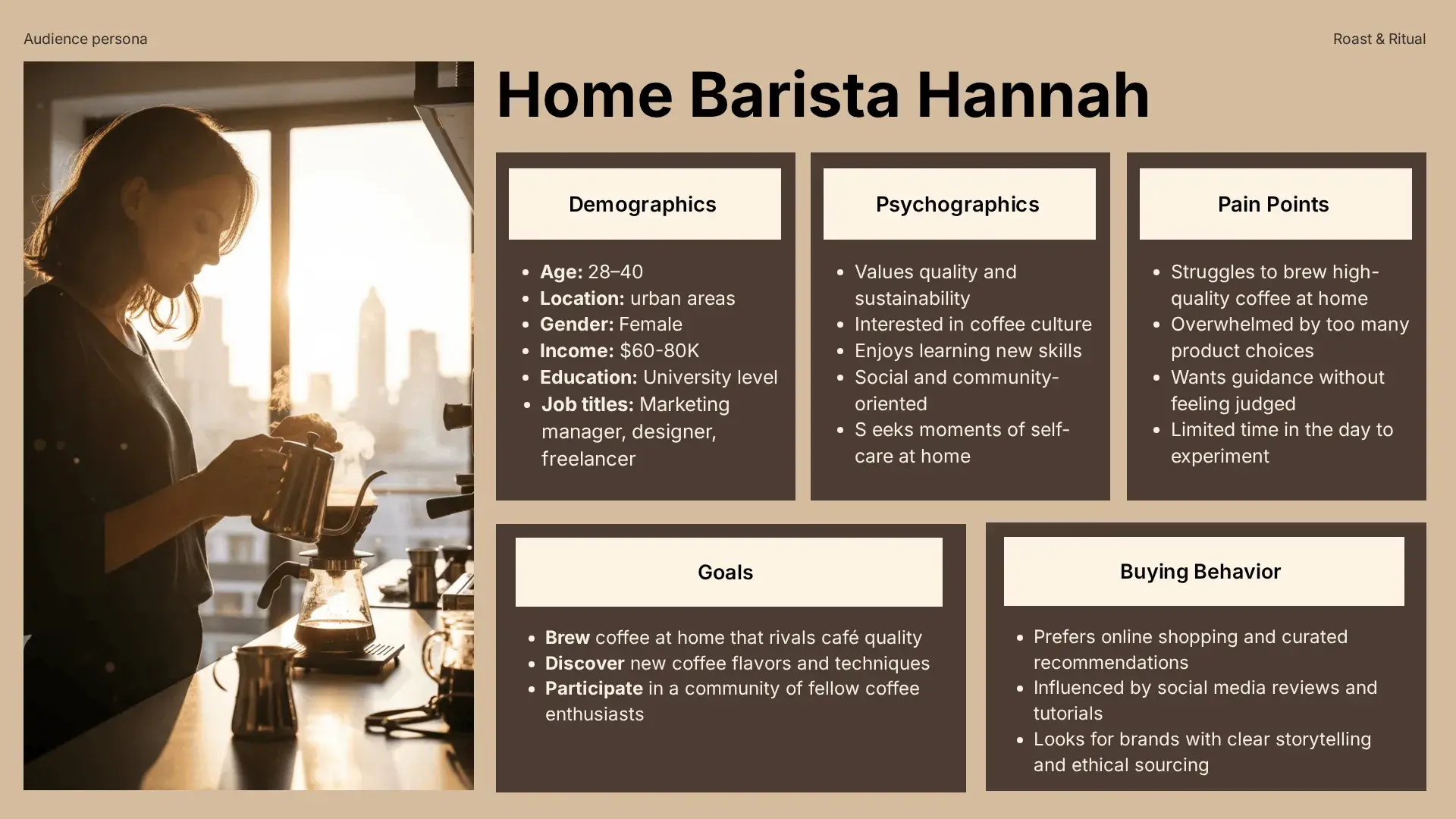
A strong content strategy hinges on understanding the people you want to reach, so it’s critical that you research and define your target audience. Review any data you have about your audience: surveys, reviews, customer support messages, Sales and Customer Success insights, social media insights, online communities, website analytics, etc.
The goal of your research is to create audience personas (also called “buyer personas”) that include the following information:
- Demographics: age, location, gender, income level, education, job title(s)
- Psychographics: beliefs, values, interests, lifestyle, motivations, personality traits
- Pain points: challenges, frustrations, or situations that create friction in their personal or professional life
- Goals: what they want to achieve in the short- and long-term
- Buying behavior: preferred channels, purchasing triggers, frequency of purchase, decision-making process
- Content preferences (optional, but useful): favorite content formats, topics of interest, preferred social platforms, and content consumption habits
The audience persona(s) you create should guide all further decisions in your content strategy to make sure you best connect to the people you want to reach.
3. Research your competitors
Analyzing competitors’ content can reveal useful insights about your industry. Look through their websites, social media profiles, and overall online presence, paying special attention to:
- The topics they cover
- The formats they use
- How their audience engages with their content
- What keywords they’re targeting
- Their tone of voice and messaging style
- Posting frequency and content cadence
- The channels they prioritize for distribution
- Which content performs best and drives the most traffic or engagement
By studying competitors in this way, you can spot gaps in their content strategy, uncover opportunities for unique angles, and refine your own content plan to better meet your audience’s needs.
4. Run content audit
Unless your brand is extremely new, chances are you’ve already published content. A content audit helps you evaluate existing content to see what works, what needs updating, and where gaps exist. The table below shows the basics of how to audit content.
| Content asset | Metrics to review | Quality and relevance analysis |
|---|---|---|
| Blog posts | Page views, engagement, social shares, backlinks, conversions | Is the content accurate, up-to-date, and aligned with goals? |
| Videos | Views, watch time, comments, shares | Are videos relevant to current audience needs and branding? |
| Social posts | Likes, shares, comments, reach | Does content match brand voice and audience interests? |
| Newsletters | Open rates, click-through rates | Are newsletters timely, useful, and engaging? |
| Guides and downloadables | Downloads, conversions, engagement | Is this content useful, clear, and accurate? |
After analyzing your existing content, decide if you should keep, update, repurpose, or remove it. For example, you may decide to delete social media posts from last year that had few likes or comments and used outdated branding design.
Some strategies for making the most of your content audit are:
- Identify content that performs well to replicate or expand on its success.
- Spot outdated or low-performing content that can be updated, consolidated, or archived.
- Look for content gaps where new topics could meet audience needs.
- Consider repurposing content into new formats (e.g., turning a successful blog post into a video or infographic).
5. Select content types and KPIs
Next, decide which content formats, pillars, channels, and cadence you want to tackle. Start by:
- Reviewing your goals
- Reviewing your audience personas
- Considering your resources
AI can help here, though you want to make sure you maintain a “human-in-the-loop” content workflow. While you can outsource some content tasks to AI—like creating images, condensing text, or brainstorming ideas—ultimately a human editor should be in charge.
Those three factors should influence the channels, formats, pillars, and cadence that you select for your content strategy. Use the table below to help guide your decisions.
| Factor | Questions to ask yourself | Example answers |
|---|---|---|
| Channels | Where does your audience spend its time? Which channels are realistic based on the resources you have? | Website/blog, social media, email, partnerships, influencers |
| Formats | What formats best deliver value to your audience? Which formats help you meet your goals? Which can you realistically create? | Articles, listicles, videos, infographics, guides, case studies |
| Pillars | Which core topics does your audience care about? What core topics can you address in a clear, authoritative, and useful way? | Pet care advice, healthy recipes and meal planning, travel tips and hacks, seasonal or holiday food trends, productivity tips and workflow optimization |
| Cadence | How often can you consistently publish content? What’s the normal cadence for each channel? | Daily, weekly, monthly; varied across channels (e.g., one blog post per week and one social media post per day) |
Once you’ve chosen your channels, formats, pillars, and cadence, you must also select the KPIs you’ll use to measure the success of your content strategy. KPIs vary according to goal, channel, and content type. For example:
- For a product-focused blog post, look at time spent on page, click-throughs to product pages, and conversions.
- For an educational blog post, track page views, time on page, organic search ranking, and social shares.
- For case studies to support sales enablement, measure downloads, demo requests, contact form submissions, and time spent on page.
- For social media posts for engagement, check likes, comments, shares, saves, and follower growth.
6. Decide on your CMS
Now that the skeleton of your content strategy is in place, it’s time to start fleshing it out. That starts with choosing a content management system (CMS)—the platform you’ll use to create, manage, and publish digital content.
Some of the most-used CMSes are WordPress, Squarespace, Wix, Webflow, Hubspot, and Ghost, but there are many others out there. Selecting the right system helps streamline workflows, organize content assets, and maintain consistency across your website or blog. When choosing a CMS, consider:
- Price
- Flexibility with respect to content types
- Ease of use for your team
- Scalability
- SEO capabilities (e.g., ability to edit metadata and URL structure)
- Security and backups
- Collaboration and permissions (e.g., available seats and user roles)
7. Set up a content calendar and content governance framework
A content calendar is a schedule of what content you’ll publish when and where. It helps your content team keep on track with creating, editing, and publishing everything, especially when working across multiple channels.
To set up a content calendar:
- Choose a calendar tool (e.g., a spreadsheet or content calendar software)
- Customize your calendar (e.g., adding metadata fields for blog post entries)
- Share it with your team and give the appropriate permissions
Alongside your content calendar, create a content governance framework. Content governance is a set of policies and processes that ensures content is accurate, consistent, and aligned with your brand. Key areas to define include:
- Roles and responsibilities: Who creates, edits, approves, and publishes content?
- Style and tone guidelines: How should your content sound and look? Include brand voice, grammar, and formatting rules.
- Publication workflows: What steps must content go through before it’s published?
- Content lifecycle management: How often will content be updated, archived, or removed?
- Compliance and legal requirements: What copyright, privacy, and accessibility standards must your content meet? If approval is needed, what’s the appropriate workflow for getting it?
Roles and responsibilities
- Content strategist: oversees the editorial calendar and content pillars
- Content writer: creates blog posts and newsletter content
- Social media manager: adapts long-form content into posts and videos
- Marketing manager: reviews and approves content before publication
Establish style and tone guidelines
- Brand voice: friendly, enthusiastic, and conversational
- Avoid overly technical language; focus on practical coffee brewing advice
- Maintain consistent grammar, formatting, and product naming
Create a content workflow
- Monthly editorial meeting to plan topics and update the content calendar
- Writers draft content one to two weeks before publication
- Editor reviews for clarity, accuracy, and brand voice
- Post goes back to writer for final check and implementation
- Social media manager schedules supporting posts
Set content maintenance rules
- Review blog posts every six months
- Update brewing guides and product references as needed
- Archive or replace outdated seasonal content
Ensure compliance and legal standards
- Credit photographers, creators, and external sources when used
- Follow copyright rules for images, music, and other media
- Include required disclosures for partnerships or sponsored content
- Speak about other brands or organizations in a neutral and objective way
- Comply with data privacy laws when collecting emails or user data
8. Brainstorm and schedule ideas
When your content calendar and content governance framework are in place, start generating ideas for specific pieces of content. When brainstorming ideas, consider:
- Your content pillars
- Audience questions and pain points
- Trending topics in your industry
- Common problems your product or service solves
- Seasonal or holiday content opportunities
- High-performing content from competitors
- Keywords and search queries your audience is using
- Customer stories, case studies, or testimonials
- New product features, launches, or updates
- Collaborations with partners, creators, or influencers
When you’ve narrowed down the content ideas you want to prioritize, schedule them on your content calendar. Make sure to include deadlines for publication—and if relevant, for drafting and editing—as well as an owner for each piece of content.
9. Create, publish, promote, and manage
Next, put your content out into the world. Publish it and promote it through the appropriate channels. Content management also includes updating older content, responding to audience feedback, and maintaining consistency in messaging and branding.
Some tips for content creation and management are:
- Keep brand guidelines handy so you don’t doubt design choices
- Promote content through multiple channels
- Use scheduling tools or your CMS to plan content ahead of time
- Monitor and respond to comments, messages, and mentions on your content
- As your content library grows, use tags, categories, and documentation to keep content easy to find and manage
10. Measure and adjust
Finally, track how your content performs using analytics tools. Monitor metrics such as traffic, engagement, and conversions to determine whether your strategy is achieving its goals. Use these insights to refine topics, formats, and distribution methods over time.
A content strategy is not static. By regularly reviewing performance data and adapting your approach, you can ensure that your content continues to support your organization’s goals and audience needs.
The team discovers that coffee brewing guides generate the most organic traffic and keep visitors on the site longer. On social media, short brewing tutorials and behind-the-scenes roasting videos receive the highest engagement, while purely promotional posts perform less well.
Based on these insights, Roast & Ritual adjusts its strategy by producing more educational coffee-brewing content and expanding its education pillar. The team also begins incorporating product recommendations into tutorials instead of relying on standalone promotional posts.
By regularly reviewing performance data and refining its approach, Roast & Ritual ensures its content strategy remains aligned with audience interests and business goals.
Tips for different types of content strategy
While the steps above apply to most content strategies, some channels and approaches require additional considerations. The following tips highlight a few factors to keep in mind when developing strategies for specific types of content or markets.
B2B content marketing strategy
A B2B content marketing strategy usually focuses on education, trust-building, and long-term relationships rather than immediate sales. In the B2B market, decision-making processes are usually longer, often involving various stakeholders and requiring some type of approval. Some tips for a B2B content marketing strategy are:
- Address the specific problems your target industries face and demonstrate expertise through in-depth content.
- Create formats that support decision-making, such as case studies, white papers, research reports, and webinars.
- Align content with different stages of the customer lifecycle (awareness, engagement, consideration, conversion, retention, and loyalty).
- Collaborate with subject-matter experts (within or outside of your company) to ensure accuracy and credibility.
- Foster close relationships with the Sales and Customer Success teams in order to get insights into how customers and leads interact with your product or service.
- Distribute content through channels where professionals spend time, such as LinkedIn, industry publications, and newsletters.
SEO content strategy
An SEO content strategy prioritizes search visibility and organic traffic. Due to this, SEO-focused strategies heavily feature blog posts, both on your own domain and as guest posts on other domains. When creating an SEO content strategy, keep these tips in mind:
- Conduct keyword research to identify topics your audience is actively searching for.
- Prioritize a mix of high-volume and long-tail keywords to balance reach and competition.
- Organize content around clear topic clusters and pillars to strengthen topical authority.
- Optimize on-page elements such as headings, metadata, internal links, and image alt text.
- Pay attention to technical SEO, like page load speed, mobile responsiveness, and website hierarchy.
- Regularly update high-performing articles to keep them accurate and competitive in search results.
Blog content strategy
A blog strategy focuses on regularly publishing consistent, informative long-form content that supports broader marketing goals. When working on a blog content strategy, try to:
- Align blog topics with your content pillars and audience questions.
- Maintain a consistent publishing cadence so readers know when to expect new content.
- Use clear structures (headings, lists, and visuals) to make articles easy to scan.
- Link related posts together to encourage deeper exploration of your content.
- Repurpose blog posts into other formats, such as social media posts, newsletters, or downloadable resources.
Social media content strategy
Social media strategies require content tailored to each platform’s format and audience behavior. Social media content also has to be concise and laser-focused; on social media, you only have a few seconds to make an impact. Some tips for a social media content strategy are:
- Choose platforms based on where your audience is most active rather than trying to be everywhere.
- Adapt content formats to each platform (short videos, carousels, polls, or stories).
- If you collaborate with influencers or creators, select partners whose audiences and values align with your brand.
- Balance promotional posts with educational, entertaining, or community-focused content.
- Track engagement metrics such as comments, shares, and saves to understand what resonates with your audience, but keep in mind each platform’s algorithm is slightly different, and this may affect metrics.
Frequently asked questions about content strategy
- How can you refine your content distribution strategy?
-
To refine your content distribution strategy:
- Start by reviewing the performance of your existing channels.
- Identify where your audience engages most with your content and prioritize those platforms.
- Analyze metrics such as reach, engagement, and conversions to understand what works.
A strong content strategy also involves testing new channels, repurposing high-performing content across formats, and adjusting your publishing cadence to maximize visibility and impact.
If you need some help, tell QuillBot’s AI Chat about your content redistribution strategy and performance metrics, and ask it to suggest refinements.
- What is influencer content strategy?
-
An influencer content strategy is when a brand or organization partners with influencers or content creators to distribute content and reach new audiences.
As part of a broader content strategy, brands select influencers whose audience demographics and values align with their own. When selected correctly, influencers promote the brand in an authentic way while helping expand brand awareness and engagement.
If you have more questions about influencer content strategy, ask QuillBot’s AI Chat.
- What does deliverables mean?
-
“Deliverables” means the specific pieces of work that a team or individual agrees to produce when working on a marketing, design, or content project.
For example, within a content strategy, deliverables might include blog posts, videos, social media posts, infographics, or reports.
Clearly defining deliverables helps teams manage timelines, assign responsibilities, and measure progress toward campaign goals.
QuillBot can help you create deliverables, like documents, presentations, social media posts, and more.
- What are key content metrics?
-
Key content metrics are the measurements used to evaluate whether a content strategy is achieving its goals.
Common content metrics include:
- Website traffic
- Search rankings
- Time on page
- Social media engagement
- Social media audience growth
- Email open rates
- Email click-through rates
- Conversions (e.g., signups or sales)
The most relevant metrics depend on the objective of the content strategy, such as brand awareness, audience engagement, or revenue generation.
For more information about these or other metrics, ask QuillBot’s AI Chat.
- What are common goals for content marketing campaigns?
-
Common goals for content marketing campaigns are:
- Increasing brand awareness
- Generating leads
- Improving customer engagement
- Driving website traffic
- Supporting product sales
A well-defined content strategy connects these goals to specific content types, distribution channels, and measurable KPIs so marketers can track the campaign’s effectiveness over time.
QuillBot’s AI Chat can help with other questions about content marketing campaigns.
Cite this QuillBot article
We encourage the use of reliable sources in all types of writing. You can copy and paste the citation or click the "Cite this article" button to automatically add it to our free Citation Generator.
Santoro, K. (2026, March 23). Content Strategy | What It Is, How To & Examples. Quillbot. Retrieved March 30, 2026, from https://quillbot.com/blog/content-writing/content-strategy/