
Narrative Writing Prompts for All Ages
Narrative writing is where stories come alive—whether you’re writing a personal memoir, helping students find their voice, or exploring your own experiences on the page. The right prompt can bring memories to the surface, inspire new ideas, and turn a blank screen or page into something meaningful.
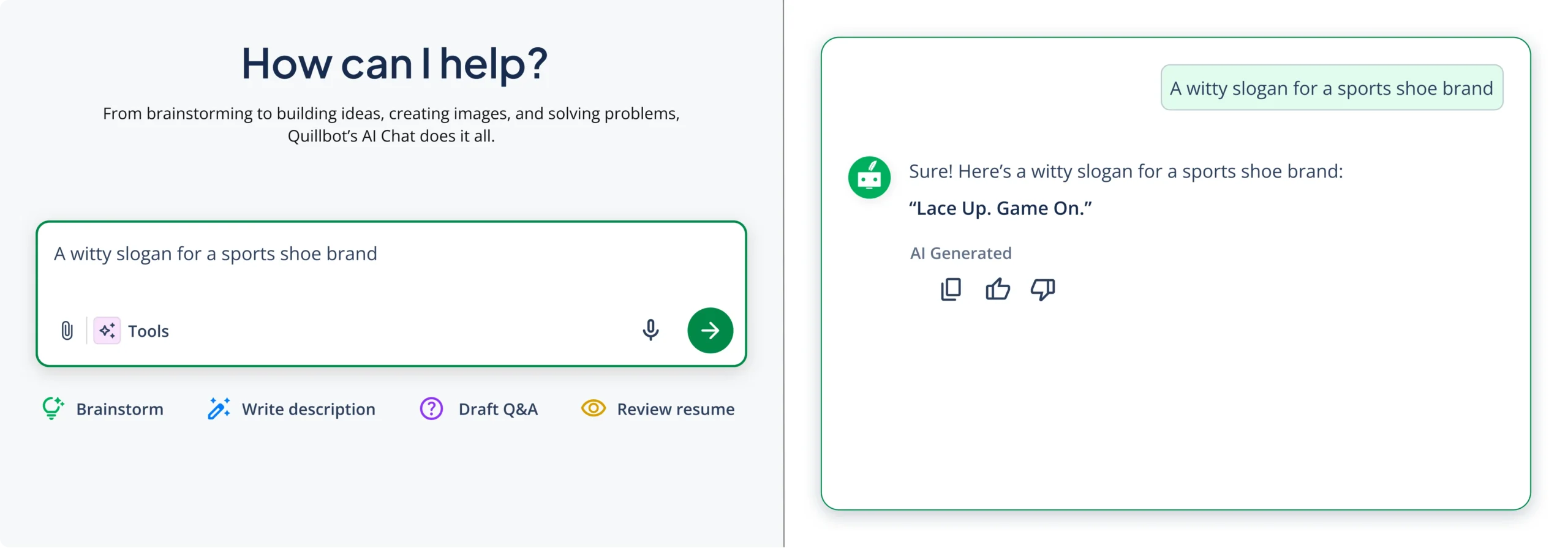
Below, you’ll find narrative writing prompts organized by theme and age level, from personal memories to creative storytelling exercises. And if you need more inspiration, a prompt-writing tool like QuillBot’s writing prompt generator can help you generate custom ideas in seconds.

Table of contents
- What are narrative writing prompts?
- How to use narrative writing prompts effectively
- Narrative writing prompts by theme and audience
- Personal narrative prompts
- Creative and fun narrative writing prompts
- Narrative writing prompts for school
- Kindergarten narrative writing prompts
- Elementary school narrative writing prompts
- Middle school narrative writing prompts
- High school narrative writing prompts
- Frequently asked questions about narrative writing prompts
What are narrative writing prompts?
Narrative writing prompts describe a real or fictional scenario and invite writers to tell a story about it. Narrative writing focuses on storytelling from a specific point of view and typically follows a clear beginning–middle–end structure.
Rather than struggling with endless topic choices, writers use prompts to narrow their focus through specific questions, situations, or scenarios—for example, “Write about a moment that changed your perspective” or “Tell a story that begins with an unexpected phone call.” These prompts serve as starting points for narrative essays, short stories, and creative writing exercises.

How to use narrative writing prompts effectively
Narrative writing prompts are most useful when they give you a clear direction without boxing you in. Here’s how to make the most of them:
- Choose a prompt that feels focused but flexible
- Decide whether your story will be personal or fictional
- Center the narrative on one moment or experience
- Organize the story with a clear beginning, middle, and end
- Use sensory details and a consistent point of view
- Adapt prompts for different age levels or writing goals
Narrative writing prompts by theme and audience
Narrative writing prompts come in many styles, suited to different needs. For students, they build essential skills like structure, voice, and detail. For adults, they offer a way to process memories or practice storytelling. Whether for school, college, or personal projects, organizing prompts by theme and audience helps you find the right fit.
Personal narrative prompts
Personal narrative prompts draw from real life—the moments and experiences that have shaped who you are. They’re ideal for memoirs, personal essays, or simply documenting your own story. Use them to explore pivotal moments, everyday encounters, or memories that still linger.
- Write about a time when a stranger unexpectedly changed your day or perspective.
- Describe an object you’ve kept for years and the story behind it.
- Write about a memory that’s tied to a particular smell and how it makes you feel.
- Recall a moment when you had to make a spontaneous choice—what happened next?
- Describe a moment when a sound or piece of music instantly took you back to a specific time or place.
- Tell a story about a dream or goal you once had and how it shaped you.
- Write about an experience that made you question something you believed strongly.
- Describe a place you visited that felt like stepping into another world.
- Share a story about a time you found beauty in an unlikely or ordinary situation.
- Tell the story of an experience you remember most through touch or texture—what sensations stand out?
Creative and fun narrative writing prompts
These prompts leave reality behind and ask “what if?” They’re built for experimentation: inventing worlds, bending rules, and following ideas wherever they lead. Use them when you want to stretch your imagination or simply write for the joy of it.
- Imagine a world where colors have personalities—describe a day when your favorite color acts up.
- Write a story about discovering a hidden language only animals understand—and you’re the only human who can speak it.
- Describe a day when gravity suddenly stops working—how do people adapt?
- Tell a tale about a character who can rewind time—but only by 10 seconds.
- Write about a world where everyone has a unique magical power—except you.
- Imagine receiving a letter from your future self. What does it say?
- Describe a friendship between a human and an object that comes to life.
- Write a story where dreams start blending into reality.
- Tell a story about an ordinary object that holds extraordinary secrets.
- Describe a town where people’s emotions change the architecture around them—what happens during a festival of joy?
Narrative writing prompts for school
School-level prompts are designed to meet students where they are—helping younger writers build strong foundations while inviting older students to explore deeper ideas. Below, you’ll find prompts carefully tailored to each age group’s unique stage of growth and creativity.
Kindergarten narrative writing prompts
Kindergarteners are just beginning to put their thoughts into words. Prompts at this level keep things simple and concrete—focusing on familiar experiences, favorite things, and what they can see, hear, or feel. The goal is to help them practice telling a story from start to finish, even if it’s just a few sentences long.
- Write about your favorite animal and what you like to do with it.
- Describe a day at the park—what do you see, hear, and feel?
- Tell a story about a magic toy that comes to life.
- Write about your best friend and a fun thing you did together.
- Imagine you found a tiny door in your house—what’s behind it?
- Describe what happens when you plant a seed and watch it grow.
- Tell a story about a funny thing that happened at school.
Elementary school narrative writing prompts
Elementary school is where storytelling begins to take shape. Students from 1st through 5th grade move beyond simple sentences to build narratives with more detail, clearer structure, and a stronger sense of voice.
These prompts encourage writers in early grades, like 2nd and 3rd, as well as those in 4th and 5th, to draw from their experiences and imaginations while learning to organize ideas into stories that others can follow and enjoy.
- Write about a day when something unexpected happened at school.
- Describe your favorite holiday and why it’s special to you.
- Tell a story about a time you tried something new and what you learned.
- Imagine you found an old letter or diary—what does it say, and how does it make you feel?
- Write about a time you helped someone and how it made you feel.
- Describe your perfect day from start to finish.
- Tell a story about a challenge you faced and how you solved it.
Middle school narrative writing prompts
Middle school writers in grades 6 through 8 are ready to move past straightforward storytelling and into something more layered. These prompts encourage them to explore complicated emotions, develop stronger characters, and experiment with how a story is told. It’s a stage where voice starts to emerge, and students begin writing with more intention and depth.
- Write about a time when you discovered something new about yourself.
- Describe a moment when you felt out of place—how did you handle it?
- Imagine discovering a secret about your family—how does it change your perspective?
- Tell a story about a day spent immersed in your favorite hobby or sport.
- Write about a situation where you had to stand up for what you believe in.
- Describe a character who faces a difficult decision and what influences their choice.
- Imagine a day when nothing goes as planned—how do you adapt?
High school narrative writing prompts
High school writers in grades 9 through 12 can handle bigger questions and more complicated stories. These prompts push them to dig deeper—exploring identity, relationships, moral dilemmas, and the messier parts of growing up. They’re designed to help students develop their own voice, experiment with structure, and write narratives that feel authentic and thought-provoking.
- Write a story where a character must confront a personal belief that is challenged by unexpected events.
- Describe a moment when a choice you made had unforeseen consequences—how did it change you?
- Imagine a world where people’s memories can be edited—what would your character choose to change, and why?
- Tell a story from the perspective of someone who feels invisible in their community.
- Write about a relationship that evolves in a surprising way over time.
- Describe a situation where a character faces a moral dilemma with no clear right answer.
- Imagine your character receives a message from their future self—what advice or warning does it contain?
Narrative writing is one of the most rewarding forms of storytelling—it connects us to our experiences, sharpens our communication skills, and helps us make sense of the world around us. Whether you’re working through a school assignment, developing a personal essay, or just writing for yourself, the right prompt can give you a place to begin. Pick one that resonates, let the story unfold, and see where it takes you.
Frequently asked questions about narrative writing prompts
- Can pictures be used as narrative writing prompts?
-
Yes, pictures can work well as narrative writing prompts. An image can suggest characters, settings, or moments, offering writers a place to start. If you want to experiment with picture prompts, try QuillBot’s AI image generator. You can create custom images and then write stories based on what you see, focusing on details and the feelings the picture inspires rather than a fixed plot.
- How do I choose the best narrative writing prompt?
-
The best narrative writing prompt is the one that resonates with you and guides your writing without limiting your ideas. Look for prompts that suggest a moment, situation, or perspective you feel drawn to, but that leave room for interpretation so you can shape the story in your own way.
If you’re unsure where to start, QuillBot’s writing prompt generator can help by offering tailored prompts based on themes, tone, or age level. This way, it’s easier to find one that genuinely fits your voice and purpose.
- Do I have to follow a narrative writing prompt exactly?
-
No, narrative writing prompts are meant to guide your thinking, not restrict it. You can adjust details, shift the focus, or interpret the prompt in a way that feels more natural to you, as long as the core idea remains recognizable. You can also use tools like QuillBot’s writing prompt generator to tweak or regenerate prompts until they find a version that fits their voice and the story they want to tell.
Cite this QuillBot article
We encourage the use of reliable sources in all types of writing. You can copy and paste the citation or click the "Cite this article" button to automatically add it to our free Citation Generator.
Nikolopoulou, K. (2026, January 16). Narrative Writing Prompts for All Ages. Quillbot. Retrieved March 10, 2026, from https://quillbot.com/blog/creative-writing/narrative-writing-prompts/