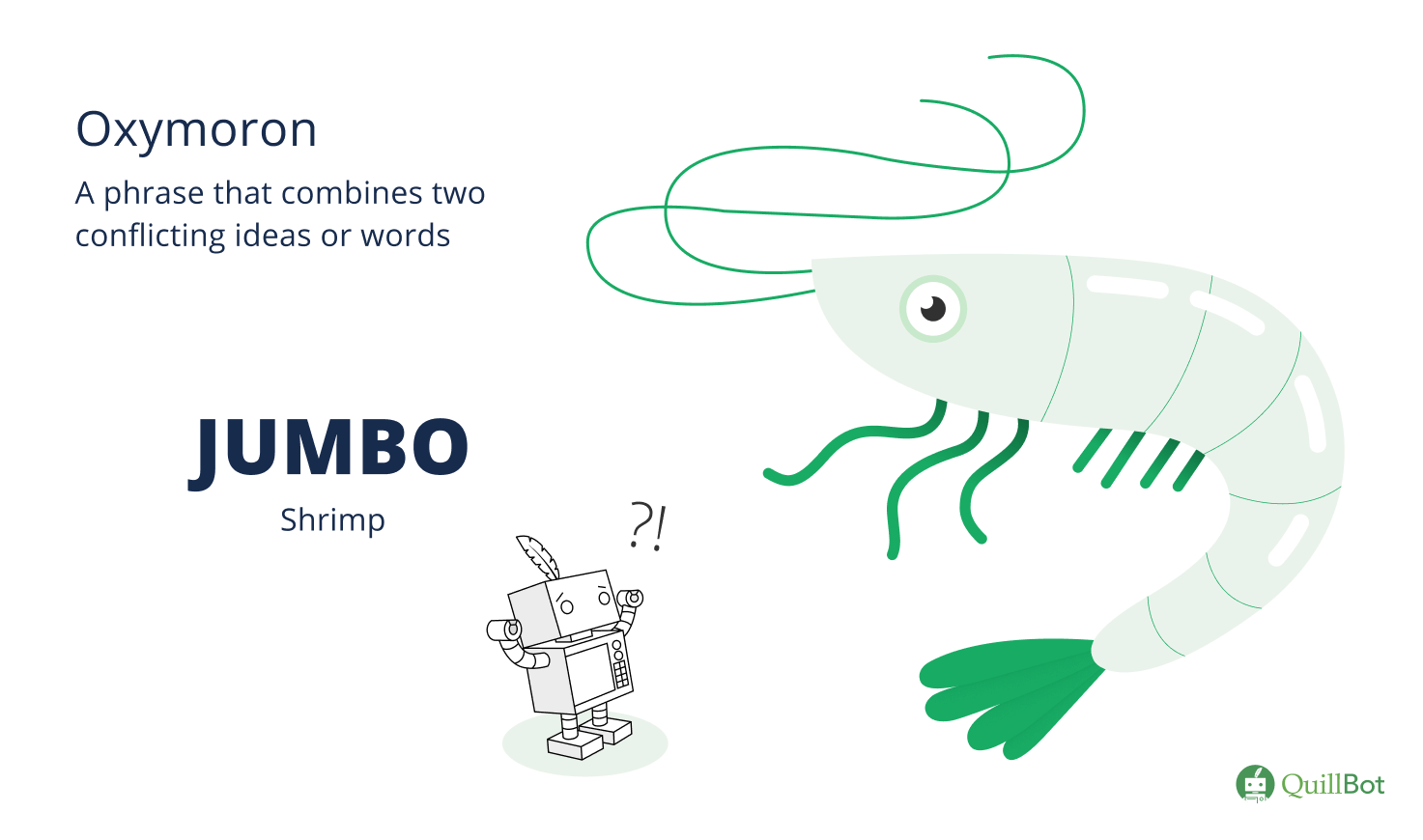
An oxymoron is when two words with opposing meanings are used alongside one another (e.g., “organized mess” or “cool passion”).
This combination of contradictory terms may seem absurd at first, but usually results in a concise expression that conveys a new complex meaning. Due to this, we encounter oxymorons in various contexts, such as literature, everyday language, and advertising.
Oxymoron examplesThe officer was struck by friendly fire from a fellow service member.
After a marathon seminar, participants staggered out of the room like the living dead.
There was a small crowd at the rally.
All our requests have been met with deafening silence.
An anachronism is a person, thing, or event that is placed in a historical time where it does not belong. For example, a knight wearing a wristwatch in a movie set in the medieval era would be an anachronism. Αnachronisms can happen by mistake or be used intentionally to convey a message or add humor to a story.
Anachronism exampleIn the movie Braveheart, characters, including William Wallace (played by Mel Gibson), are shown wearing kilts, which is historically inaccurate for the time period portrayed in the film. However, the anachronistic use of kilts serves a cinematic purpose, as kilts have become symbolic of Scottish identity.
Anachronisms can be found in books, paintings, movies, and other creative works.
Rhyme in literature is using words with identical or similar final sounds, like “cat” and “hat.” Typically, that happens at the end of a line of text, but it can also occur in the middle.
Rhyme exampleShall I compare thee to a summer’s day?
Thou art more lovely and more temperate:
Rough winds do shake the darling buds of May,
And summer’s lease hath all too short a date;
In these first lines of William Shakespeare’s famous “Sonnet 18: Shall I compare thee to a summer’s day?” rhyme occurs at the end of the line.
Because rhyme adds a musical quality to a text, it also makes it more memorable and pleasant to the ear. Due to this, rhyme is a common device in poetry and songwriting.
Assonance is the repetition of vowel sounds in two or more nearby words, such as “dumb luck” or “squeaky wheel.” Assonance helps to create a sense of flow between words that can make phrases catchy and easy to remember. Because of this, we often find it in poetry, prose, and song lyrics.
Example of assonance“The rain in Spain stays mainly in the plain.”
This phrase from the musical My Fair Lady is used as a speech exercise to help the protagonist “improve” her accent.
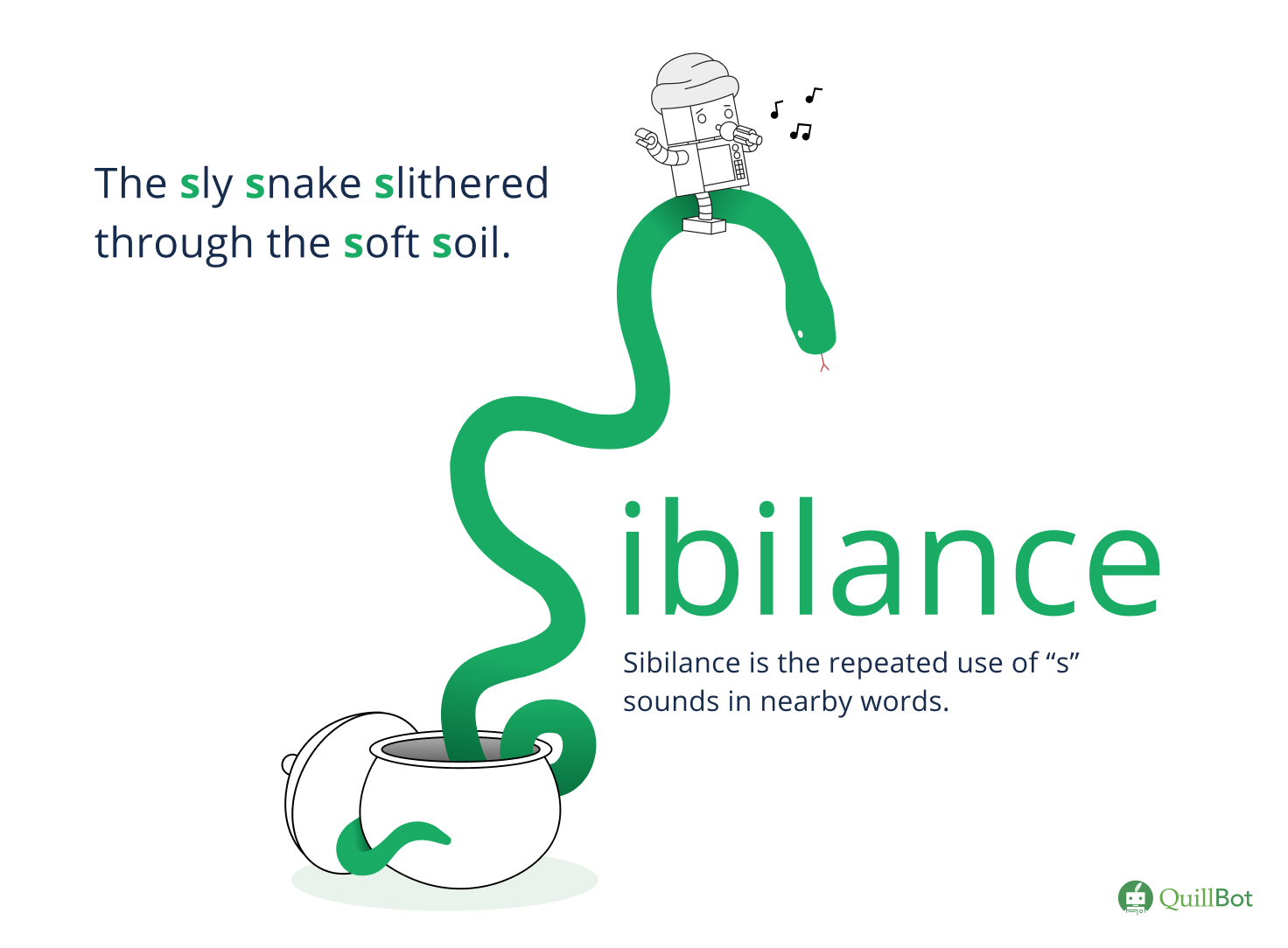
Sibilance is the repetition of “s” sounds in a series of neighboring words, such as “silent whispers in the shadows.” This deliberate repetition creates a hissing sound that contributes to the musicality and mood of a text. Sibilance is used in poetry, prose, and song lyrics.
Sibilance examplesThe squirrel shook the snow off its coat.
A double entendre is a phrase that can be understood in two different ways, one of which is obvious and innocent while the other may require some interpretation. The second meaning is usually sexually suggestive or inappropriate in some way.
Double entendre exampleIn Shakespeare’s play Hamlet, there is a famous example of a double entendre. In Act 3, Scene 2, Hamlet engages in a wordplay with Ophelia:
Hamlet: Lady, shall I lie in your lap?
Ophelia: No, my lord!
Hamlet: I mean, my head upon your lap?
Ophelia: Ay, my lord.
Here, Hamlet’s first line can be interpreted as either “shall I rest my head on your knee?” or “shall we sleep together?” When she refuses, he assures her he only meant the former, not the latter.
Double entendres are often used to communicate hidden meaning and inject humor in everyday conversation, movies, TV shows, and literature.
Symbolism involves using a word or object to represent something beyond its literal meaning. For example, a light bulb is an electric device that can also stand for sudden insight or innovation.
Symbolism exampleSome symbols are easy to interpret because they have been associated with specific meanings for a long time. For example, a heart symbolizes love and affection, a dove is a symbol of peace, and a globe with Wi-Fi waves signifies an available wireless internet connection.
We encounter symbolism in various aspects of life, including literature, art, and everyday experiences.
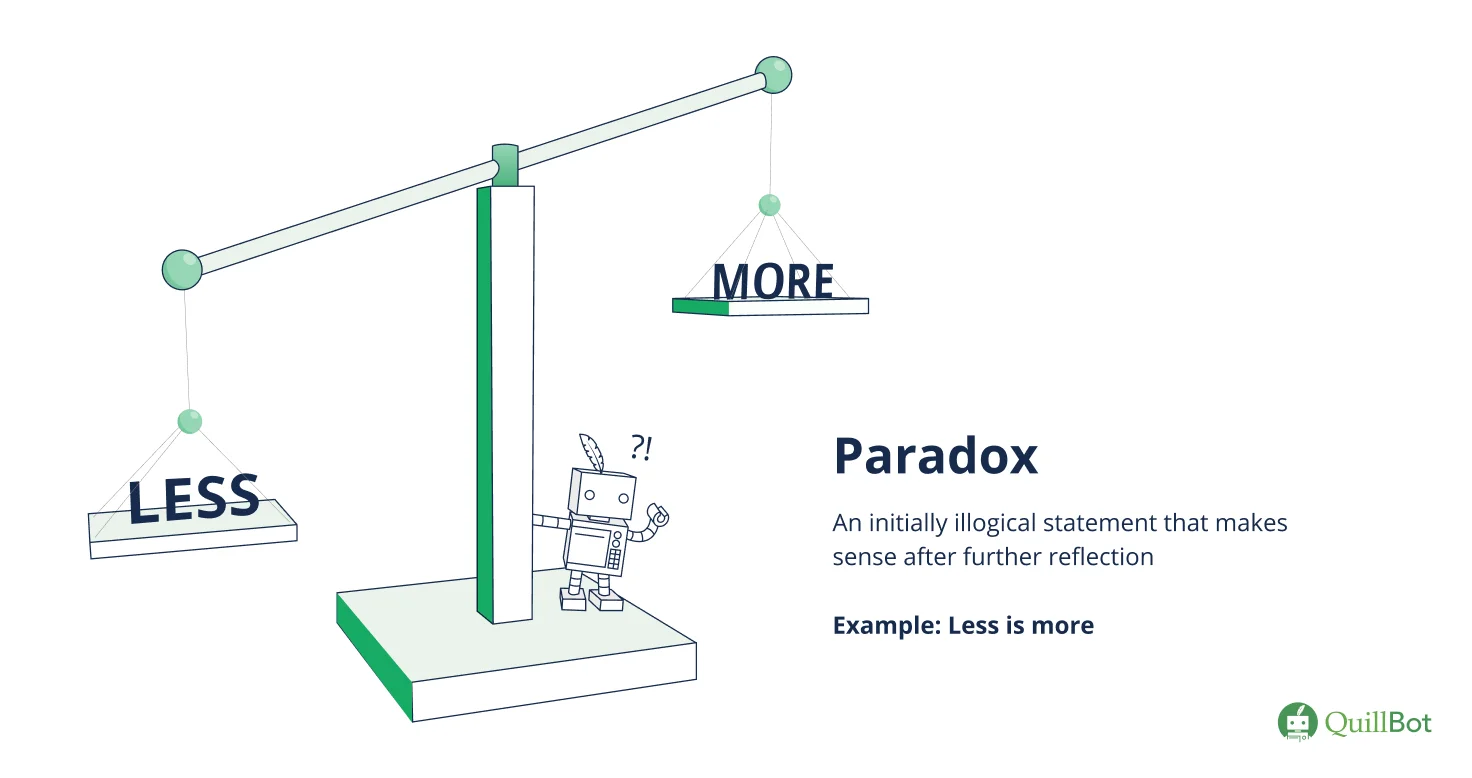
A paradox is a statement or situation that seems absurd initially but can be true or make sense upon further reflection. Because a paradox invites deeper contemplation, it can be used to challenge conventional thinking.
Paradox exampleA well-known paradox is the phrase “The only constant in life is change.” This may sound illogical because change and consistency are opposite concepts. However, this phrase encapsulates a deeper truth: that life is characterized by continual change.
Paradoxes are often used in literature, philosophy, and logic.
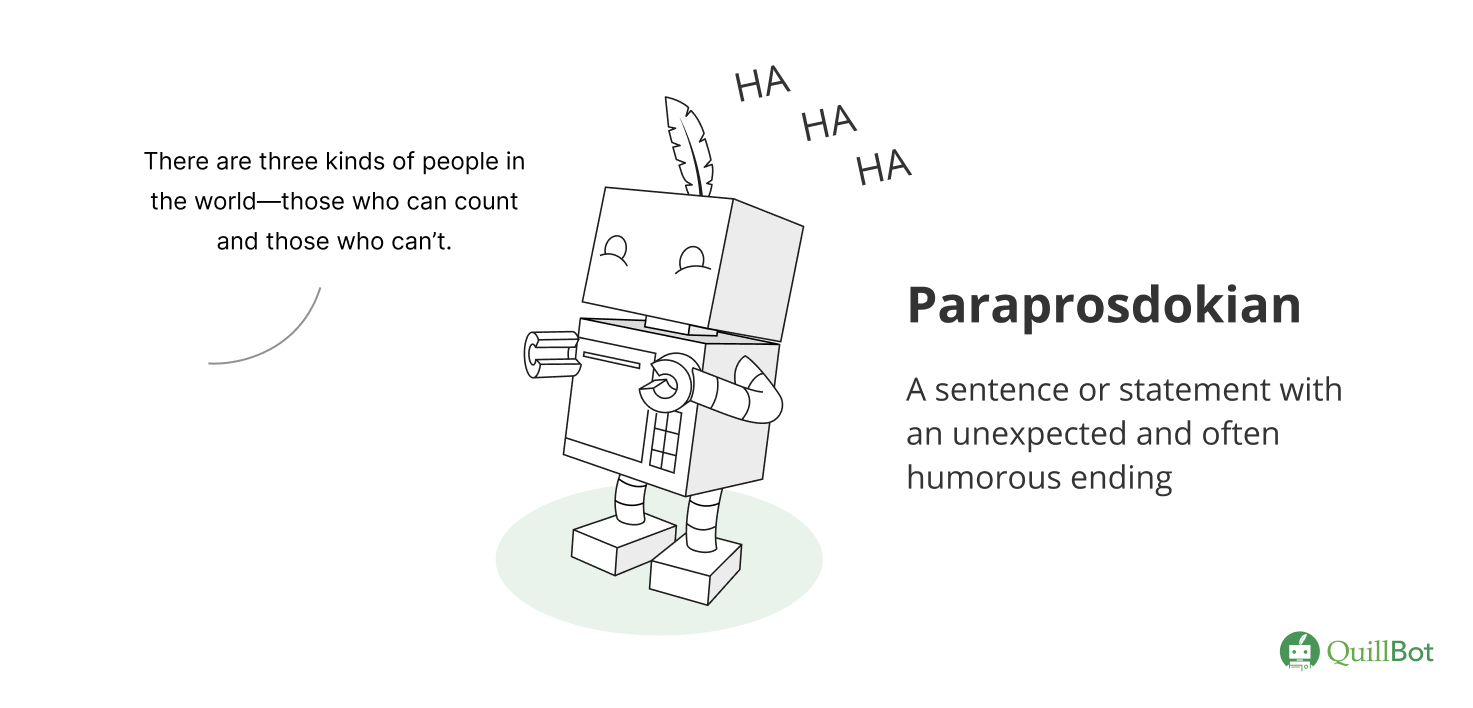
A paraprosdokian is a sentence or statement with an unexpected and often humorous ending. The surprising twist makes us think and reinterpret the entire phrase.
Paraprosdokians are often used in satire and comedy because they keep the audience engaged and entertained.
Paraprosdokian example“I’ve had a perfectly wonderful evening, but this wasn’t it.” —Groucho Marx
A “play on words” is a clever manipulation of language to create a humorous or rhetorical effect. It involves exploiting multiple meanings of a word or phrase or using words that sound alike but have different meanings.
It’s a form of wordplay, also known as verbal wit, that adds a layer of cleverness to communication. Due to this, we often encounter it in literature, advertising, and everyday conversations.
Play on words example: Alice’s Adventures in Wonderland“You see the earth takes twenty-four hours to turn round on its axis–”
“Talking of axes,” said the Duchess, “chop off her head!”