Brand Assets | What They Are, Types & Examples
Brand assets are the visual, verbal, and conceptual elements that define brand identity. A few common examples of brand assets are logos, color palettes, and taglines. Brand assets, when consistently applied across channels, build brand awareness and boost recall among the brand’s target audience.
Quillbot’s AI Chat can help answer any specific questions you may have about brand assets or assist you in brainstorming assets for your own brand.
Key takeaways
- Brand assets are the recognizable visual, verbal, and sensory elements (like logos, colors, and taglines) that define a brand’s identity and make it memorable.
- When used consistently, they build recognition, trust, and differentiation, helping brands stand out and stay top of mind.
- A strong set of brand assets spans multiple categories—from design and tone of voice to digital, social, and physical experiences—working together as a cohesive system.
- Organizing and managing these assets effectively (e.g., through brand guidelines and centralized brand kits) improves efficiency, consistency, and scalability across teams and channels.
What are brand assets?
Brand assets are unique, recognizable design and marketing elements that come together to form a brand’s identity. Effective brand assets create an immediate association in the mind of the audience, helping to set a brand apart from its competitors.
There are a few categories of brand assets based on how the audience perceives them:
- Visual assets (e.g., logo, colors, typography, imagery, or packaging)
- Verbal and written assets (e.g., name, tagline, tone of voice, or brand story)
- Sensory assets (e.g., jingle, sonic logo, scent, or shape)
- Experiential assets (e.g., in-store design, website UX, or customer service)
Brand assets are usually created as part of the branding design process. Once completed, assets are usually stored in a central repository called a brand kit, with usage instructions and examples outlined in brand guidelines. The organization and maintenance of brand assets is called “brand asset management” and is often a part of the wider, ongoing process of brand management.
Brand assets vs digital assets
The purpose of brand assets is to create a direct association with your brand. Digital assets, on the other hand, are any digital files your brand has the right to use, whether they were created strictly to communicate brand identity or not. Brand assets may be digital assets, but not all digital assets are brand assets.
Digital assets are often used for marketing, user experience, sales, and internal operations. A few examples of digital assets are:
- Raw images, videos, and audio files
- Graphics, icons, and animations
- Customer reviews and user testimonials
- Influencer content and UGC
- Presentations, spreadsheets, and PDFs
- Employee headshots and photos from events
12 key brand assets
These are the key brand assets that most brands should have. However, depending on your brand, market, and products or services, your brand may not need all of the following brand assets.
| Brand asset | Description | How it supports the brand |
|---|---|---|
| Name | The official name of the brand, product, or company | Serves as the primary identifier and anchor for all brand recognition, recall, and communication |
| Logo | The primary visual symbol used to identify the brand | Creates instant recognition and helps audiences quickly identify the brand |
| Color palette | A defined set of brand colors used across all materials | Reinforces visual identity and improves recall across channels; can also transmit certain emotions as per color theory |
| Typography | The fonts and text styles used in communications | Ensures readability and contributes to a consistent visual style |
| Imagery and graphics | Photos, illustrations, icons, and visual elements associated with the brand | Helps convey personality, tone, and emotional appeal |
| Tagline or slogan | A short, memorable phrase that communicates the brand’s value and/or positioning | Strengthens messaging and aids memorability |
| Tone of voice | The style and personality of written and spoken communication | Shapes how the brand “sounds” and connects with its audience |
| Sound effects and jingles | Short, distinctive audio elements used in advertising, apps, or other brand touchpoints | Reinforce brand recognition through sound and improve recall, even without visual cues |
| Website and digital presence | The design and structure of the brand’s online platforms | Serves as a central touchpoint for brand experience and communication |
| Social assets | Branded content and visual elements used across social media platforms (e.g., post templates, profile images, highlight covers) | Guarantees consistency across social channels and strengthens recognition and engagement in digital environments |
| Packaging | The design of product packaging or physical materials | Extends the brand experience and reinforces identity at the point of use |
| Physical locations | The design and layout of physical stores or spaces where customers interact with the brand | Creates a tangible brand experience and reinforces identity through environment, layout, and atmosphere |
Examples of brand assets
The brand asset examples below are for a fictional restaurant brand, Verdant Kitchen, which offers fast-casual, seasonal food such as grain bowls, salads, and daily specials. Verdant Kitchen’s branding, in a nutshell, is:
- Target audience: Urban professionals (25–45), health-conscious but convenience-driven
- Positioning: Fresh, seasonal meals built around whole grains and locally sourced ingredients
- Core value proposition: Restaurant-quality, nutritious meals prepared quickly and transparently
Below, find some brand assets used by Verdant Kitchen, plus explanations about why the brand chose each.
Name
“Verdant” signals freshness, greenery, and growth, and “kitchen” reinforces craft, preparation, and authenticity. This name speaks to the values the brand shares with its target audience. Moreover, “Verdant Kitchen” is easy to say and remember, and the letters “V” and “K” resemble trees or plants growing upwards and outwards, which connects to the idea of fresh food.
Logo
The brand’s logo turns part of the “V” into a plant to play off the idea of fresh, healthy food. The logo also includes the full name of the brand and its tagline for maximum recognition.
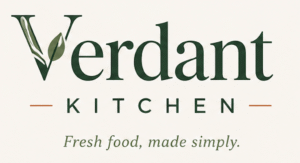
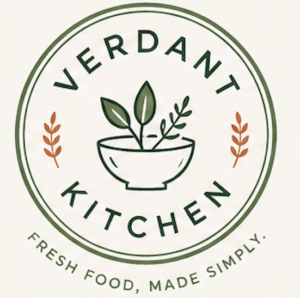
They have other logo options, too. The brand’s secondary logo is a reworking of the first with a round format. It also employs a sans serif font, which is better for readability at smaller sizes. Its design also emphasizes fresh food and natural grains.
Finally, these icons are used as a favicon and in other contexts where the brand’s logo appears at a small scale.

Color palette
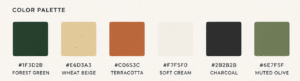
Verdant Kitchen’s color palette is natural, earthy, and calm. Primary colors include deep forest green (#1F3D2B) to communicate freshness and sustainability and warm wheat beige (#E6D3A3), which represents natural ingredients.
The secondary colors are terracotta (#C0653C), which symbolizes warmth and cooked food, and soft cream (#F7F5F0), which is used to create clean, minimal backgrounds. Functional colors—colors used for the brand’s digital presence—are charcoal (#2B2B2B) for text and muted olive (#6E7F5F) for user interface accents.
Typography
The brand uses three fonts, each with a specific function:
- An elegant serif for headlines and its main logo
- A modern sans-serif for body text
- A handwritten font to use as an accent

Imagery and graphics
The brand uses photography that emphasizes natural lighting, close-up textures, and minimal staging, like the image found below.

For graphic elements, they use simple line illustrations of ingredients. These most prominently feature in packaging design and as icons on the brand’s website.

Tagline or slogan
Verdant Kitchen’s tagline is “Fresh food, made simply.” It’s simple, to the point, and communicates the brand’s core values. The tagline matches the product the customer receives, boosting trust in the brand.
Tone of voice
The core traits of the brand’s tone of voice are:
- Clear
- Informative
- Warm but not overly casual
- Ingredient-focused
- Transparent
The brand avoids overly technical nutrition jargon or slang-heavy or ironic language. This promotes wholesome interactions with customers and pushes the idea that the brand is authentic and reliable.
Packaging
Verdant Green’s packaging is simple and sustainable, made from compostable materials with minimal ink design. Simple kraft bowls keep food fresh without damaging the environment. Personalized tags clearly label the ingredients in each item, and occasional handwritten-style notes are used for special seasonal menu options. This lends a sense of transparency and warmth at the critical moment when customers receive their food.

In-store experience
Verdant Kitchen’s physical locations showcase interiors made from natural materials with plant accents, and an open kitchen layout emphasizes transparency. The brand strives for a calm and bright atmosphere, with plenty of natural light and indie folk music playing softly in the background. Staff wear uniforms in neutral earth tones with green accents so they are easily identifiable and approachable.

Why brand assets are important
Brand assets are the building blocks of how a brand is recognized, remembered, and trusted. Without clearly defined and consistently used assets, it becomes difficult for a brand to establish a strong presence in the market.
Some of the benefits of brand assets are:
- Consistency: Having defined assets ensures that the brand looks and sounds the same everywhere it appears. Consistency reinforces credibility and prevents mixed messaging.
- Recognition: Brand assets make a brand instantly identifiable. Elements like logos, colors, and typography act as visual shortcuts, helping audiences recognize the brand quickly across different channels. This is particularly important for new brands or those going through a rebranding.
- Differentiation: Strong, distinctive assets build a strong brand identity, which helps a brand stand out from competitors, especially in crowded markets where there are many similar products or services. Brand assets can communicate brand purpose, making it clear why your brand does what it does.
- Trust and credibility: Consistent use of brand assets signals professionalism and reliability. Over time, this builds trust with customers, as they know what to expect from the brand.
- Efficiency: When brand assets are organized, accessible, and explained to your teams, they can create content faster and with fewer errors. This reduces duplication of work and publication delays and avoids off-brand materials reaching your audience.
- Scalability: As a business grows, brand assets make it easier to maintain consistency across new markets, teams, and channels, including with partners and external vendors.
Frequently asked questions about brand assets
- What are distinctive brand assets?
-
Distinctive brand assets are the unique, recognizable elements that help people immediately identify a brand without needing to see or hear its name.
They act as mental shortcuts in the customer’s memory and are key to building strong brand recognition over time.
A few examples are Nike’s swoosh logo, Netflix’s “t’dum” sound, or the robin’s egg cyan blue color used by Tiffany & Co.
Learn more about distinctive brand assets with Quillbot’s AI Chat.
- How can I track which brand assets perform best?
-
Track brand asset performance by linking each asset to measurable KPIs (e.g., click-through rate, conversions, engagement, recall) and tracking in analytics platforms. Apply consistent naming and tagging to assets so performance data is traceable.
For deeper analysis, use social listening tools, brand tracking surveys, and attribution models to understand how specific brand assets contribute to awareness and revenue.
If you want help tracking brand asset performance, try asking Quillbot’s AI Chat.
Other interesting articles
If you want to know more about colors, letters, or the meaning of emojis, make sure to check out some of our other articles with explanations and examples.Cite this Quillbot article
We encourage the use of reliable sources in all types of writing. You can copy and paste the citation or click the "Cite this article" button to automatically add it to our free Citation Generator.
Santoro, K. (2026, April 30). Brand Assets | What They Are, Types & Examples. Quillbot. Retrieved September 16, 2026, from https://quillbot.com/blog/branding/brand-assets/