Best AI Detector for Recruiters: Hiring Guide 2026
Recruiters are facing a new kind of challenge.
Candidates are no longer just polishing their resumes; they’re generating them. With tools capable of producing perfectly structured cover letters, tailored responses, and even interview answers, it’s getting harder to tell what’s real.
As a result, many teams are now searching for the best AI detector for recruiters to help identify AI-generated applications and maintain hiring quality. AI detectors promise a solution. But like any AI tool, they only work if you use them correctly.
This guide breaks down how recruiters can use AI detectors effectively without losing strong candidates in the process.
Key takeaways
- AI-generated resumes and cover letters are now common, and detection is becoming essential in hiring workflows
- AI detectors should be used to flag risk, not reject candidates outright
- The best results come from combining AI detection with structured interviews and skill validation
- A human-in-the-loop hiring process is the most reliable way to assess authenticity
Table of contents
- Rethink what “authentic” means in hiring
- Where AI detectors actually fit in your hiring funnel
- Spotting signals beyond AI Detection scores
- AI detectors as a strategic advantage in modern hiring
- How to verify candidate authenticity in interviews
- Balance efficiency with fairness
- Standardizing AI detection across your hiring team
- Use multiple tools for better signals
- Learning from hiring outcomes (not just tools)
- Build a consistent and fair AI-aware hiring process
- Frequently asked questions about AI detector for recruiters
Rethink what “authentic” means in hiring
Most recruiters approach detection like a yes/no problem:
“Was this written by AI?”
That’s the wrong starting point.
Some better questions include:
- Does this accurately represent the candidate’s abilities?
- Is this submission overly optimized or generic?
- What’s the risk if this content is AI-assisted?
The AI detector flags it as “likely AI-generated.”
But during the interview, the candidate clearly articulates the same ideas.
The issue isn’t AI use. It’s whether they can back it up.
Where AI detectors actually fit in your hiring funnel
AI detectors are best used early in the funnel to:
- Identify overly templated applications
- Flag inconsistent writing styles
- Highlight content that needs deeper review
They should not be used to auto-reject candidates.
Spotting signals beyond AI Detection scores
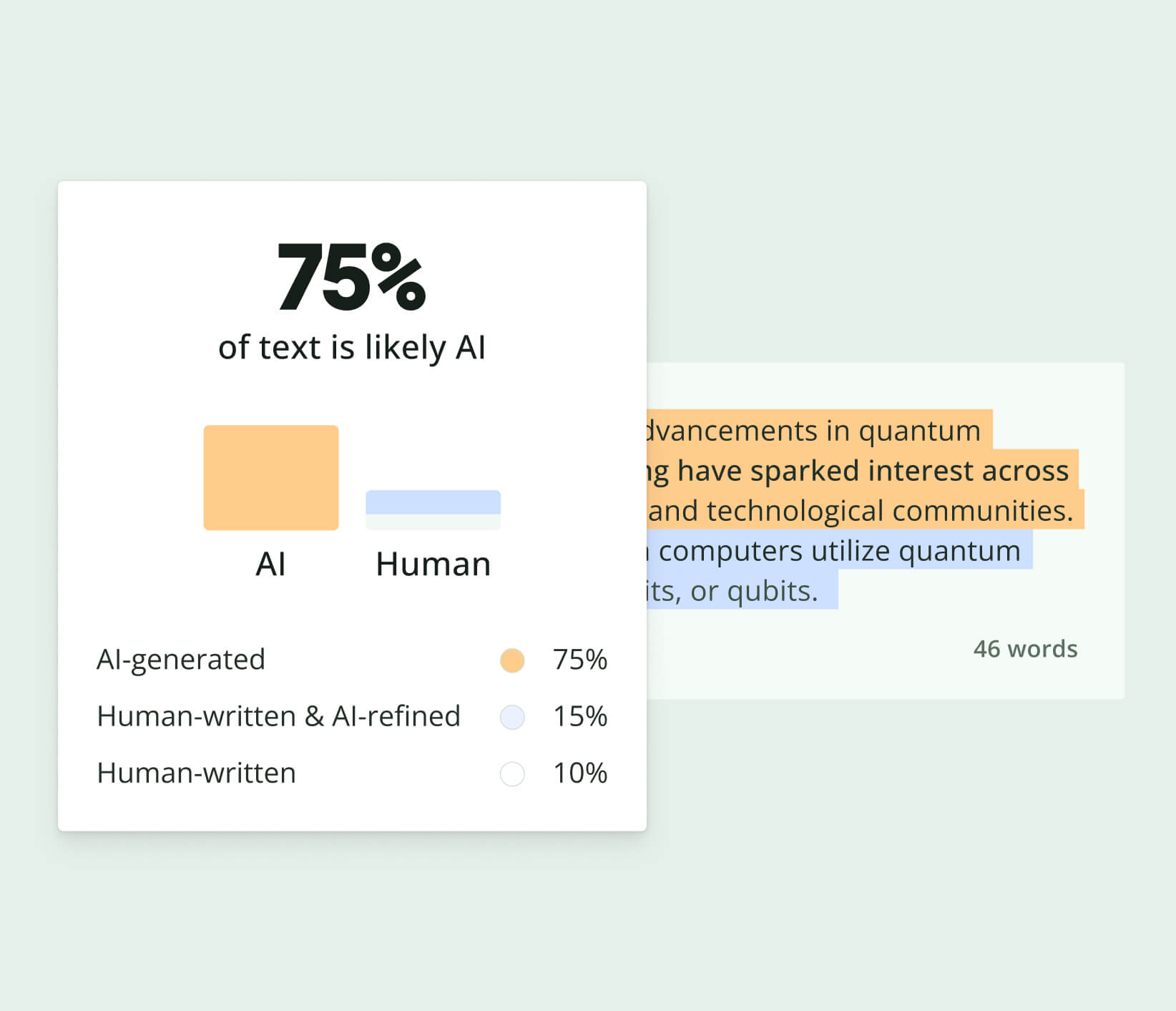
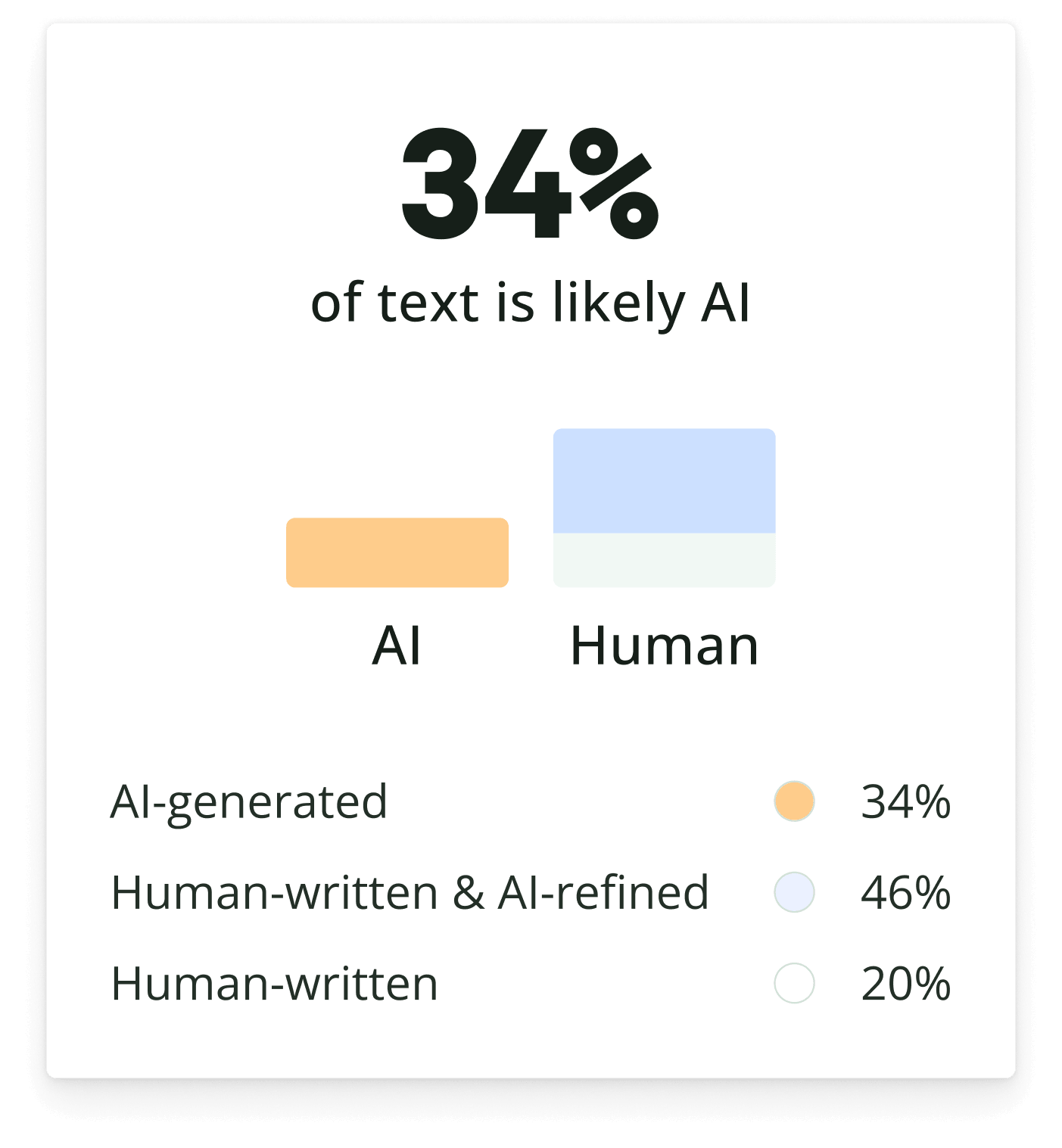
Detection tools often assign a percentage:
- “80% AI-generated”
- “Likely human-written”
These numbers highlight issues that need closer attention.
Instead, look for patterns:
- Repetitive phrasing across applications
- Overuse of buzzwords without specifics
- Lack of measurable achievements
Candidate A: Generic phrases like “results-driven professional”
Candidate B: Specific metrics and detailed project examples
Same score, but very different signal quality.
AI detectors as a strategic advantage in modern hiring
In high-volume hiring environments, speed and consistency are everything. This is where AI detectors can become a real competitive advantage.
Instead of manually scanning every application, recruiters can use AI detectors to:
- Quickly identify overly generic or templated submissions
- Spot inconsistencies in candidate materials
- Prioritize applications that need deeper review
This allows teams to move faster, without compromising evaluation quality.
Instead of discarding them, they prioritize those candidates for deeper analysis, ensuring strong candidates aren’t overlooked while still maintaining efficiency.
In other words, they don’t just detect AI; they help you hire smarter in an AI-driven world.
How to verify candidate authenticity in interviews
AI detectors can’t evaluate:
- Real-world experience
- Problem-solving ability
- Communication under pressure
That’s your job.
Use structured interviews to:
- Ask candidates to elaborate on their submissions
- Introduce scenario-based questions
- Probe for specifics behind generic claims
Balance efficiency with fairness
Here’s where many recruiters get it wrong:
- Over-flagging AI use
- Penalizing candidates for using tools
The reality? AI assistance is becoming standard.
Your goal isn’t to eliminate AI. It’s to ensure authentic representation.
Rejecting them for AI use means losing a potentially strong hire. Instead, validate their experience during interviews.
Standardizing AI detection across your hiring team
The best hiring teams don’t rely on tools only. They design systems.
A practical workflow:
- AI detector scan
- Recruiter review
- Candidate validation (interview/task)
- Final decision based on evidence
Detection scores are useful only when paired with context and human review.
A consistent workflow improves outcomes:
use detection → validate with interviews → decide based on evidence.
Relying on tools alone leads to bias; combining them with structured evaluation leads to better hiring decisions.
Use multiple tools for better signals
No single detector is perfect. Combining tools gives you better coverage and helps you evaluate candidates more effectively throughout the hiring process.
Quillbot tools can support different stages of screening:
- AI text detection for resumes and cover letters that may be overly templated or AI-generated
- AI image detection to assess the authenticity of portfolio images or design samples
- Grammar and clarity checks to evaluate how clearly and professionally a candidate communicates
Using these tools together helps you screen faster while still focusing on what matters: whether the candidate can actually do the job.
Learning from hiring outcomes (not just tools)
The most effective recruiters learn from results.
Track:
- Which flagged candidates performed well
- Which “clean” applications failed in interviews
- Where detection added value vs noise
Then refine your process.
If poor hires passed easily, your validation steps need improvement.
Build a consistent and fair AI-aware hiring process
AI detectors are just one part of modern recruiting.
When used correctly, they:
- Save time during screening
- Highlight risk areas
- Improve consistency
But they don’t replace human judgment.
AI is changing how candidates present themselves, but it doesn’t change what actually matters: skills, experience, and authenticity.
The best recruiters won’t be the ones who avoid AI. They’ll be the ones who know how to work alongside it, using detection tools to enhance their process, not define it.
Because in the end, hiring isn’t about catching AI. It’s about finding people who can actually do the job.
Frequently asked questions about AI detector for recruiters
- What is the best AI detector for recruiters?
-
While there’s no single “best” tool, Quillbot’s AI Detector is a strong option for screening resumes and cover letters and identifying original content.
However, AI detection results alone can’t confirm whether someone is a good candidate for a job. For a more in-depth approach, combine AI detection with interviews and candidate validation.
- Can AI detectors accurately identify AI-generated resumes?
-
AI Detectors provide estimates, not certainty.
For better results:
- Use Quillbot’s AI Detector to flag suspicious content
- Cross-check writing consistency with the Grammar Checker
- Look for unnatural phrasing patterns
- Why do some AI-generated resumes pass detection?
-
Some AI-generated resumes pass detection because modern AI tools produce highly human-like content.
To improve accuracy:
- Combine AI Detector results with manual review
- Check for specificity and measurable achievements
- Use a Grammar Checker to identify overly polished or unnatural text
- Can AI-generated portfolios or images be detected?
-
AI-generated portfolios or images can be detected to some extent. Tools like Quillbot’s AI Image Detector can help recruiters assess whether portfolio visuals or design samples are AI-generated.