Parts of Speech | Definitions, Examples & Tips
In English grammar, parts of speech are the basic categories of how words can function in a sentence:
- Noun
- Verb
- Adjective
- Adverb
- Conjunction
- Preposition
- Pronoun
- Interjection
Being able to identify parts of speech is important if you want to understand how English works. QuillBot’s free AI Chat can help you practice identifying parts of speech in a sentence.
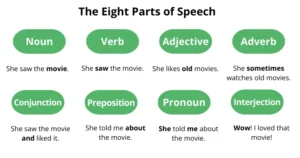
Table of contents
- 8 parts of speech
- Tips for identifying parts of speech
- Nouns: Part of speech
- Verbs: Part of speech
- Adjectives: Part of speech
- Adverbs: Part of speech
- Conjunctions: Part of speech
- Prepositions: Part of speech
- Pronouns: Part of speech
- Interjections: Part of speech
- Frequently asked questions about parts of speech
8 parts of speech
Knowing about the eight parts of speech helps you:
- Use dictionaries more effectively
- Understand grammar explanations (e.g., “It should be ‘effect,’ not ‘affect,’ because here the word is a noun, not a verb, and you mean ‘result.’”)
- Compare English with another language you’re learning
A word’s part of speech depends on how it’s being used in a sentence, so the same word can have different parts of speech in different contexts.
| Parts of speech | Parts of speech definition | Parts of speech examples |
|---|---|---|
| Noun | Nouns are words for people, places, and things, as well as abstract concepts.
They often have plural forms (e.g., teacher → teachers), and you can typically put words like “a,” “the,” and “that” in front of them. |
|
| Verb | Verbs often describe actions and are often called “doing words,” but they also express things like thoughts, feelings, states of being, and relationships between things.
Verbs change depending on who or what they refer to (e.g., I teach → He teaches) and the time they refer to (e.g., We teach → We taught). |
|
| Adjective | Adjectives describe nouns and are often called “describing words.”
They usually come before nouns, but they can also appear after the noun they refer to—when used with linking verbs like “be,” “become,” and “seem.” |
|
| Adverb | Adverbs can describe verbs, adjectives, and other adverbs.
There are many different kinds of adverbs. Some refer to a whole sentence, while others refer to ideas in different sentences, for example. |
|
| Conjunction | Conjunctions connect words and parts of sentences. |
|
| Preposition | Prepositions come before nouns (or noun phrases) and point to information about things like time, location, direction, and logical relationships. | |
| Pronoun | Pronouns are words that you can use in place of nouns, like:
|
|
| Interjection | Words and short, fixed phrases like:
They can express feelings and reactions, as well as call attention and fill pauses. If you take an interjection out of the sentence, the sentence is still grammatically complete. They’re typically used in speech and informal writing, like texting. |
|
Tips for identifying parts of speech
Learning to identify the parts of speech takes practice. Over time, you start to develop a sense of where words in each category usually appear in a sentence and the different forms they can take. The tips below will help you get started.
Nouns: Part of speech
These tips will help you identify nouns in a sentence.
- If a word makes sense after a determiner like “a,” “an,” “the,” “this,” or “that”—in the sense that it’s being used in the sentence in question—its part of speech is typically a noun (e.g., in the sentence “I like movies,” “the movie” makes sense and “the like” doesn’t; “movies” is a plural noun).
- Words ending in these suffixes are very often nouns:
- -ance, -ence (importance, difference)
- -ment (payment, judgment)
- -ion (action)
- -ity (ability)
- -ness (happiness)
- You can typically make a noun plural by adding an “s” to the end. But nouns are sometimes used in an “uncountable” sense (e.g., “Do you want some cheese?”), where you can’t add an “s,” but you can make them plural with phrases like “a piece of” and “a cup of” (e.g., “Put two slices of cheese in each sandwich). Some nouns also have irregular plurals (e.g., child → children).
Verbs: Part of speech
These tips will help you identify verbs in a sentence.
- Verbs can change their form to express who or what they are referring to (e.g., We walk → she walks).
- Verbs change their form to express time (verb tense) (e.g., I walk → I walked → I am walking)
- Main verbs are often accompanied by the following auxiliary verbs (help verbs) to show tense and to form questions and negative statements:
“I walk every day.”
“I am walking there now.”
“I have walked there before.”
“I had walked there before.”
“I will walk there tomorrow.”
Questions:
“Does she walk every day?”
“Is she walking there now?”
“Has she walked there before?”
“Had she walked there before?”
“Will she walk there tomorrow?”
Negative statements:
“They don’t walk every day.”
“They aren’t walking there now.”
“They haven’t walked there before.”
“They hadn’t walked there before.”
“They won’t walk there tomorrow.”
Adjectives: Part of speech
When identifying adjectives in a sentence, remember that they don’t always come before a noun.
Adjectives do often come directly before nouns, adding information about that noun.
That’s a very big portion!
What an amazing goal!
But they can also come after verbs like “be,” “become,” “seem,” and “sound” (linking or copular verbs). Here, they’re called predicate adjectives, and they describe the subject of the sentence.
These portions seem very big.
Wow! That sounds amazing!
Adverbs: Part of speech
Adverbs can be tricky to identify because they can function in so many different ways, so it’s usually easier to identify the nouns, verbs, and adjectives in a sentence first.
If a word ends in “-ly,” that’s a good sign that it’s an adverb (often an adverb of manner). But not all adverbs end in “-ly.”
They serve very big portions.
That portion is too big.
It’s almost blue, but it still looks a bit purple to me.
Do you always have sugar in your tea?
I never put sugar in my coffee.
We sometimes go there for lunch.
I just made coffee.
We ate there yesterday.
He arrived late.
I looked everywhere for it.
She found it upstairs.
They live abroad.
Conjunctions: Part of speech
Here are some points to bear in mind when identifying conjunctions:
- The words “and,” “or,” and “but” are almost always used as conjunctions (coordinating conjunctions).
- Subordinating conjunctions like “if,” “when,” “because,” and “while” come at the start of the part of the sentence they belong to (called a dependent clause).
- Some conjunctions are made up of multiple words (e.g., “as if,” “as soon as,” and “in order that”).
Prepositions: Part of speech
These characteristics of prepositions will help you to identify them in a sentence:
- They are often short words, like “by,” “on,” “for,” and “until.”
- They are followed by a noun, noun phrase, or pronoun called the object of a preposition (e.g., “… on Monday,” “… on that big, old wooden table,” “jumped on me”).
- They often indicate locations (e.g., “on” and “under”), movement and direction (e.g., “into”), and time (e.g., “since”).
Pronouns: Part of speech
If a word stands in for a person, thing, or group—and you need context to know what it refers to—there’s a good chance it’s a pronoun (e.g., “you,” “me,” “yours,” “yourself”).
Some pronouns show who or what something belongs to. These are called possessive pronouns (e.g., “The pen is hers,” “The pens are theirs”). But when words like “her” and “their” come before a noun, they’re called possessive determiners or possessive adjectives and are traditionally classed as a type of adjective (e.g., “her pen,” “their pens”).
Another type of pronoun points to specific people or things. These are called demonstrative pronouns (e.g., “This/that is a good pen,” “These/those are good pens”). When the same words come before a noun, they’re called demonstrative determiners or demonstrative adjectives and are traditionally classed as adjectives (e.g., “This/that pen is good,” “These/those pens are good”).
Interjections: Part of speech
Interjections are typically short words or phrases followed by an exclamation point or a comma (e.g., “Hey!”, “Wow!”, “Oh no!”, “Well”). They express things like frustration, surprise, excitement, agreement, or hesitation. Interjections don’t affect the grammar of the rest of the sentence—so if you remove them, the sentence will still make grammatical sense.
Frequently asked questions about parts of speech
- What is a parts of speech identifier?
-
A parts of speech identifier is a software tool that analyzes text and labels each word with its part of speech.
You can use QuillBot’s free AI Chat to identify the parts of speech in a sentence or passage of text.
- What is a parts of speech anchor chart?
-
A parts of speech anchor chart is a visual reference that teachers display in the classroom to help students remember key concepts about the parts of speech while they work.
Anchor charts are often created with students during a lesson. This makes the chart more meaningful and helps students remember the ideas behind it.
Why not use QuillBot’s free AI lesson plan generator to brainstorm ideas for creating a parts of speech anchor chart with your students?
Cite this QuillBot article
We encourage the use of reliable sources in all types of writing. You can copy and paste the citation or click the "Cite this article" button to automatically add it to our free Citation Generator.
Challenger, T. (2025, December 03). Parts of Speech | Definitions, Examples & Tips. Quillbot. Retrieved March 16, 2026, from https://quillbot.com/blog/sentence-and-word-structure/parts-of-speech/