Brand Voice | What It Is & How to Create Yours
Brand voice is the personality a brand has when it communicates through language. Brand voice can be, for example, confident and clever, witty and sassy, or authentic and urgent. As a core component of brand identity, brand voice directly affects how the target audience perceives the brand, which in turn impacts brand awareness, engagement, and loyalty.
This guide walks through what brand voice is, why it’s important, examples, and how to develop your own. If you’re experimenting with brand voice, try Quillbot’s Paraphraser, which changes the tone and style of your text so you can decide what sounds right for your brand.
Key takeaways
- Brand voice is the consistent personality your brand uses across all communication. A strong voice helps customers recognize, trust, and connect with your brand while differentiating you from competitors.
- Effective brand voices are clear, distinctive, and consistent across channels (e.g., websites, emails, social media, and customer support). While your brand voice stays stable, your tone may shift depending on the audience or situation.
- Developing a brand voice starts with understanding your brand values, target audience, competitors, and existing messaging. Tools like buyer personas, content audits, and “this, but not that” exercises help define how your brand should sound.
- Successful brands like Nike, Slack, and Duolingo use distinct voices to make their messaging more memorable, relatable, and effective.

What is brand voice?
Brand voice is the unique and consistent personality a brand exhibits across all communications. A clear, distinct brand voice enables more powerful copywriting and content marketing, leading to stronger brand recognition, differentiation, and trust. Without a well-developed brand voice, brand messaging falls flat, and the brand becomes forgettable.
An effective brand voice is:
- Practical: It can be applied across different formats, channels, and content types without constant reinterpretation or too much variation. If brand voice is too confusing or technical, it’s no good to either the brand team or the customers.
- Distinctive: It reflects a unique personality that sets the brand apart from competitors and makes it easily recognizable while still connecting to the target audience. This is particularly important in saturated markets where there are many similar product or service offerings.
- Consistent: It remains stable across all touchpoints, ensuring a unified brand experience regardless of who is creating the content. If your voice changes too much across different contexts, your brand identity comes across as fractured and unreliable.
Brand voice is documented in brand guidelines so all team members understand how to apply it consistently. These guidelines usually include example messages that demonstrate how the voice should sound in practice.
For example, if your brand voice is formal, elegant, and timeless, but your brand’s visual identity—its logo, color palette, typography, etc.—is casual, spunky, and contemporary, there’s a disconnect. The audience will pick up on this, leading to confusion and even a lack of trust in your brand.
Why does brand voice matter?
Brand voice matters because it injects your brand with personality and sets it apart from your competitors. A successful brand voice:
- Builds recognition and trust: A consistent voice makes your content instantly recognizable and reinforces credibility over time.
- Differentiates your brand: Your distinct voice highlights what makes your brand unique, helping it stand out in crowded markets.
- Attracts your target audience: A brand voice aligned with your audience’s expectations, personalities, pain points, and values makes your messaging more relevant and engaging.
- Humanizes your brand: A defined personality makes your brand feel more relatable and approachable, rather than corporate or generic. And when the audience feels they can approach your brand, they’re more likely to trust in it.
- Facilitates consistency: Clear voice guidelines ensure alignment across teams, channels, and content types. This leads to fewer chances for your brand to be misrepresented.
- Strengthens communications: A well-defined voice improves clarity, tone, and impact across all messaging. This bolsters marketing campaigns, website copy, and even UX copy.
- Streamlines production: With clear voice guidelines in place, teams can create content faster without second-guessing tone or style.
Brand voice examples
Reviewing a few brand voice examples can help you better understand what it is and why it matters. Below are some examples of well-known brands, their voices, and why those voices have been successful.
| Brand | Brand voice | Example | Why it works |
|---|---|---|---|
| Mailchimp | Friendly and approachable | “Send better emails. Sell more stuff.” | Uses simple, direct language; avoids jargon; makes marketing feel accessible and manageable for small businesses and creators |
| Nike | Motivational and empowering | “Just Do It.” | Uses short, impactful messaging that inspires action and reinforces ambition, discipline, and achievement |
| Duolingo | Playful and humorous | “Spanish won’t learn itself.” | Uses casual, internet-savvy language and humor to create a highly recognizable and engaging personality |
| Apple | Minimalist and confident | “Shot on iPhone.” | Relies on concise, polished messaging that reinforces a premium, design-focused brand identity |
| Slack | Clear and human | “Where work happens.” | Combines clarity with a conversational tone that makes workplace communication feel approachable rather than corporate |
| Oatly | Quirky and unconventional | “It’s like milk, but made for humans.” | Uses humor, self-awareness, and unconventional phrasing to stand out in a crowded market |
How to find your brand voice
Crafting a strong brand voice requires more than choosing a tone or writing style. It involves defining how your brand communicates, what it represents, and how it should sound across different contexts and audiences.
1. Center your brand purpose and values
Your brand voice should reflect your brand purpose, mission, and core values. Before defining how your brand sounds, make sure you’re clear on what your brand stands for and why it exists.
For example, a brand focused on accessibility and education may adopt a clear, supportive, and straightforward voice, while a luxury brand may use more refined and aspirational language. Whatever the case, brand voice should reinforce your broader brand identity rather than feel disconnected from it.
2. Research your target audience
Your brand voice should resonate with the people you want to reach. You should already know about your target audience: their ages, genders, and other key demographics; industries or professional backgrounds; interests; values; pain points; and expectations.
Now research their preferred communication styles and the platforms and content formats they engage with—if you haven’t done this already. How do they speak? Do they use slang? What type of language are they receptive to? What do they value in communication?
For example, a brand targeting corporate executives will probably require a more polished and authoritative tone, while a brand aimed at Gen Z consumers may benefit from a more casual and conversational style.
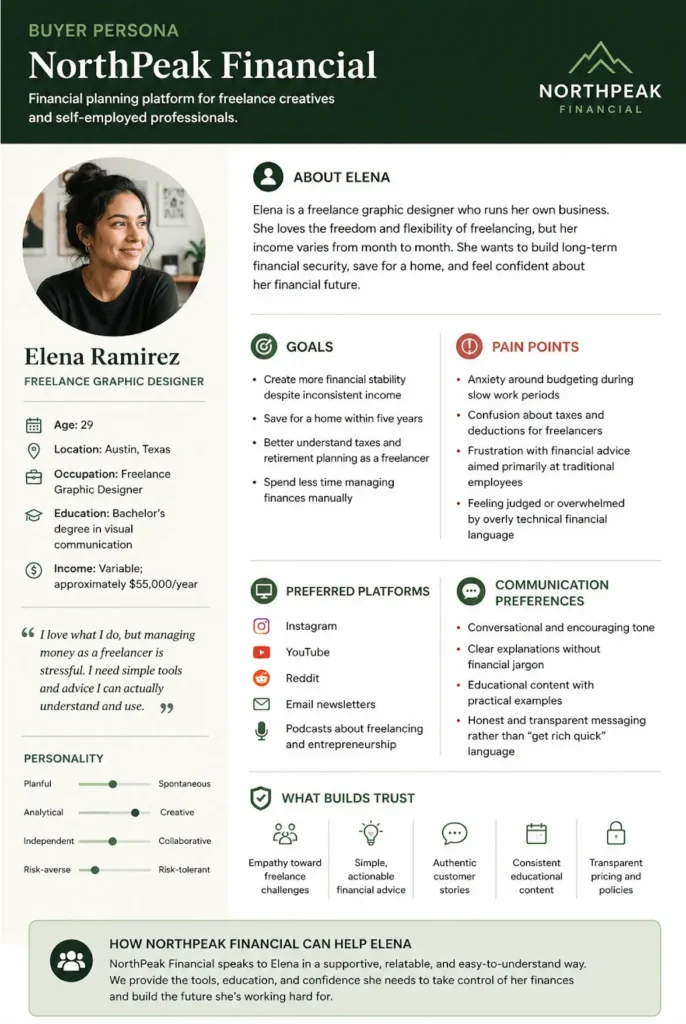
If you haven’t created buyer personas, consider doing it now. They can be useful tools in helping you develop your brand voice. A buyer persona is a fictional profile that stands in for your target customer. Answer questions like:
- What’s their age, gender, and occupation?
- How can you describe their personality?
- What are their goals and challenges?
- What problems are they trying to solve?
- Where do they spend time online?
- Are they digital natives?
- Do they prefer in-person or digital communication?
- What type of content do they engage with most?
- What tone or communication style are they most responsive to?
- What motivates them to trust or purchase from a brand?
Once you create your buyer personas, you can then start building a brand voice that helps you communicate with them.
They create the following buyer persona:
3. Research your competitors
Analyzing competitor messaging can help you identify common industry patterns and opportunities for differentiation. Review competitor websites, social media content, advertisements, emails, and customer communications to evaluate how they position themselves. Look for:
- Repeated tone and messaging trends
- Overused language or clichés
- Gaps in brand positioning
- Opportunities to sound more distinctive or authentic
The goal is not to imitate competitors but to identify how your brand can stand apart from them while still connecting with your target audience.
To stand out, the brand adopts a more science-based, transparent, and approachable voice focused on ingredient education and realistic skincare results rather than beauty or environmental trends.
4. Audit your current brand voice
Before creating new brand voice guidelines, evaluate how your brand already communicates across channels. Review website copy, blog posts, emails, advertisements, social media content, customer support interactions, and internal communications.
Ask questions such as:
- Is the tone consistent across channels?
- Does the messaging reflect the brand’s values and positioning?
- Are there conflicting styles or tones?
- Which content feels most effective or authentic?
This audit helps you understand how your brand is currently communicating and allows you to identify what you’re doing well, what you can improve, and any inconsistencies you need to address. It’s important to have a clear view of the current landscape in order to make intentional decisions about how your brand voice should change.
5. Decide who your brand isn’t
Another step in defining your brand voice is determining what it isn’t. Putting constraints and boundaries on your brand voice is a great way to help you find it more easily.
Identify personality traits or communication methods that your brand voice should avoid. To start, make a list of adjectives that you don’t want associated with your brand. Then, in response to that, think of what traits your brand should embody. For example:
- Our brand is confident but not arrogant.
- Our brand is professional but not stuffy.
- Our brand is friendly but not childish.
- Our brand is humorous but not sarcastic.
Use this exercise as a springboard for developing your brand voice. By defining boundaries for your brand voice, you’ve already established clearer guidance for how your brand should communicate.
6. Define and document your brand voice
You’ve made it to the brand voice ballpark, and now you have to narrow in on its final definition. Your goal is to turn your research into a clear, usable framework that brings your voice to life.
First, write a single statement that clearly defines your brand voice. This should summarize the key aspects and goal of your voice and explain how it affects your customers. If someone who’s never heard of your brand before reads this statement, they should be able to intuit how your brand would sound.
“NorthPeak Financial communicates in a clear, supportive, and grounded voice that simplifies complex financial topics for freelance creatives and self-employed professionals, helping them feel confident and in control of their financial lives.”
Next, flesh out your brand voice further by outlining its defining characteristics in greater depth. You need to define:
- Three to five traits that describe your brand
- A description of how each trait manifests in your copy and content
- Actionable advice (“dos and don’ts”) on how to apply each characteristic
These three components make up what branding experts call a “brand voice chart” or “brand voice template.” It looks something like the table below, which uses the fictional brand NorthPeak Financial as an example.
| Trait | Description | Do | Don’t |
|---|---|---|---|
| Clear | We explain financial concepts in simple, accessible language so freelance creatives can understand and apply information without prior financial expertise. | Break down topics into plain, step-by-step explanations. Use everyday vocabulary. | Use technical financial jargon or overly academic explanations. |
| Supportive | We encourage users to feel capable and in control of their finances, especially in the face of irregular income or uncertainty. | Use reassuring, inclusive language like “you can do this” and “here’s a simple way to start.” | Use judgmental or pressure-driven language. |
| Practical | We focus on real-world applications, giving users clear steps, tools, and frameworks they can use immediately. | Provide checklists, templates, and step-by-step instructions for financial tasks. | Be abstract or theoretical. |
| Calm | We maintain a steady, composed tone that reduces financial stress and avoids alarmist messaging. | Normalize irregular income. Frame financial planning as manageable over time. | Use fear-based messaging or imply urgency without context. |
| Transparent | We communicate openly about limitations, assumptions, and variability in financial advice. | Clearly state when outcomes depend on individual circumstances. | Overpromise results or share financial guidance as guaranteed. |
When you’ve defined your brand voice, it’s time to document it. Write your brand voice guidelines, and include guidance on:
- Formality: Is your voice conversational, semi-formal, or professional? What point of view should writers use? Which pronouns should they use? Can they use contractions?
- Sentence structure: Which types of sentences transmit your brand voice? Are sentence fragments okay? Should writers use active voice and avoid passive voice? Should sentences and paragraphs be short and direct or long and flowy?
- Vocabulary guidelines: Are there any words or phrases your writers should prioritize or avoid? Should they follow British or American English or something else?
- Tone variations: How does your brand voice shift slightly across different contexts, like blog posts, onboarding emails, and support messages? When is your writing educational, supportive, urgent, persuasive, etc.?
- Examples: Include “on-brand” vs. “off-brand” writing samples to remove ambiguity for writers. Your guidelines should be practical rather than abstract, and anyone reading it should be able to apply your brand voice in writing without second-guessing it.
Make your brand voice guide a living document, ideally as part of your brand guidelines. As your brand evolves, your audience grows, or your product changes, revisit and refine your guidelines. A strong brand voice is consistent, but it should not be static.
7. Track, review, and adapt
Your brand voice is defined, and while it may seem like the work is over, that’s far from the truth. A brand voice needs to be monitored and refined over time to stay effective and consistent.
Track how it performs across channels by reviewing website content, emails, social media, and customer interactions. Pay attention to audience response. Engagement, feedback, and support queries can show whether your messaging is clear, trusted, and effective.
Also check internal consistency. If multiple writers are involved, make sure the brand voice is being applied in the same way across teams. Finally, revisit your guidelines regularly. As your brand, audience, or product evolves, your voice may need small, intentional adjustments.
Frequently asked questions about brand voice
- What’s the difference between brand voice and tone?
-
Brand voice is your brand’s consistent personality and communication style across all channels. Tone is the emotional variation of that voice depending on the situation and audience.
For example, a brand voice may always be professional and supportive, but its tone might become more celebratory in a marketing campaign or more empathetic in a customer support message. In short, voice stays consistent while tone adapts to circumstances.
To experiment with tone, try Quillbot’s free Paraphraser
- What are brand voice guidelines?
-
Brand voice guidelines are a set of rules that define how your brand communicates verbally across all platforms. Brand voice guidelines outline things like brand personality, values, tone of voice, and messaging pillars.
They are similar but not the same as brand guidelines, which also define your brand’s visual identity. Brand guidelines should include a section on brand voice, though some brands prefer to also have additional, longer brand voice guidelines.
Need help developing your brand voice? Quillbot’s Paraphraser can help you experiment with tone.
Other interesting articles
If you want to know more about colors, letters, or the meaning of emojis, make sure to check out some of our other articles with explanations and examples.Cite this Quillbot article
We encourage the use of reliable sources in all types of writing. You can copy and paste the citation or click the "Cite this article" button to automatically add it to our free Citation Generator.
Santoro, K. (2026, July 13). Brand Voice | What It Is & How to Create Yours. Quillbot. Retrieved September 25, 2026, from https://quillbot.com/blog/branding/brand-voice/