Project Manager Resume Guide | What Recruiters Look For
When it comes to project manager roles, the competition is fierce, with recruiters scanning hundreds of resumes per opening. That’s why you need a project manager resume that quickly shows your impact in a reader-friendly format.
In today’s tough market, recruiters and hiring managers want PMs who can keep complex work on track, align cross-functional teams, and drive successful outcomes.
This guide shows you how to write a project management resume that gets recruiters’ attention and positions you as a top candidate. The resume examples at the end show how to tailor these strategies to specific project management roles.
With Quillbot’s Resume Templates, you can quickly build a polished, eye-catching resume that highlights your strongest qualifications.
Key takeaways
- A strong project manager resume template should be scannable and structured around key sections like a professional summary, skills, experience, and certifications, making it easy for recruiters to quickly assess your qualifications.
- What recruiters want in a project management resume is clear evidence of impact, leadership, and scope, including quantified results, strong action verbs, and experience managing budgets, teams, and complex initiatives.
- Using project manager resume keywords effectively means matching job posting language with relevant methodologies, tools, and certifications while incorporating natural variations to pass ATS screening and remain readable for humans.
- Real project manager resume examples show how tailoring your resume to specific environments (such as technology, software delivery, or operations) helps highlight the right skills, metrics, and achievements for each role.
Key elements of a project manager resume template
Recruiters skim resumes in seconds, so you need a scannable project manager resume template with these core sections.
- Contact information: Include your full name, phone number, professional email address, and LinkedIn profile link. Ensure your LinkedIn profile matches your resume’s timeline perfectly, as recruiters use it to verify your background. List your city and state for location-specific roles, but leave off your street address.
- Professional summary: Position yourself as a high-value leader right away by detailing the scale of projects you’ve led, your industry domain, and the financial or operational value you’ve delivered. Delete empty catchphrases like “organized leader” and focus on concrete capabilities.
- Skills: Because an Applicant Tracking System (ATS) is the initial gatekeeper, optimize this section for algorithms, but keep it reader-friendly for humans. Organize your technical tools and methodologies with bullet points or vertical bars. Avoid complex text boxes or graphics, which can trigger ATS parsing errors.
- Professional experience: Hiring managers already know what a project manager does on paper; they want to know what you delivered under constraints. For each past role, include concise bullet points about the scope, budget, methodology, and outcome of your projects. Always tie daily tasks to measurable business results.
- Education and certifications: In project management, specialized credentials drastically influence hiring decisions. List your highest level of education alongside globally recognized certifications like PMP (Project Management Professional), CAPM (Certified Associate in Project Management, or CSM (Certified ScrumMaster).
What recruiters want in a project management resume
Recruiters seek instant proof that you can handle high-stakes initiatives, control budgets, manage difficult stakeholders, and adapt to shifting scopes. The following resume benchmarks help you stand out as a top project management candidate.
For some quick tips on creating a resume that gets noticed, watch our video below.
Scannable, project-focused layout
Recruiters do not read resumes chronologically on the first pass; they look for scope, scale, and methodologies. Make their job easier by ensuring your layout features:
- Bold headings for your resume summary, skills, work history, education, and project management certifications
- Concise details in your resume summary about your years of experience, methodology expertise (e.g., Agile, Waterfall, Hybrid), and typical project budget
- A reverse-chronological work history that maps your career progression and includes a bold subheading for each past job followed by concise bullet points highlighting measurable accomplishments
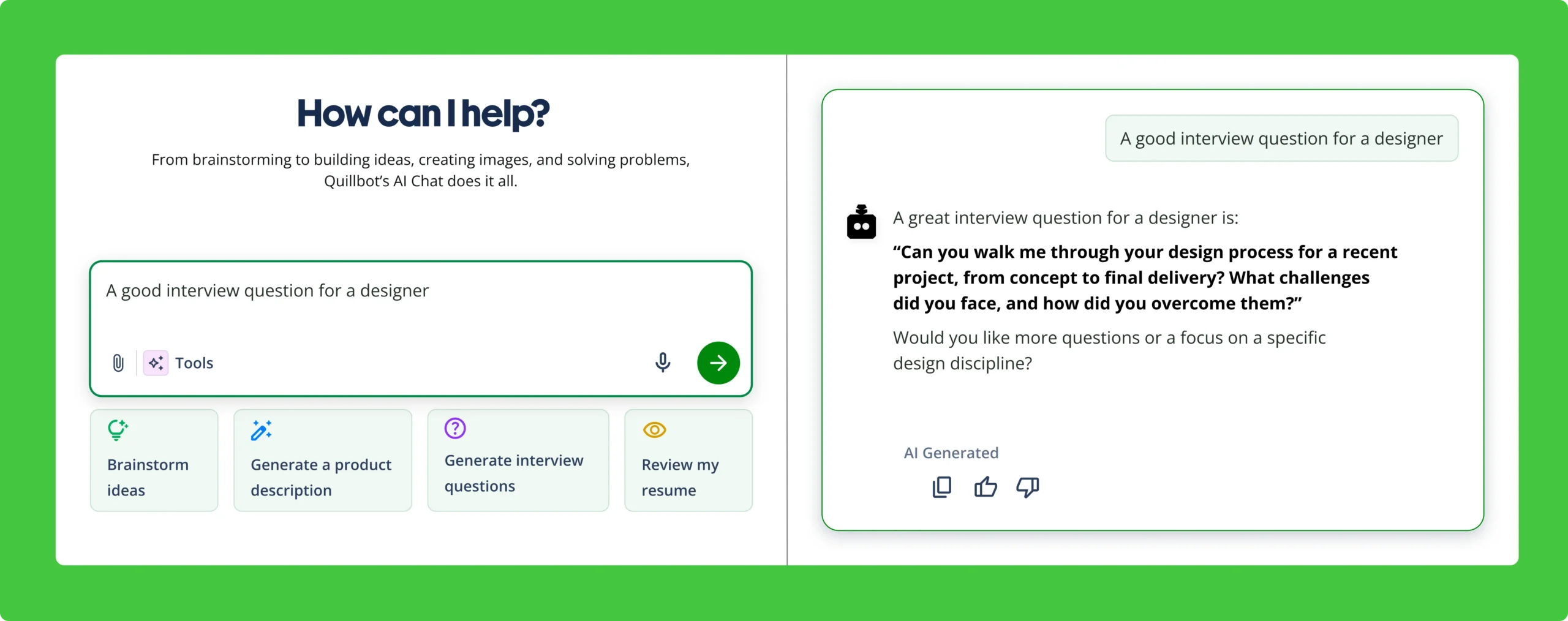
Quillbot’s AI Resume Maker can help you write impactful bullet points that are tailored to the project management role you’re applying for.
Proof of scope and impact
The biggest mistake project managers make is listing job duties instead of project delivery outcomes. Recruiters already know what a PM does. They want to know how much time, money, or resource capacity you saved. In your experience section:
- Quantify your workload: Always state the financial budget, team size, and timeline you managed (e.g., “Led a cross-functional team of 14 software engineers on a $1.2M cloud migration project”).
- Frame tasks as business outcomes: Show what improved, whether it was a reduction in project variance, an increase in on-time delivery rates, or a decrease in labor hours.
Leadership verbs
Recruiters look for project managers who actively drive progress rather than passively document it. Your word choices signal whether you are an autonomous leader who owns the lifecycle or simply a coordinator.
- Ditch passive phrasing: Eliminate phrases like “responsible for leading daily standups” or “assisted with risk management.”
- Lead with execution ownership: Start every bullet point with a dynamic action verb like “orchestrated,” “engineered,” “optimized,” “navigated,” “standardized,” “streamlined,” or “mitigated.”
Flawless communication
Project managers are the primary liaisons between technical teams, vendors, and C-suite executives. Your resume acts as your first communication sample.
- Ensure the tone is highly professional, direct, and completely free of vague clichés, like “strategic thinker” and “results-oriented.”
- Align your project descriptions to standard project management lifecycles: initiation, planning, execution, monitoring/controlling, and closing.
- Eliminate typos by running your resume through Quillbot’s Grammar Checker.
How to use project manager resume keywords
To make an ATS friendly resume that passes the initial screening, you need the right project management keywords. But using keywords too often (aka “keyword stuffing”) makes a resume less appealing to the human recruiter who evaluates it next.
To optimize your project manager resume for both ATS screening and human readers:
- Identify the keywords in the job posting.
- Decide which keywords accurately reflect your experience and certifications.
- Use relevant keywords naturally throughout your resume, including exact-match terms and semantic variations.
The chart below breaks down common project manager keywords, what they mean to recruiters, and how they typically appear in job descriptions. Use this chart to identify which keywords and synonyms are best for each version of your project manager resume.
| Core competency | ATS terms and synonyms | What it means |
|---|---|---|
| Agile methodologies | Agile delivery, Agile frameworks, Kanban, SAFe, sprint cycles, retrospectives, iterative development, PMI-ACP | You can manage adaptive project workflows and respond effectively to changing priorities. |
| Scrum leadership | Scrum ceremonies, sprint planning, backlog refinement, velocity tracking, burndown charts, Scrum Master collaboration, Certified ScrumMaster (CSM) | You can facilitate team execution, remove blockers, and maintain sprint momentum. |
| Financial and budget control | Capital expenditure (CapEx), operational expenditure (OpEx), cost-benefit analysis, Earned Value Management (EVM), forecasting, variance tracking, resource allocation | You protect corporate capital by monitoring project burn rates, forecasting accurately, and preventing cost overruns. |
| Risk and scope management | Scope creep mitigation, risk register, contingency planning, change control management, critical path analysis, dependency management | You proactively identify dependencies, solve project bottlenecks before they scale, and enforce strict change protocols. |
| Stakeholder management | Cross-functional alignment, vendor relations, matrix environmental leadership, C-suite reporting, change management, conflict resolution | You balance conflicting priorities, manage vendor performance, and maintain clear alignment across diverse business units. |
| Project lifecycles and tools | Jira, Asana, MS Project, Smartsheet, Monday.com, Confluence, Waterfall, Hybrid methodology, governance framework | You leverage modern project infrastructure to maintain data integrity, build transparent dashboards, and track critical paths. |
- PMP (Project Management Professional)
- CAPM (Certified Associate in Project Management)
- CSM (Certified ScrumMaster)
- PMI-ACP (Agile Certified Practitioner)
- Lean Six Sigma (Green Belt, Black Belt)
Project manager resume examples
Review these specialized resume templates to see how resume format, project management keywords, and performance metrics look across different project environments and industries.
Project manager resume example: Technology and software delivery
This example demonstrates how an IT project manager can highlight software delivery lifecycles, Agile transformations, cloud infrastructure projects, and sprint velocity metrics. MARA ZHU Project Manager | Technology & Software Delivery (555) 019-2834 | mzhu@example.com | linkedin.com/in/mara-zhu | Seattle, WA PROFESSIONAL SUMMARY Agile Project Manager with over 6 years of experience engineering software delivery frameworks and managing cloud infrastructure initiatives. Proven history of optimizing cross-functional engineering workflows, accelerating sprint velocity by 22%, and delivering high-stakes enterprise applications within scope and budget. SKILLS Agile & Scrum | Hybrid Methodologies | Jira & Concur | CI/CD Pipelines | AWS Cloud Infrastructure | Resource Capacity Planning | Scope Creep Mitigation | Vendor Management EXPERIENCE Project Manager | Nexus Software Solutions | Seattle, WA | 2024–Present Associate Project Manager | Vanguard Digital Corp | Tacoma, WA | 2021–2024 EDUCATION & CERTIFICATIONS
Project manager resume example: Operations and enterprise strategy
This layout shows how an enterprise operations PM can emphasize process standardization, capital expenditure (CapEx) tracking, vendor management, and large-scale change management frameworks.
SARAH J. LIN
Project Manager | Operations & Enterprise Strategy
(555) 014-7789 | sarah.lin@example.com | linkedin.com/in/sarah-j-lin | Chicago, IL
PROFESSIONAL SUMMARY
Strategic Project Manager specializing in enterprise operations transformation, supply chain optimization, and global process standardization. Expert in cross-functional matrix leadership, managing annual capital expenditures up to $3M, and driving operational waste reductions across multi-site organizations.
SKILLS
Waterfall Frameworks | Change Management | MS Project & Smartsheet | CapEx/OpEx Forecasting | Process Mapping (Six Sigma) | Procurement | Risk Mitigation
EXPERIENCE
Enterprise Operations Project Manager | Apex Logistics | Chicago, IL | 2023–Present
- Standardized operational fulfillment workflows across 4 Midwestern distribution centers, yielding a 14% reduction in fulfillment cycles within the first 180 days
- Supervised an annual CapEx budget portfolio of $3M, consistently maintaining project variances under 2.5% through precise financial forecasting and Earned Value Management (EVM)
- Navigated a complex change management strategy for an ERP system transition affecting 450+ internal stakeholders, preserving 100% supply chain continuity during go-live
- Established a centralized corporate risk register that reduced project delivery bottlenecks by 18% through proactive dependency mapping
Operations Project Coordinator | Meridian Manufacturing | Aurora, IL | 2020–2023
- Coordinated procurement logistics and critical path timelines for a $1.2M plant expansion project, ensuring compliance with strict regulatory and safety timelines
- Utilized Smartsheet to design collaborative workspace tracking modules, improving communication transparency across engineering, legal, and finance divisions
- Negotiated contracts with 14 major raw materials vendors, reducing procurement lead times by 11% and ensuring reliable supply chain logistics
EDUCATION & CERTIFICATIONS
- Lean Six Sigma Green Belt | IASSC
- Certified Associate in Project Management (CAPM) | Project Management Institute
- Bachelor of Business Administration in Operations Management | Loyola University Chicago
Frequently asked questions about project manager resumes
- What does an entry level project manager resume need?
-
An entry-level project manager resume should emphasize transferable skills, foundational project knowledge, and any hands-on experience supporting coordination or delivery activities rather than extensive leadership history. Include these core elements:
- Resume summary: Highlight your education, interest in project management, familiarity with methodologies like Agile or Waterfall, and readiness to support project teams.
- Skills: Place relevant competencies like task coordination, communication, organization, problem-solving, and familiarity with tools such as Excel, Jira, Trello, or Asana near the top.
- Related experience: Highlight internships, academic projects, volunteer work, or roles in customer service, retail, or administration that involved scheduling, teamwork, documentation, or process support.
- Education and certifications: Include your degree and any entry-level certifications such as CAPM, Agile fundamentals, or Scrum training to demonstrate baseline PM knowledge and commitment to the field.
Your project manager resume also needs to be error free. Quillbot’s free Grammar Checker is a fast and free way to eliminate errors.
- What should I include in a project manager resume summary?
-
A project manager resume summary should be a concise, 3–4 sentence hook that immediately positions you as a results-driven leader of projects, not just a task coordinator. To capture a recruiter’s attention in seconds, include these three elements:
- Your title and professional identity: Start with a clear descriptor that reflects your experience and methodology (e.g., “Agile Project Manager with 5+ years of experience leading cross-functional software delivery teams…”).
- Quantifiable achievements: Include 1–2 measurable results that demonstrate your impact, such as budget size managed, delivery speed improvements, cost savings, or on-time delivery rates (e.g., “delivered enterprise projects 15% under budget and 3 weeks ahead of schedule”).
- Core methodologies and tools: Explicitly mention your strongest frameworks and platforms, such as Agile, Scrum, Waterfall, Jira, MS Project, or stakeholder management expertise.
Quillbot’s AI Chat is a fast and free resource for project manager resume feedback and optimization.
- Can I use AI to write a resume summary?
-
You can use generative AI to draft a resume summary, but you should always rewrite AI-generated text to reflect your own writing voice and to ensure that your resume summary accurately describes your experience.
Some employers use AI detectors, and you don’t want a resume summary that’s too similar to other applicants. The purpose of a resume is to show your unique value.
When you do use AI for help with a resume summary, write the AI prompt with the job description and the rest of your resume {in curly brackets}.
Quillbot’s free Paraphraser can help you revise a resume summary and improve word choices from AI outputs.
- Should a resume be one page?
-
A resume can be one page when you’re in the beginning or early stages of your career. A resume can also be up to two pages when you have a lot of experience (e.g., 5 or more years) or when the role requires a wide range of projects, achievements, and/or skills.
When deciding how long your resume should be, consider who will be reviewing your application. For example, if you’re applying for a role at a small business where one person is reviewing hundreds of the applications, consider a one-page format.
Quillbot’s free Resume Templates can help you achieve a concise resume length.
Other interesting articles
If you want to know more about colors, letters, or the meaning of emojis, make sure to check out some of our other articles with explanations and examples.