Marketing Fundamentals | Core Concepts & Definitions
Marketing fundamentals are the core principles businesses use to identify target audiences, develop products and services that meet customer needs, and communicate value effectively. They form the foundation of how organizations attract, convert, and retain customers, making them essential knowledge for marketers and anyone working alongside marketing teams.
This guide shares the fundamentals of marketing to help you get a clear understanding of how marketing works, what it involves, and the strategies it entails. Learn about the 7 Ps of marketing, different types of marketing, and how to set up your own marketing strategy.
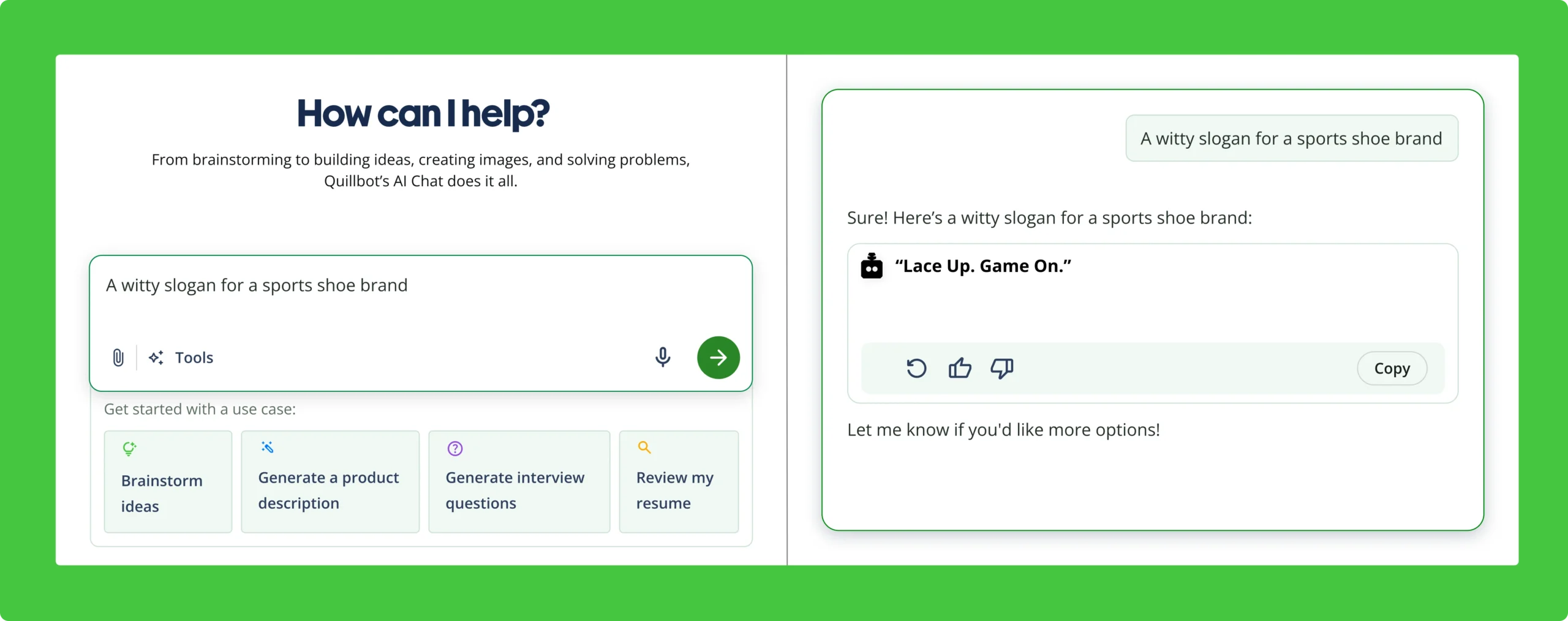
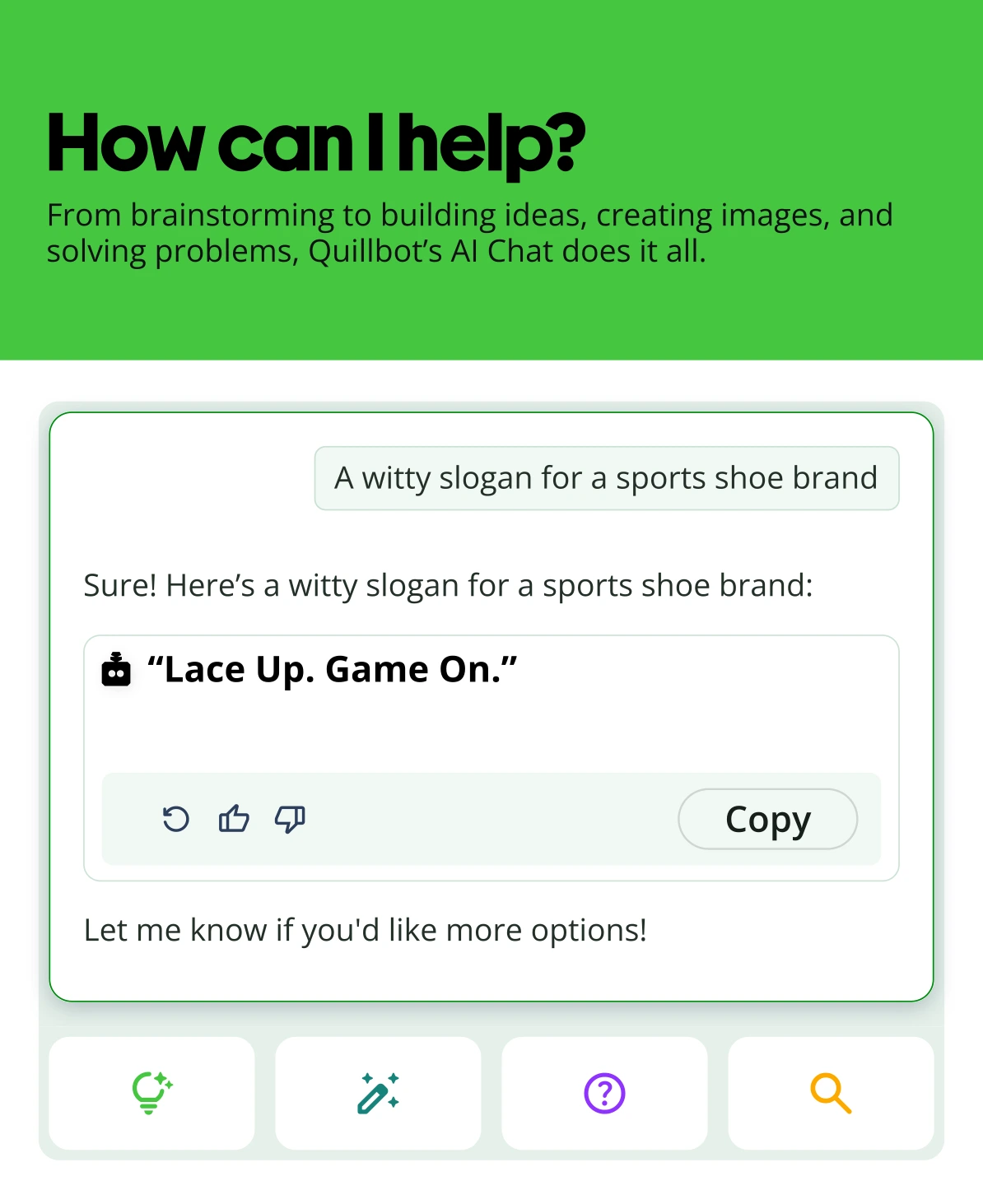
Quillbot’s AI Chat can help you brainstorm ideas for your own marketing, from content marketing topics to email marketing subject lines to the key performance indicators (KPIs) you should be tracking to measure your success.
Key takeaways
- Marketing fundamentals explain how businesses attract, convert, and retain customers by understanding audience needs, creating clear value, positioning offerings effectively, maintaining consistent branding, and choosing the right channels to reach users.
- Core strategy is built on proven frameworks like the marketing mix (4 Ps and expanded 7 Ps), which help structure decisions around product, price, place, promotion, and service experience factors such as people and process.
- There are many types of marketing (like content, email, and pay-per-click) that target different goals and support different strategies. Understanding how these compare and contrast is one of the fundamentals of marketing.
- Modern marketing is data-driven and iterative, using funnels, analytics, and performance metrics to test, measure ROI, and continuously improve campaigns while strengthening long-term customer relationships and loyalty.
What is marketing?
Marketing is the process of attracting, acquiring, converting, and retaining customers. As one of the primary components of commerce and business, marketing involves identifying customer needs, building relationships based on those needs, and generating value for both customers and the organization.
While marketing often aims to increase revenue and profitability, it can also strengthen brand awareness, build customer loyalty, and establish long-term brand equity. Different marketing approaches serve different goals. For example, direct-response marketing focuses on encouraging immediate action, while content marketing emphasizes education, trust-building, and long-term audience engagement.
Marketing can target individual consumers (B2C, or business-to-consumer) or other businesses (B2B, or business-to-business). It can be managed by an in-house team or outsourced to agencies and consultants. Regardless, successful marketing depends on understanding customers, market conditions, and competitive positioning.
Marketing fundamentals
Marketing fundamentals include core principles, common marketing frameworks, different types of marketing, and key terminology used in the industry.
Core fundamentals of marketing
While marketing strategies vary across industries and business models, most successful marketing efforts are built on a few core principles. The most important fundamentals of marketing are:
- Understanding the target audience: Successful marketing hinges on you identifying who your customers are, what they need, and what influences their purchasing decisions. This often involves market research, customer personas, and audience segmentation.
- Communicating value: Marketing is not just about selling products. It’s about identifying what your customers need, shaping your offers around those needs, and clearly communicating how your product or service solves a problem or delivers meaningful benefits.
- Building strong positioning: Positioning defines how a brand wants to be perceived in the market. Strong positioning aligns with your brand purpose and helps you differentiate yourself from competitors and communicate a unique value proposition.
- Maintaining consistent branding: Branding includes a company’s brand messaging, visual identity, brand voice, and reputation. Consistent branding helps customers recognize and trust a business over time.
- Choosing the right marketing channels: Strong marketing requires you to determine where and how to reach your audience, whether through social media, email, search engines, paid advertising, events, or traditional media.
- Measuring performance: Marketing relies heavily on data and analytics. You should track metrics like website traffic, conversions, engagement, customer acquisition costs, and return on investment (ROI) to evaluate success and improve campaigns.
Marketing and branding overlap, and in some organizations, they may be handled by the same team. At others, there may be different departments for marketing and brand management, and others may outsource some or all of this work.
Marketing frameworks
A marketing framework is a model or plan that guides marketing strategy. In other words, frameworks are structured approaches businesses use to analyze markets, understand customers, and make decisions. Understanding these frameworks—and how they differ—is an important part of learning marketing fundamentals.
The marketing funnel
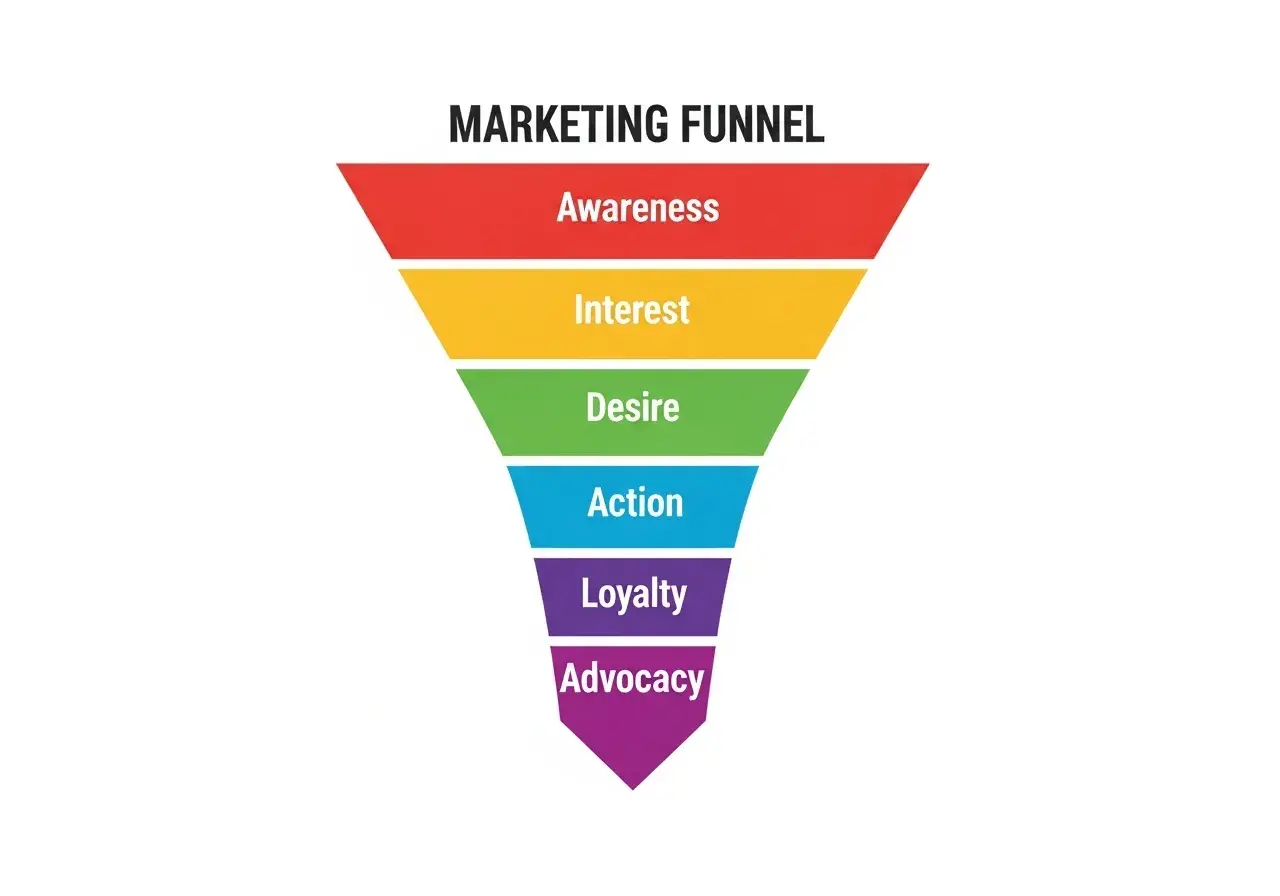
The marketing funnel is a model that describes the stages a potential customer goes through from first becoming aware of a product or brand to completing a purchase (and often beyond). It is called a “funnel” because the number of people decreases at each stage as some drop off before converting.
The classic funnel includes:
- Awareness: The customer first discovers your brand or product.
- Interest: They begin exploring and engaging with your offering.
- Consideration: They compare options and evaluate if yours meets their needs.
- Conversion (Action): They make a purchase or complete a desired action.
Many modern models also extend the funnel to include post-purchase stages such as loyalty and advocacy, where satisfied customers return and recommend the brand to others.
- Desire: The customer develops an emotional or practical preference for your product or brand.
- Loyalty: After purchase, the customer returns and continues buying or engaging with your brand.
- Advocacy: Satisfied customers recommend your product or brand to others, helping generate word-of-mouth growth.
The 4 Ps of marketing
The 4 Ps of marketing (also known as “the Marketing Mix”) are a classic framework used to develop marketing strategies. The model helps businesses consider the key factors involved in successfully marketing a product or service. The 4 Ps are Product, Price, Place, and Promotion.
| P | Definition | Key questions |
|---|---|---|
| Product | Good or service a business offers to customers | What problem does it solve? What features or benefits does it offer? Who is it for? |
| Price | What customers pay for a product or service | How much are customers willing to pay? How does pricing compare to competitors? Will discounts or subscriptions be offered? |
| Place | Channels used to distribute and sell the product | Where do customers shop? Will the product be sold online, in stores, or both? How will delivery work? |
| Promotion | Methods used to raise awareness of and advertise the product | How will customers learn about the product? Which marketing channels will be used? |
The 4 Ps framework remains one of the most widely used models in marketing because it provides a simple structure for planning and evaluating marketing strategies.
- Product: The app provides personalized workout plans, guided video sessions, progress tracking, and nutrition advice. It also includes features like AI coaching and community challenges to improve engagement.
- Price: It uses a freemium model, offering basic workouts for free and charging a monthly or annual subscription for premium features such as personalized plans and advanced analytics. When subscribing annually, customers get a discount.
- Place: The product is distributed digitally through app stores and accessed globally via smartphones, tablets, and web platforms.
- Promotion: The app is promoted through social media advertising, influencer partnerships with fitness creators, search ads targeting workout-related keywords, and referral incentives for existing users.
The 7 Ps of marketing
The 7 Ps of marketing expand on the original Marketing Mix by adding three additional elements: People, Process, and Physical Evidence. This extended framework is especially important for service-based businesses and those that depend heavily on customer experience. The table below outlines the 7 Ps and an example of how a brand may use the framework.
| P | Definition | Example (fictional coffee shop) |
|---|---|---|
| Product | Good or service offered to customers | A coffee shop offers specialty coffee drinks, pastries, sandwiches, and seasonal beverages made with locally sourced ingredients |
| Price | What customers pay for the product or service | The shop sets premium prices to reflect high-quality ingredients and artisanal preparation while offering loyalty discounts to regular customers |
| Place | Channels used to distribute and sell the product | Customers can order in-store, through a mobile app, or via food delivery platforms |
| Promotion | Strategies used to advertise and communicate value | The business promotes new drinks on Instagram, sends email coupons, and partners with local influencers |
| People | Employees and representatives involved in customer interactions | Friendly baristas provide personalized service and help create a welcoming atmosphere |
| Process | Systems and procedures used to deliver the product or service | Mobile ordering, efficient payment systems, and quick drink preparation improve the customer experience |
| Physical evidence | Tangible elements customers associate with the brand | Branded cups, cozy interior design, curated music, clean seating areas, and a modern, functional website reinforce the shop’s identity and quality |
Other marketing frameworks
While the funnel and 4–7 Ps are some of the most widely known marketing frameworks, they’re not the only ones. Marketers also use other models, with different frameworks serving different purposes. Other marketing frameworks include:
- STP marketing (Segmentation, Targeting, Positioning): A framework for dividing a market into groups, selecting the most relevant audience, and positioning a product to appeal specifically to that group. This helps you market your products or services directly to manageable subsets of your target market.
- SWOT analysis: A strategic tool that evaluates internal strengths and weaknesses alongside external opportunities and threats to guide decision-making. A SWOT analysis allows you to get a snapshot view of your company’s capabilities and the broader market conditions so you can build a competitive strategy.
- AIDA model: A customer journey framework that maps how marketing captures attention, builds interest, creates desire, and leads to action. This helps you create a tailored marketing funnel for your customers.
- Porter’s Five Forces: A competitive analysis model that evaluates industry pressure through rivalry, supplier power, buyer power, substitutes, and new entrants. This model helps you assess the attractiveness and profitability of a market.
- SMART goals: A goal-setting framework that ensures objectives are specific, measurable, achievable, relevant, and time-bound. SMART goals can help you plan marketing objectives and develop the strategies you’ll use to reach them.
- AARRR (“Pirate metrics”): A startup-focused growth framework that tracks the customer lifecycle across five stages—Acquisition, Activation, Retention, Revenue, and Referral. It helps businesses identify where users drop off and optimize each stage to improve overall growth and profitability.
There are many other marketing frameworks out there, but these are good starting points if you’re just learning the marketing fundamentals.
Types of marketing
Another marketing fundamental is understanding the different types of marketing. Each type has its own goal and is designed to reach customers in different ways, depending on the product, audience, and stage of the customer journey. Most businesses use a combination of several marketing types rather than relying on just one.
The table below outlines the most common channels, techniques, and strategies, as well as the main goal they work towards achieving.
| Marketing type | Description | Main goal |
|---|---|---|
| Digital marketing | Marketing through online channels such as websites, search engines, social media, email, and apps | Reach and engage audiences online where they spend most of their time |
| Content marketing | Creating and sharing valuable content like blogs, videos, and guides | Build trust, educate audiences, and attract potential customers |
| Social media marketing | Using platforms like Instagram, LinkedIn, TikTok, and Facebook to promote brands | Increase engagement, awareness, and traffic through social interaction |
| Search engine optimization (SEO) | Improving website visibility in search engine results | Drive organic (non-paid) traffic from search engines |
| Pay-per-click (PPC) advertising | Paid ads where businesses pay per click | Generate fast traffic, leads, or sales |
| Email marketing | Sending targeted emails to prospects and customers | Nurture relationships, improve retention, and drive repeat sales |
| Influencer marketing | Collaborating with creators or public figures to promote products | Reach new audiences through trusted third-party voices |
| Affiliate marketing | Performance-based marketing where partners earn commissions | Expand reach and sales through external promoters |
| Traditional marketing | Offline channels like TV, radio, print, and billboards | Reach broad audiences at regional or national scale |
| Relationship marketing | Long-term strategy focused on customer retention and loyalty | Increase customer lifetime value and repeat business |
| Event marketing | Promoting or hosting in-person or virtual events such as conferences, workshops, or product launches | Build brand awareness, generate leads, and create direct audience engagement |
| Direct response marketing | Marketing designed to prompt an immediate action such as clicking, signing up, or buying | Drive quick, measurable responses and conversions |
Sometimes, the different types of marketing overlap. For example, you may have a direct response marketing initiative that prompts website visitors to sign up to your newsletter and receive a 10% discount. Upon completing this action, the user is then funneled into your email marketing flows.
As another example, social media marketing and influencer marketing often converge. You may pay an influencer to create content promoting your brand and then upload that content to your brand’s own profiles as a form of social proof.
Key marketing terminology
Marketing fundamentals can be tricky to learn when you’re getting a lot of new terminology thrown at you. On top of that, marketing loves acronyms: KPI, SWOT, TOFU, MOFU, BOFU, B2B, CAC… and there are more.
This glossary of key marketing terminology can help you better understand the fundamentals of marketing and converse confidently about the subject:
- A/B testing: A method of comparing two versions of a marketing asset (e.g., an ad, email, or landing page) to determine which performs better based on a specific metric
- Awareness: The stage where a potential customer first becomes familiar with a brand or product
- B2B (business-to-business): Marketing or sales between businesses rather than directly to consumers
- B2C (business-to-consumer): Marketing or sales from businesses directly to individual consumers
- Brand assets: Branding components (e.g., logo, colors, and typography) that are often used in marketing materials
- Brand equity: The value a business derives from the brand itself, based on factors such as customer perception, recognition, and loyalty
- Brand positioning: How a brand sets itself apart in the market relative to competitors
- Buyer persona: A semi-fictional representation of an ideal customer based on research and data
- CAC (customer acquisition cost): The total cost of acquiring a new customer, including marketing and sales expenses
- Churn rate: The percentage of customers or subscribers you lose during a certain period (often used by SaaS and telecom companies)
- CLV (customer lifetime value): The total revenue a business expects to earn from a customer over the entire relationship
- Competitor analysis: The process of evaluating direct and indirect competitors to understand their strengths, weaknesses, strategies, and market positioning
- Content calendar: A planning tool that organizes when and where marketing content will be published across different channels
- Content pillars: Core themes or topics that a brand consistently creates content around to support its marketing strategy
- Conversion: A desired action taken by a customer (e.g., a sale, sign-up, or install)
- Conversion rate: The percentage of people who complete a desired action, such as making a purchase or signing up
- CTR (click-through rate): The percentage of people who click on a link or ad after seeing it
- Customer journey: The full experience a customer has with a brand from awareness to post-purchase
- Display advertising: A form of advertising that uses visual ads such as banners, images, or videos placed on websites, apps, social platforms, or in printed publications to promote products or services
- Earned media: Publicity gained organically rather than through paid promotion, such as media coverage, word-of-mouth, reviews, or social media shares
- Engagement: Any interaction a user has with a brand, such as likes, comments, shares, or clicks
- Funnel (marketing funnel): A model that represents the stages a customer goes through before and after purchase
- Geofencing: A location-based marketing technique that uses GPS or RFID technology to trigger ads or notifications when a user enters a defined geographic area
- Growth marketing: A data-driven approach to marketing focused on rapid experimentation across the entire customer journey to improve acquisition, activation, retention, and revenue
- Impressions: The number of times content or an ad is displayed to users
- Inbound marketing: A strategy focused on attracting customers through helpful content rather than direct advertising
- KPI (key performance indicator): A measurable value used to evaluate the success of a marketing activity (e.g., clicks, web traffic, and time on page)
- Lead: A potential customer who has shown interest in a product or service
- Lead generation: The process of attracting and converting prospects into leads
- Market research: The process of collecting and analyzing information about customers, competitors, and market trends to support business decision-making
- Market segmentation: Dividing a broad audience into smaller groups based on shared characteristics
- MarTech (marketing technology): The tools, software, and platforms used to plan, execute, and measure marketing activities, such as analytics tools and automation platforms
- MoM (month-over-month): A metric comparing performance from one month to the next
- Organic traffic: Website visitors who arrive through unpaid search results
- Owned media: Marketing channels that a brand fully controls (e.g., its website, blog, email list, or social media profiles)
- Paid media: Any marketing that involves paying to promote content or reach an audience (e.g., PPC ads, display ads, or sponsored posts)
- PPC (pay-per-click): A form of advertising where advertisers pay each time a user clicks on an ad
- ROI (return on investment): A measure of profitability calculated by comparing profit to cost
- Retention: The ability of a business to keep customers over time
- SaaS (software-as-a-service): Digital-first companies whose main product is a software application accessed via the internet/cloud
- TOFU, MOFU, BOFU (top/middle/bottom of funnel): Top, middle, and bottom stages of the marketing funnel. TOFU is the awareness stage, when you should capture attention. MOFU is the consideration stage, when you should demonstrate value and earn trust. BOFU is the decision stage when you should drive the final conversion.
- Traffic: The number of visitors to a website or digital platform
- UGC (user-generated content): Content created by customers or users rather than the brand itself
- USP (unique selling proposition): The specific benefit that differentiates a product or brand from competitors
- Viral marketing: Marketing that spreads rapidly through word-of-mouth or sharing, often via social media
Frequently asked questions about marketing fundamentals
- What are some digital marketing fundamentals?
-
Digital marketing fundamentals include knowing your target audience, creating valuable online content, choosing the right digital channels, and measuring and analyzing results.
Some fundamental strategies for digital marketing are content marketing, social media marketing, email marketing, search engine optimization, and paid ads.
To learn more about digital marketing fundamentals, ask Quillbot’s AI Chat.
- What are some content marketing fundamentals?
-
Content marketing fundamentals focus on knowing your target audience and creating content that addresses their needs, questions, and pain points.
In content marketing, it’s important to keep the customer journey at heart. You should know how a buyer moves through the stages of the marketing funnel—awareness, consideration, decision, and conversion—and how your content supports each step of that journey.
For greater depth on content marketing fundamentals, ask Quillbot’s AI Chat.
- What is B2C marketing?
-
B2C marketing means “business-to-customer” marketing. It’s when a business markets its products or services to an individual customer, not another business. This concept is one of the fundamentals of marketing.
B2C marketing relies heavily on certain types of content marketing, particularly website content, social media, video, influencer collaborations, and UGC.
Through this content, B2C marketers strive to build awareness, engagement, emotional connection, and trust with customers.
Quillbot’s AI Chat can help you learn more about B2C marketing.
- What is B2B (business-to-business) content marketing?
-
B2B content marketing involves creating helpful content aimed at other businesses because the products or services are designed for business use. The goal is to build trust and demonstrate expertise, helping businesses make informed decisions. B2B is one of the marketing fundamentals when considering the target audience.
B2B content marketing relies on different types of content marketing, like blog posts and emails. For example, a software provider might share guides on improving office productivity or case studies showing how their tools helped other companies succeed.
Try Quillbot’s blog post generator to create detailed B2B content that educates and persuades business customers effectively.
- What are some hard skills for marketing?
-
Examples of hard skills for a resume if you’re applying for a marketing job include:
- Campaign performance analysis (e.g., using Google Analytics)
- Social media account management (e.g., using SocialHub)
- Keyword research (e.g., using Google Keyword Planner)
- Skills evidenced by certifications (e.g., AMA Professional Certified Marketer)
- Survey and feedback tools (e.g., SurveyMonkey)
- Marketing fundamentals (e.g., target audience analysis, competitor research, and marketing frameworks)
Have you tried Quillbot’s free Paraphraser to help write the descriptions of the hard skills on your marketing resume?