Published on
March 27, 2025
by
Kate Santoro, BS.
Revised on
July 18, 2026
A chatbot is a computer program designed to simulate human conversation. Chatbots serve a variety of functions in society, allowing humans to interact with digital devices as if they were people. Many—but not all—are powered by artificial intelligence.
Quillbot’s AI Chat is a chatbot that can generate content, synthesize information, and help break down complex topics.
What is a chatbot exampleYou are communicating with a chatbot if you:
Use ChatGPT to get information or generate content
Ask Siri or Alexa to tell you the weather or search for something online
Call a customer service number and tell an automated system why you’re calling so that it can direct you to the correct department
Published on
January 23, 2025
by
Kate Santoro, BS.
Revised on
April 30, 2026
Artificial intelligence (AI) is any computer program designed to mimic human intelligence, which enables them to learn, problem-solve, and understand language.
There are diverse types of AI applied across various industries. Delivery drones, medical detection scanners, Quillbot’s AI Chat, and the virtual assistant on your smartphone are all AIs.
Published on
December 19, 2024
by
Quillbot.
Revised on
November 28, 2025
In a recent IBM video about AI ethics, Phaedra Boinodiris, a global leader in ethical AI and author of AI for the Rest of Us, said that three AI-related ethical issues keep her up at night:
Climate change
A lack of awareness that AI-based “decisions” impact people’s real lives
The misconception that AI is logically, morally, and ethically infallible
Generative AI has only been around for a few years, and it’s profoundly changed professional workflows, student writing, hiring practices, and eligibility for anything from mortgages to college admissions. The technology can also lead to adverse effects, such as culture and gender biases, privacy violations, and misinformation.
Using generative AI responsibly involves understanding the risks and AI ethics.
Since ChatGPT was released in 2022, generative AI has become ubiquitous. It’s an integral part of the Google search experience, and it’s embedded in most of the tools that students and professionals use every day.
Now that generative AI is literally everywhere, understanding how it works is a crucial part of digital literacy, critical thinking, and academic integrity.
Generative AI is an artificial intelligence technology that generates original media, such as text, images, or videos. To generate this media, generative AI tools (e.g., Quillbot’s AI Chat, ChatGPT, Gemini, or Davinci AI) need prompts from human users. For example, you can prompt generative AI tools to draft a cover letter, or you can ask AI questions.
TipThe results you get from generative AI depend heavily on the prompt you give it. Not sure how to write an effective one? Use Quillbot’s Prompt Generator to create an effective prompt for AI.
Published on
November 28, 2024
by
Kate Santoro, BS.
Revised on
July 14, 2026
Detecting AI writing involves a combination of automated tools and manual analysis of linguistic patterns. Some strategies that can help detect AI writing, including:
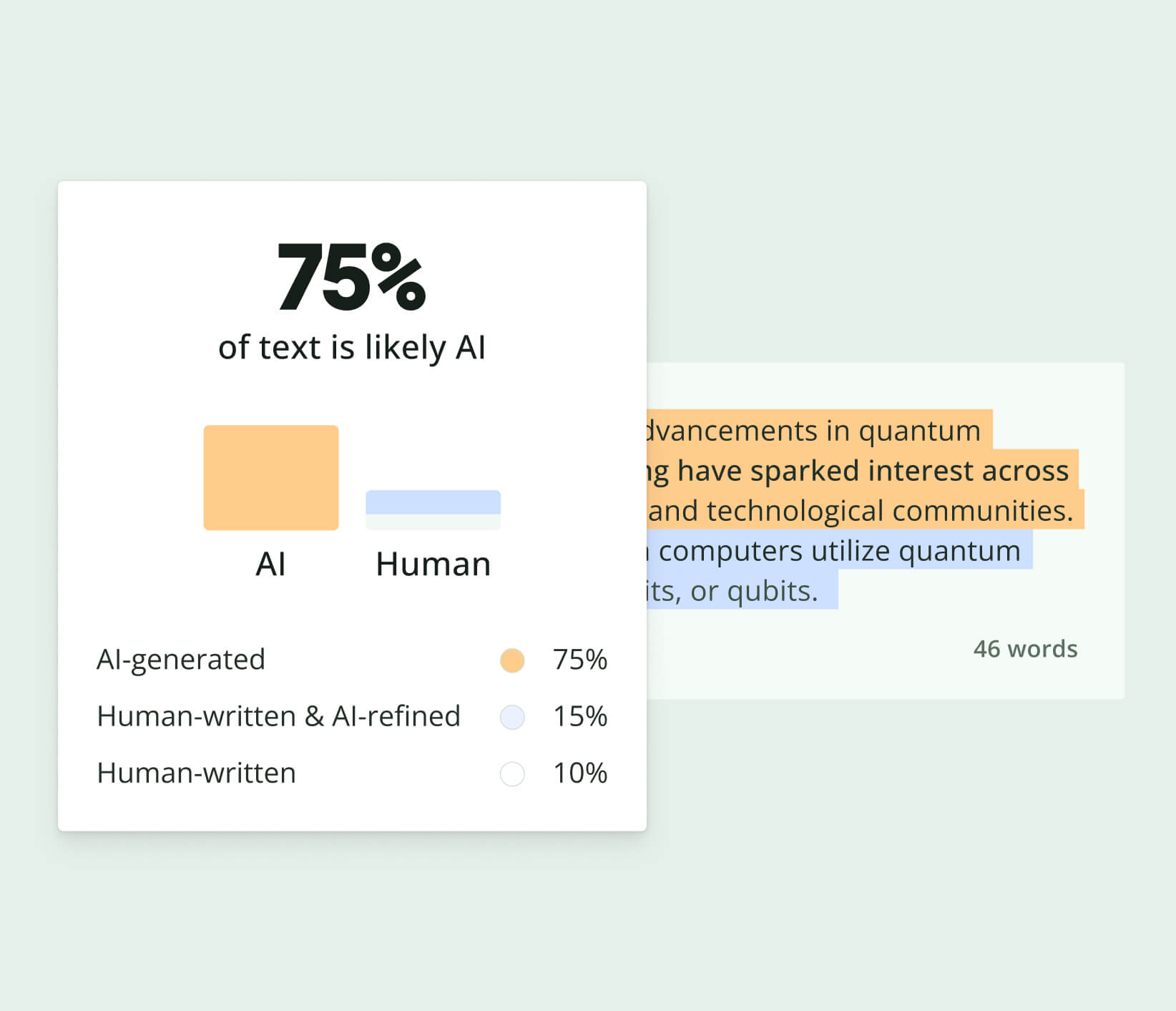
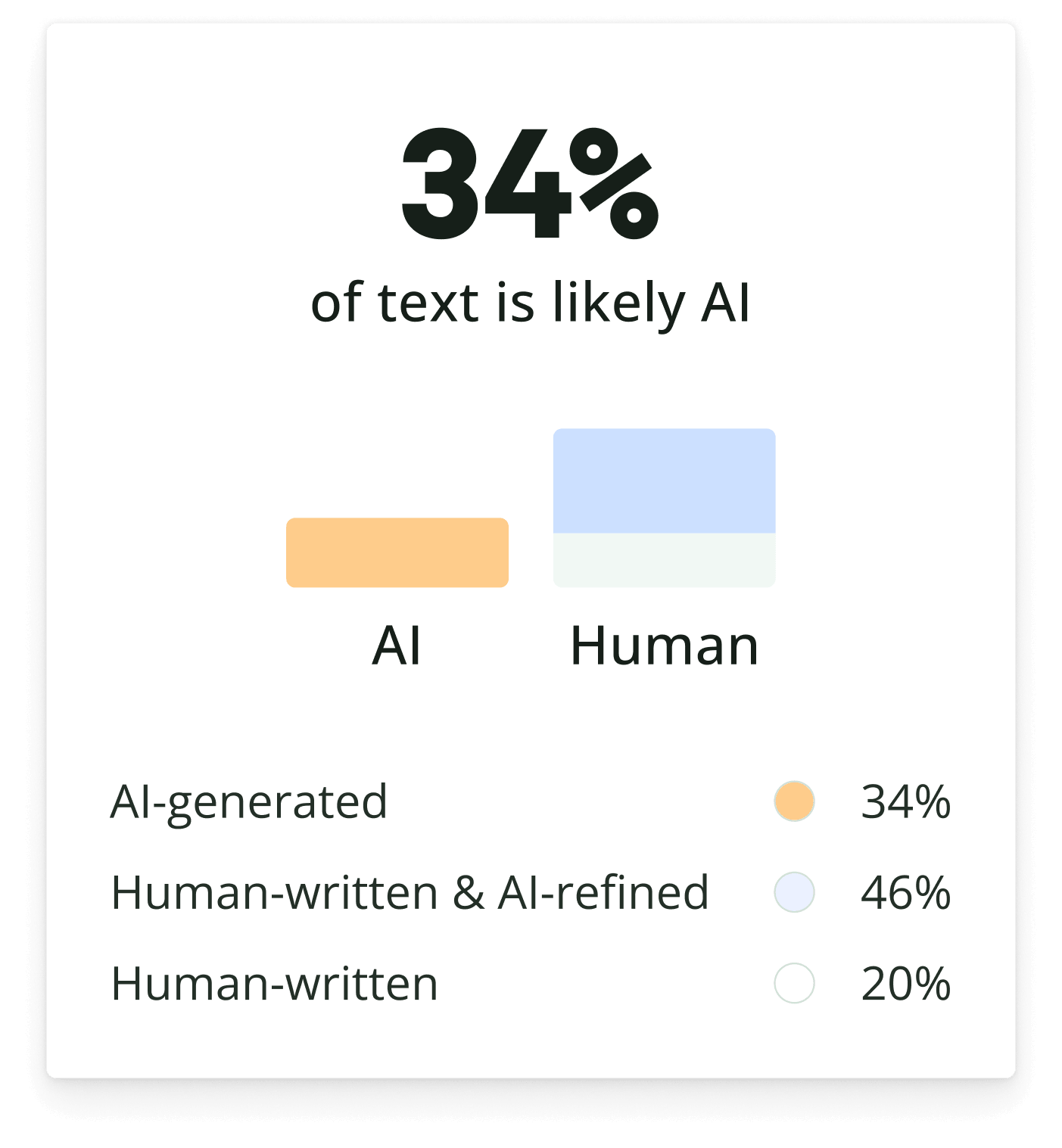
For a fast, reliable starting point, you can use Quillbot’s AI Detector, which analyzes text and provides a detailed report showing how much of it may be AI-generated or AI-refined.
Published on
November 27, 2024
by
Kate Santoro, BS.
Revised on
May 22, 2026
AI detectors are tools designed to estimate whether a piece of text was written by a human or generated by artificial intelligence. They analyze patterns such as predictability, sentence structure, repetition, and word probability to identify signals commonly associated with AI-generated writing.
As AI writing tools become more common in education, marketing, publishing, and business, AI detectors are becoming increasingly important for evaluating originality, transparency, and content authenticity. However, since AI detection is not perfect, understanding how these tools work is essential for interpreting results accurately.
Quillbot’s AI Detector can help users quickly analyze text and identify patterns that are commonly associated with AI-generated content.
Key takeaways
AI detectors analyze predictability, repetition, and sentence structure to estimate whether text was AI-generated
Most AI detectors rely on signals like perplexity, burstiness, and statistical language patterns
AI detectors are not fully accurate and may produce false positives or false negatives
AI detection differs from plagiarism detection because it evaluates writing patterns rather than copied text
AI detectors work best when combined with human review and editorial judgment.
Work smarter with Quillbot’s AI Detector. Quickly assess whether text appears
AI-generated or human-written before publishing or submitting your content.
Work smarter with Quillbot’s AI Detector. Quickly assess whether text appears
AI-generated or human-written before publishing or submitting your content.