10 Ways to Work Smarter, Not Harder
Whether you’re a business builder, freelancer, or team manager, you’ve probably felt overwhelmed at times while trying to keep everything running smoothly. As a result, it can feel difficult to come up for air long enough to think about how to work smarter, not harder.
In this guide you’ll find tried-and-tested strategies for maximizing your impact while minimizing the overall effort required to do your best work. If you apply just a few of these tips, you’ll have more headspace to think about the bigger picture—and more free time to focus on the things you love.
Key takeaways
- Prioritize high-impact work: Use the Eisenhower Matrix and 80/20 principle to identify your most important tasks, focus on what drives results, and delegate or eliminate low-priority work.
- Build smarter systems: Create reusable templates, checklists, and workflows, batch similar tasks, and automate repetitive activities to save time and reduce decision fatigue.
- Protect your time and focus: Use time blocking, set realistic deadlines, avoid multitasking, and schedule demanding tasks around your natural energy levels to get more done efficiently.
- Set boundaries and optimize continuously: Learn to say no, delegate where possible, improve your attention span, and regularly review your workflows to reduce unnecessary work and prevent burnout.
Table of contents
- Use the Eisenhower Matrix to identify priorities
- Try time blocking
- Build systems and templates
- Give yourself deadlines
- Apply the 80/20 principle
- Automate repetitive tasks
- Improve your attention span
- Stop multitasking
- Group similar tasks together
- Work with your energy, not against it
- Learn to say no
- Regularly review your workflows
- Frequently asked questions about working smarter, not harder
- Other interesting articles
Use the Eisenhower Matrix to identify priorities
When it comes to working harder than you need to, one of the biggest pitfalls is expending energy on low-priority tasks. So before you begin implementing any of the other strategies on this list, it’s worth identifying what’s actually worth your time and energy. That’s where the Eisenhower Matrix comes in.
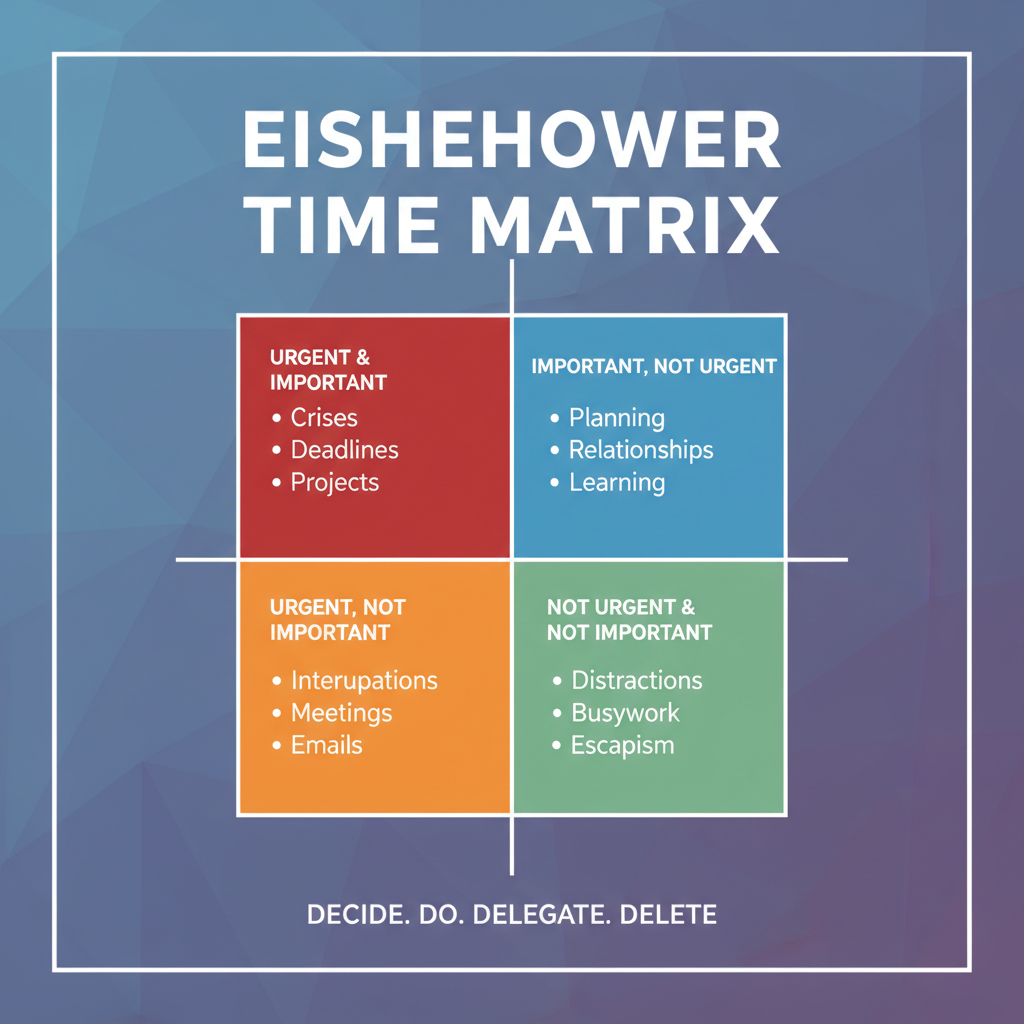
Review your to-do list and place each task into one of the following categories:
- Do: This is for tasks that are both urgent and important. This can include things like submitting a funding application before an upcoming deadline, meeting an important target at work, or paying your rent.
- Decide: This section is for things that are important but don’t have concrete deadlines attached. Maybe you are taking a self-paced online course, trying to practice another language, or get back in shape. The task here is deciding how to fit them into your schedule consistently.
- Delegate: These to-do list items are also important, but maybe be better off in someone else’s hands. This could include paying a tax advisor to file your upcoming return, getting a virtual assistant to handle your scheduling, or asking a colleague to provide feedback on a project where you’ve been feeling stuck.
- Delete: These are for tasks that you keep putting off because, even though they would be nice to tackle in theory, they’re really not necessary right now. This could be cleaning out the shed in your backyard, clearing your inbox, or painting your spare bedroom. You can always return to this quadrant when you have some extra time.
Try time blocking
Now that you’ve identified your priorities, it’s time to tackle them as efficiently as possible. One great time management technique to try is time blocking. There is no one-size-fits-all approach here, but the Pomodoro Method is a good starting point. It involves working in 25-minute focused increments followed by a 5 minute break. You’ll be amazed at how much you can get done.
Build systems and templates
Reduce cognitive load and decision fatigue that adds up when you have to decide how to approach each workday. Instead, develop repeatable systems and templates, so you can dive right into the task at hand without wondering how to wrangle it. Some options for systems and templates that enable you to work smarter, not harder include:
- Using the 3-3-3 rule: Structure your day by starting with three hours of focused time on your most important task. Follow that by completing three time-sensitive but less mentally demanding tasks like replying to emails or paying bills. Finish with three maintenance tasks such as creating tomorrow’s to-do list, updating your calendar, or tidying your workspace.
- Developing a productivity recipe: This is a personalized set of practices that enable you to consistently do your best work. Your “ingredients” include habits such as starting the day with a mindfulness meditation. The “method” describes the steps that go into creating a productive day, such as ending the day with a 30-minute sprint to answer pressing messages and emails.
- Next actions filing system: Sort tasks into folders based on their status. This could include things like “urgent,” “awaiting a response,” or “low priority.”
- Project templates: Develop a single template for routine tasks such as briefs, emails, or pitches. This way, you don’t have to reinvent the wheel every time.
- Establish standard operating procedures: Create to-do lists or checklists with useful links included for less-frequent tasks like monthly invoicing, tax filing, or other forms of business administration to jog your memory and save time.
Give yourself deadlines
Oftentimes, the amount of time it takes to complete a task expands to the amount of time you have to do it. That’s why so many people find they work much more efficiently on a deadline. You can apply the same principle to yourself by setting firm deadlines for finishing your work.
This also involves determining how much time you actually need to complete something for it to be sufficient enough. For example, instead of spending ages on endlessly perfecting internal memos, Slack messages, first drafts, or prototypes at work, practice discerning whether these things are good enough to fulfill their required purpose.
Apply the 80/20 principle
Identify the 20% of your tasks that drive 80% of your results, and prioritize those high-impact activities first. At work, people often drown in shallow tasks like clearing minor emails, passively attending meetings, or doing work for clients that don’t pay very well. These things can easily consume most of the day but deliver negligible value. Ruthlessly auditing your workload reveals the few critical levers that actually move the needle.
Take a couple of days to honestly interrogate where your time goes, and how much is directed toward actually making a significant impact on output and income. Remember the time saved can be directed toward more useful activities like landing a dream client, growing your business, or simply enjoying more free time (and less burnout).
Automate repetitive tasks
Much of the work people do in a day involves mundane, repetitive tasks like data entry, inbox management, scheduling, and moving tasks from one stakeholder to the next. These can easily be overtaken by automation. The key is to find which processes would make the biggest difference in your productivity if they were automated.
The most effective way to decide what to automate is to evaluate tasks based on their frequency, complexity, and the manual friction they cause. For example, automating a daily data entry task that takes 30 minutes can save dozens of hours monthly while eliminating human error.
Improve your attention span
Most people in today’s day and age are constantly overstimulated. It’s incredibly common to lose track of what you were trying to do when multitasking or to get distracted by your phone. Putting in the effort to gradually improve your attention span can help minimize hours wasted on unnecessary sidetracking as well as procrastination.
One of the best ways to grow your attention span is through a daily mindfulness meditation practice. Start with just five minutes per day and gradually increase it as your ability to focus improves. You’ll also reap other benefits such as the capacity to stay calm under stress and even better sleep.
Stop multitasking
Multitasking might seem like a good choice for boosting your productivity, but when it comes to working smarter, not harder it can actually come with a hidden cost: time and energy wasted on context switching. When you try to jump between browsers, task-management tools, and communication platforms, things can easily run amok.
Instead, try identifying which task on your to-do list would make today a success if you completed it. Reserve additional tasks for after you complete the high-priority items, and try the following tip to keep your productivity streak going.
Group similar tasks together
Reduce cognitive load and stay focused by batching similar types of tasks together. This can mean allocating a specific time window in your schedule to things like replying to messages, paying bills, or providing peer feedback on drafts. This will make it much easier to work efficiently than if you try and squeeze these things in at various points throughout the day. It’ll also help prevent overwhelm.
Work with your energy, not against it
At the end of the day, people aren’t machines. If you assume you can produce the same level of output all day every day, you’re setting yourself up for failure. Instead, take an honest look at when in the day you feel most energized, motivated, and focused.
For many, this is in the first hours of the workday, which means it’s best to schedule deep, focused work during this time. Perhaps after lunch you’d prefer more social forms of work like straightforward check-in meetings or concentrating on simpler tasks such as routine chores and errands.
Learn to say no
Much of this guide thus far has been about learning to identify priorities and make the most out of your time and attention. This can all sound nice in a vacuum, but it’s easy to get thrown off course when new requests are constantly coming in. Setting boundaries is imperative if you’re committed to working smarter not harder.
Learning to say no can look like:
- Saying you don’t currently have capacity to take the requested task on.
- Marking focused blocks in your calendar and not accepting meetings during this time.
- Delegating tasks to team members or direct reports where necessary.
- Offering to compromise in a way that matches your bandwidth, such as doing part of the requested task.
Regularly review your workflows
Even with the best strategies and intentions, it’s easy to get so swept up in trying to meet daily demands. As a result, you can lose sight of where you are doing unnecessary work or making things harder for yourself than need be. Try scheduling an end-of-week audit to review your workflows and identify areas where processes can be automated, tasks delegated, or energy better managed.
Frequently asked questions about working smarter, not harder
- What are productivity tips for people who work from home?
-
Work smarter not harder with these productivity tips for people who work from home:
- Creating rituals for signing on and off from work, even if you don’t have a designated home office space. These can include writing a to-do list, crossing off the date on your calendar, or doing a short meditation.
- Using an accountability buddy. Find a friend or colleague who also works from home and have periodic check-ins, co-working sessions over video call, or share weekly wins. They can help you stay focused and keep you in check on goals like reducing screen time.
- Mixing up your environment. Consider working part time in a local library or favorite coffee shop if working at home is too distracting.
If you’re facing roadblocks that squander your productivity when writing papers, emails, or reports—Quillbot’s free Paragraph Rewriter is a great productivity hack to help you get back on track.
- What are productivity tips for fast-paced work environments?
-
Productivity tips for a fast-paced work environment include:
- Triaging priorities: At the start and end of each day, take 10–15 minutes to review your tasks and identify the highest priority items to focus on.
- Doing focused work: Set time blocks in your schedule for putting your head down and getting pressing tasks done. Turn off notifications and remove distractions.
- Setting boundaries: Once you know where your priorities lie, protect your focus time by setting boundaries. Let colleagues know your capacities and make your availability clear via calendar blockers and pausing notifications.
Work smarter not harder by automating time-consuming tasks with tools like Quillbot’s Summarizer, so you can dedicate your energy where it counts.
- What are productivity strategies for academics?
-
Productivity strategies for academics include:
- Using task decomposition: Break down vague and unwieldy tasks like writing a chapter or conducting a literature review into smaller, more tangible subtasks that you can allocate to specific timeslots in your day.
- Protecting focused work time: Dedicate focused blocks to tasks that require your sharpest mental energy. Hit pause on your notifications, respond to emails later, and limit interruptions as much as possible.
- Minding your work environment: Whether you prefer the total silence of a library or the hum of a cozy cafe, find which kinds of environments are most conducive to your productivity.
- Taking breaks to prevent burnout: At first glance, this may not seem like it has anything to do with productivity. However, the only way to make the demands of academic life sustainable is by taking intentional breaks for rest and wellbeing.
Work smarter not harder by automating tedious and time-consuming tasks with Quillbot’s free Citation Generator.
- What are some free productivity techniques that work?
-
Some of the best productivity techniques are surprisingly simple and don’t cost any money.
Free productivity tips include:
- Extended pomodoros: Try implementing 90 minute focused work blocks followed by 15 minute breaks.
- 3-21- to-do list method. Each day, choose three work tasks, two health-related activities, and one fun thing you’ll do. Consider completing this list a productive day.
- Airplane mode. There are tons of fancy products, apps, and gadgets promising to free you from distractions, but simply putting your phone in airplane mode while you work is usually enough to do the trick by reducing unnecessary screen time.
Work smarter not harder with Quillbot’s free Summarizer. This productivity hack cuts down the time it takes to read and analyze papers and documents so you can focus on other tasks.
Other interesting articles
If you want to know more about colors, letters, or the meaning of emojis, make sure to check out some of our other articles with explanations and examples.