Pitch Deck Examples | Decks & How to Create
A strong pitch deck is one of the most important tools for securing funding, winning clients, or gaining approval for internal projects. Your deck directly affects whether your audience understands your idea, takes your proposal seriously, and decides to move forward; therefore, clear narrative structure, concise content, and consistent presentation all matter.
This guide walks through how to create a pitch deck, provides pitch deck examples to inspire you, and explains how to streamline the entire process with an AI presentation tool like QuillBot’s AI presentation maker.
How to create a pitch deck
Effective pitch decks follow a consistent structure regardless of industry. The goal is to communicate your idea in a way that is fast to grasp, backed by data, and visually organized. The following steps outline the creation process from planning to final design.
1. Define your objective and audience
Before writing any slide content, decide on the following:
- The purpose: What is your pitch deck’s objective—securing fundraising, making sales, gaining a partnership, promoting an internal initiative, proposing a project or program, etc.?
- The target audience: Are you pitching to investors, clients, executives, donors, or someone else? What technical depth do these people already have? What information will they be looking for?
- The specific “ask”: What are you hoping to acquire through your pitch? This might be funding, approval, partnership terms, a pilot program, next steps, or something else.
This planning step determines tone, data granularity, length, and the level of supporting evidence required for your pitch deck.
2. Map out the essential pitch deck slides
Most decks fall within 10–15 slides and follow a predictable order that guides the audience through a logical narrative. The pitch deck slides you include will vary a bit depending on your pitch’s purpose, but often-essential slides are outlined in the table below.
Essential pitch deck slides
| Slide | What and why |
| Title | Introduces the company or project name, tagline, and presenter. Sets the visual tone for the deck. |
| Problem | Defines the pain point, inefficiency, or opportunity gap your idea addresses. Must be specific and evidence-based. |
| Solution | Presents the product, service, or initiative that solves the problem. Explains the value proposition in one clear statement. |
| Product or service overview | Shows what you’ve built (or will build), how it works, and the core features. Often includes diagrams, mockups, or flows. |
| Market size | Quantifies the revenue opportunity. Demonstrates that the market is viable, accessible, and growing. |
| Business model | Explains how the organization makes money (e.g., pricing, revenue streams, and customer lifecycle assumptions). |
| Traction and milestones | Shows evidence of progress (e.g., user numbers, revenue, product development, pilots, performance metrics, or key wins). |
| Go-to-market strategy | Outlines how you plan to acquire customers or users (e.g., channels, messaging, partnerships, and sales model). |
| Competitive landscape | Identifies competitors. Highlights your strengths, differentiators, and positioning. |
| Team | Introduces the core team and their relevant experience. Whenever possible, emphasize execution capability. |
| Financials and forecasts | Provides revenue projections, key assumptions, unit economics, and high-level cost structure. |
| The ask | Specifies what you want: funding, approvals, partnerships, resources, etc. |
| Next steps | Indicates how you want the audience to move forward. |
3. Draft, design, and refine
Once you define and outline, it’s time to draft and design. This is also the stage to gather feedback and refine your pitch deck (and oral pitch) accordingly.
Some tips for that process are:
- Write raw content first. Don’t edit while drafting; just capture the core message of each slide.
- Edit aggressively. Slides should communicate ideas quickly. Cut words aggressively, and replace long sentences with bullets, charts, or diagrams. You can use QuillBot’s AI Chat to help you find redundant words and ideas.
- Check narrative flow. The problem should logically lead to the solution, which then leads to the market opportunity, and so on.
- Add visual hierarchy. Use headings, subheadings, spacing, and visuals so key points stand out.
- Proofread. Grammar and spelling errors in your pitch can lower your credibility. Make sure your pitch content is error-free with QuillBot’s Grammar Checker.
- Rehearse delivery. The spoken explanation will expand on the slides; the deck is not the full script.
Pitch deck examples
Below are a few fictional pitch deck examples you can adapt. These avoid real brands, real logos, and real company data, so you can use them as inspiration for your own pitch deck.
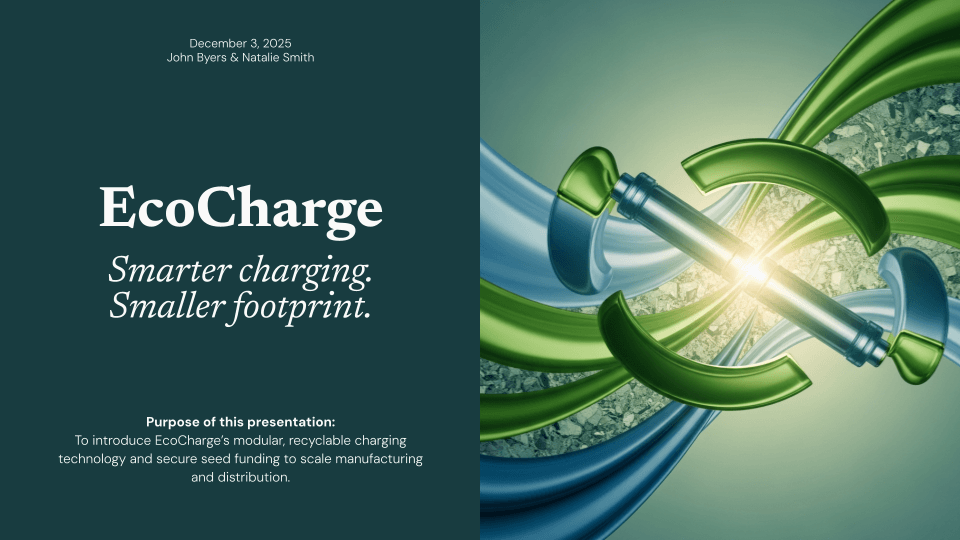
Pitch deck example 1: “EcoCharge” (green tech startup)
EcoCharge produces a modular charging unit made from recyclable components designed to extend device battery life. The purpose of their pitch deck is to secure seed-stage investment to transition EcoCharge from a working prototype to scalable manufacturing.
Pitch deck structure:
- Title: EcoCharge name and tagline: “Smarter charging. Smaller footprint.”
- Problem: High electronic waste volume and inefficient charging cycles.
- Solution: A recyclable, modular charging device with adaptive power optimization.
- Product overview: Hardware features, safety components, and modular design.
- Market: TAM/SAM/SOM analysis based on consumer electronics accessory demand.
- Business model: Direct hardware sales + subscription diagnostics.
- Traction: Prototype performance metrics and pilot testing results.
- Go-to-market: Retail partnerships and online DTC sales.
- Financials: Revenue projections, manufacturing costs, and margin targets.
- Ask: Capital to scale production and expand distribution.
Title slide example:
Pitch deck example 2: “UrbanCrafters” (e-commerce marketplace)
UrbanCrafters is a curated digital marketplace connecting independent artisans with customers.
Pitch deck structure:
- Title: UrbanCrafters name and logo, presenter details, and date
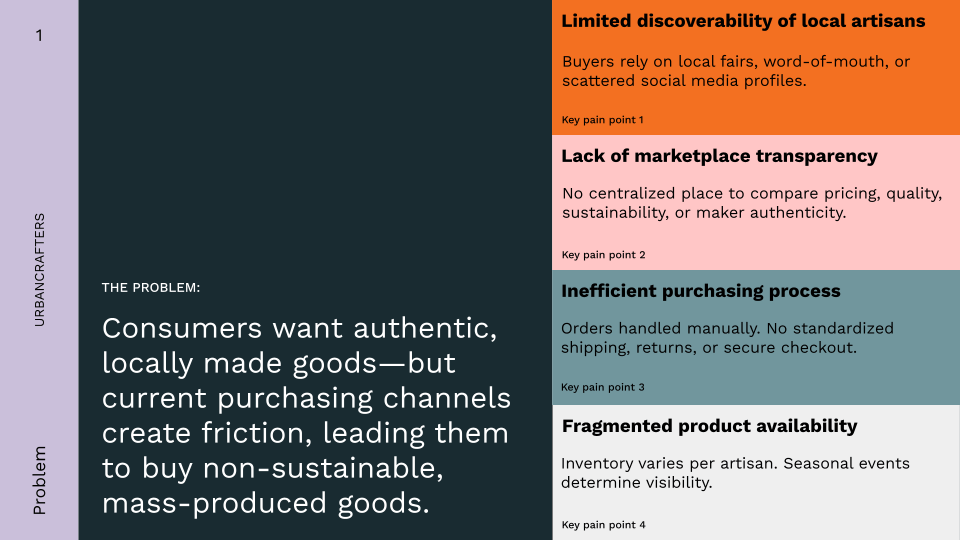
- Problem: Small makers struggle to reach wider audiences.
- Solution: A curated discovery platform with transparent artisan profiles and quality verification.
- Market: Growth of online craft and handmade goods segments.
- Acquisition: Paid social campaigns, SEO, and influencer micro-collaborations.
- Business model: Commission-based marketplace plus featured listing fees.
- Financials: CAC vs. LTV modeling.
- Ask: Funding for inventory partnerships and marketing scale-up.
Problem slide example:
Pitch deck example 3: “SoundNest” (meditation and focus platform)
SoundNest is a neuroscience-informed app that uses adaptive soundscapes to boost concentration and reduce stress.
Pitch deck structure:
- Title: Sound Nest logo, mission statement, and presentation date
- Problem: High burnout, low focus, fragmented wellness solutions.
- Solution: Personalized soundscapes generated based on biometric feedback.
- Product: Mobile app, web dashboard, focus-tracking metrics.
- Market: Mental wellness apps and productivity tech.
- Business model: Subscription tiers + enterprise licensing.
- Traction: Beta users show increased productive time.
- Go-to-market: Corporate wellness partnerships.
- Ask: Funding to secure research partnerships and grow the content library.
Solution slide example:
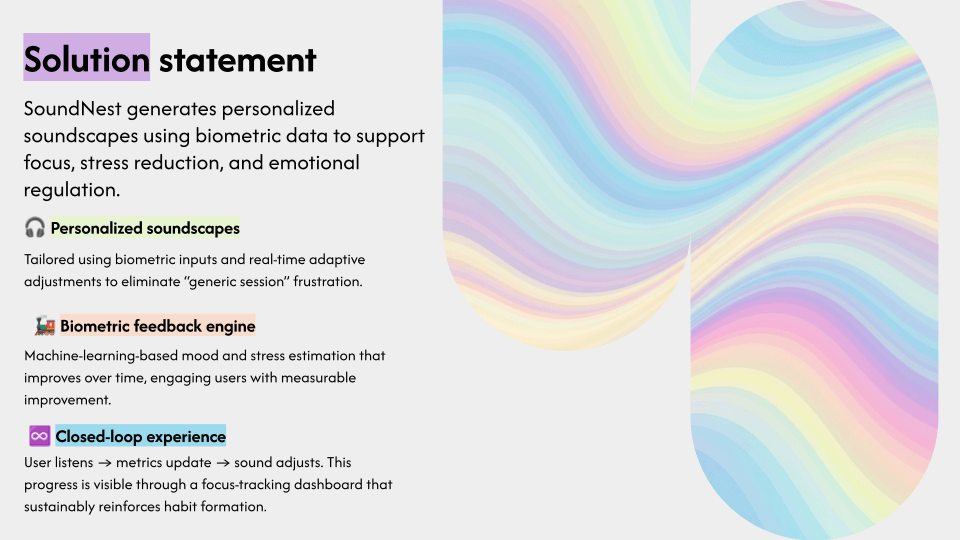
“Create an abstract image of soundwaves. Use pastel colors and make the image look relaxing.”
Using an AI presentation maker to create pitch decks
Building a pitch deck from scratch requires research, writing, organization, and design. QuillBot’s AI presentation maker accelerates this process by generating structured, concise slides you can use as a jumping-off point for your deck.
To generate a pitch deck with the AI presentation maker:
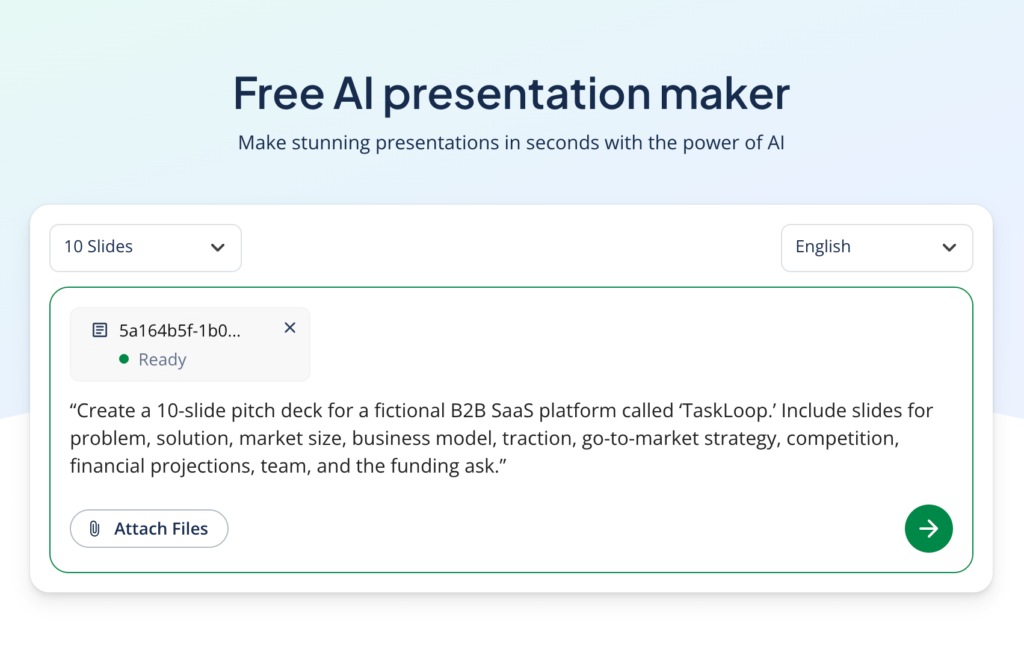
- Set the number of slides and language. The maximum is 10, but you can always add more later on. Choose a language from English, French, Spanish, German, and Portuguese.
- Add your prompt and attach files. Include a detailed prompt about the type of pitch deck you want. You can also attach files (e.g., your slide content, an outline, or images) that you want incorporated into the presentation.
- Click the green arrow to review the proposed outline. The presentation maker will generate an outline of the slides and content included on each. You can edit this now or leave it and edit the slides later on.
- Choose a template. Select your desired template from options like “Codedark,” “Minimalist,” or “Vibe – Midnight.”
- Click “Generate.” You can now share a link to the presentation or export it as a PDF or PPTX to edit in PowerPoint. Or, use additional prompts to update your slides using QuillBot until you’re happy with the results.
Frequently asked questions about pitch deck examples
- What is a pitch deck?
-
A pitch deck is a structured, slide-based presentation used to communicate the value, viability, and growth potential of a business or initiative.
Looking at pitch deck examples can help you understand what type of pitch deck your organization needs.
Need help creating a pitch deck? Try QuillBot’s AI presentation maker to jumpstart the process.
- What is the purpose of a pitch deck?
-
The purpose of a pitch deck is to communicate a business opportunity clearly and convincingly so the audience is compelled to take action (e.g., offer funding or greenlight an initiative)
It does that by presenting the strongest, most relevant facts about the opportunity in a structured, visual format. Reviewing pitch deck examples can help you see how to do this.
If you want to create a pitch deck, get started fast with some help from QuillBot’s AI presentation maker.
Cite this Quillbot article
We encourage the use of reliable sources in all types of writing. You can copy and paste the citation or click the "Cite this article" button to automatically add it to our free Citation Generator.
QuillBot. (2025, December 05). Pitch Deck Examples | Decks & How to Create. Quillbot. Retrieved January 23, 2026, from https://quillbot.com/blog/ai-writing-tools/pitch-deck-examples/