One of the easiest ways to make AI-generated writing sound more natural is to use an AI humanizer. Quillbot’s Humanize AI tool refines your text by improving its tone, flow, and sentence structure while preserving your original meaning. If you want an even more tailored experience, the tool can adapt your writing to sound more conversational and adjust the tone to fit different contexts.
For the best results, combine AI with a quick manual review:
- Vary sentence lengths and structures to create a more natural rhythm.
- Add transitions like “for example,” “however,” or “in practice” to improve flow.
- Replace vague or repetitive phrases with more specific, engaging language.
- Read your text aloud to catch awkward wording and ensure it sounds authentic.
Before publishing or submitting your work, you can also run it through Quillbot’s AI Detector to understand how your writing may be perceived and verify that it reads naturally.
Read this FAQ: What is the best way to humanize AI text?
An AI content writer can refer to:
- An AI-powered tool (like ChatGPT or Claude) that can create various types of written material, like blog posts, social media content, and marketing copy.
- A human writer who specializes in using AI tools as part of their writing process.
In both cases, knowing how to humanize AI content is really important. Without thoughtful editing, AI-generated text can feel flat and impersonal, making it harder to engage your audience. You can use tools like Quillbot’s free Humanizer to help you with this process.
Read this FAQ: What is an AI content writer?
AI-generated content refers to any type of content, such as video, text, images, or audio, that is created using AI tools. By analyzing vast amounts of data they’ve been trained on, these tools can produce new content that mimics human-created work.
When it comes to writing, AI can quickly generate articles, summaries, and marketing copy, but the result often feels generic or impersonal. That’s why knowing how to humanize AI content is important; it helps you connect with your audience and create material that resonates on an emotional level rather than just conveying information. Tools like Quillbot’s free Humanizer can help make your text feel more natural, and pairing it with Quillbot’s AI Detector lets you check that your final version reads as authentic and genuinely human.
Read this FAQ: What is AI-generated content?
Using AI to rewrite text can be a quick and easy way to improve clarity, tone, or structure, depending on what you need. You can then use a humanizer tool, like Quillbot’s, to humanize AI text so it reads more like something a person would actually write.
If you’re unsure whether the final version still feels too “AI-generated,” Quillbot’s AI Detector can also help you check the text before you share it.
Read this FAQ: Can you use AI to rewrite text?
Some examples of chatbots are:
- ChatGPT
- Gemini
- Claude
- Alexa
- Siri
- Cleo
- Zendesk’s Answer Bot
- Bank of America’s Erica
- Duolingo Max
A chatbot is any computer program designed to simulate human conversation. They are often, but not always, powered by AI.
Remember not all AIs are chatbots. For example, Quillbot’s Translator is a type of AI, but it is not a chatbot, as you do not have a conversation with it.
Read this FAQ: What are some examples of chatbots?
Some chatbots are AI, but not all. A chatbot is any computer program designed to simulate human conversation.
Some of these are powered by AI and can tackle various, complex tasks. Other chatbots are rule- or keyword-based and have a more limited range of capabilities.
Likewise, not all AI are chatbots. For example, Quillbot’s Humanizer is a type of AI, but it is not a chatbot, as you do not have a conversation with it.
Read this FAQ: Are chatbots AI?
A chatbot in education is a conversational computer program that helps students, teachers, and staff with learning and administrative tasks.
A chatbot is any computer program, often powered by AI, that simulates human conversation.
In education, chatbots might offer personalized learning and extra support, help students practice a foreign language, assist in brainstorming and proofreading, and automate administrative and organizational tasks.
While not a chatbot, another type of technology used in education is an AI Detector, which helps teachers decide if student work was written by AI.
Read this FAQ: What is a chatbot in education?
Computer scientists make AI chatbots sound human-like through various technologies, mainly natural language processing (NLP) and machine learning.
A chatbot is a computer program designed to simulate human conversation. AI chatbots can learn from their past experiences in order to continuously improve.
They can also vary the language they use, which leads to more human-like answers. For example, instead of always saying “I can help with that,” an AI chatbot could also say “I can tackle that” or “I can take a shot at that.”
Remember that not all AIs are chatbots. For example, Quillbot’s Grammar Checker is powered by AI, but it is not a chatbot.
Read this FAQ: How do computer scientists make AI chatbots sound so human-like?
The most reliable way to check whether a document was written by AI is to run it through an AI Detector. These tools analyze patterns in the text (like phrasing, predictability, and structure) to determine whether the content is more likely to have been written by a human or generated by AI. For the most reliable results, analyze longer passages of text rather than a single sentence, since AI detectors need enough language patterns to evaluate.
You can also review the document yourself for common signs of AI writing. AI-generated text often relies on predictable sentence structures, repetitive word choices, and a neutral or overly generic tone. While these clues can be helpful, they’re not always definitive on their own. Because no detection method is perfectly accurate, it’s best to combine automated tools with manual review.
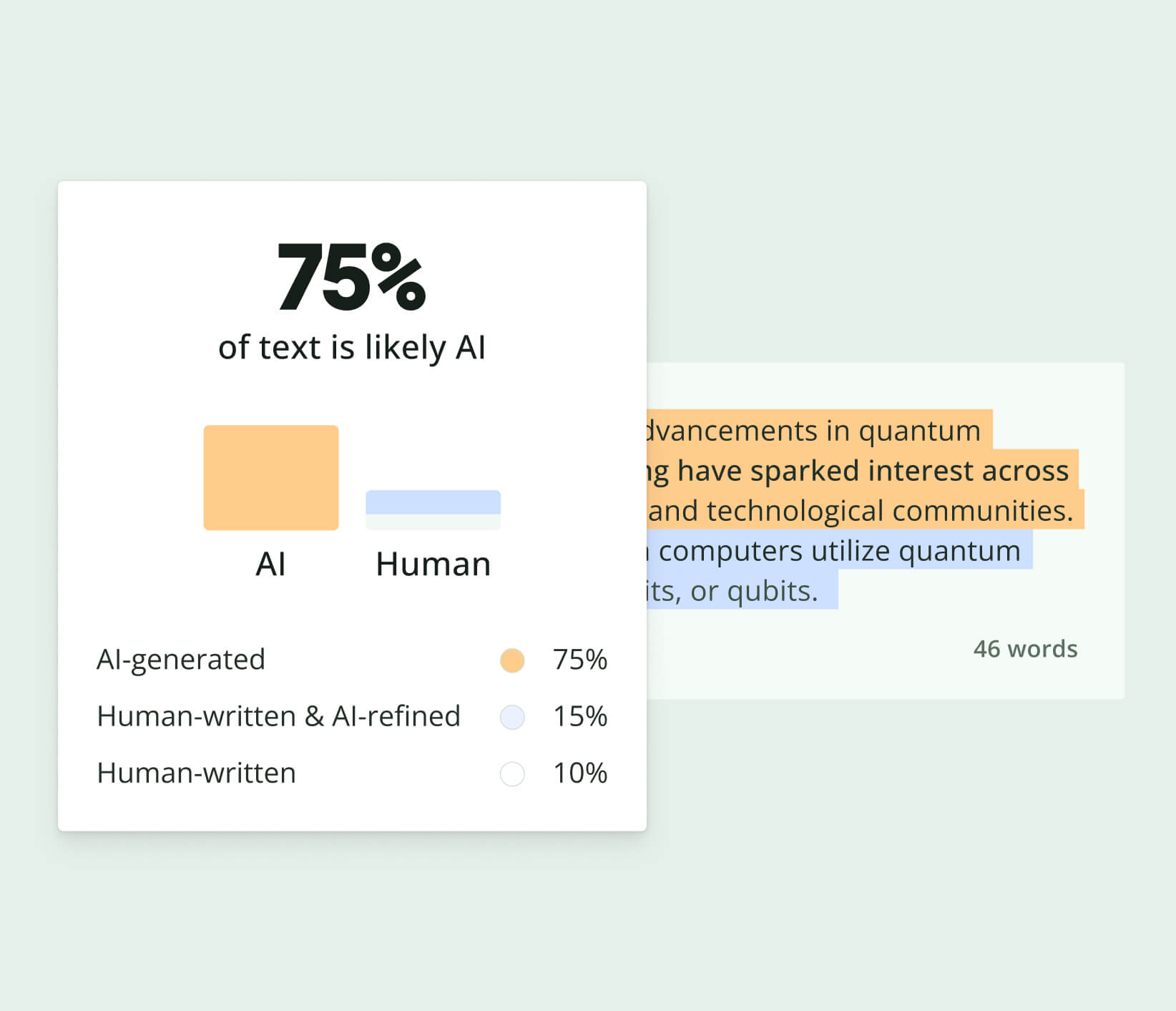
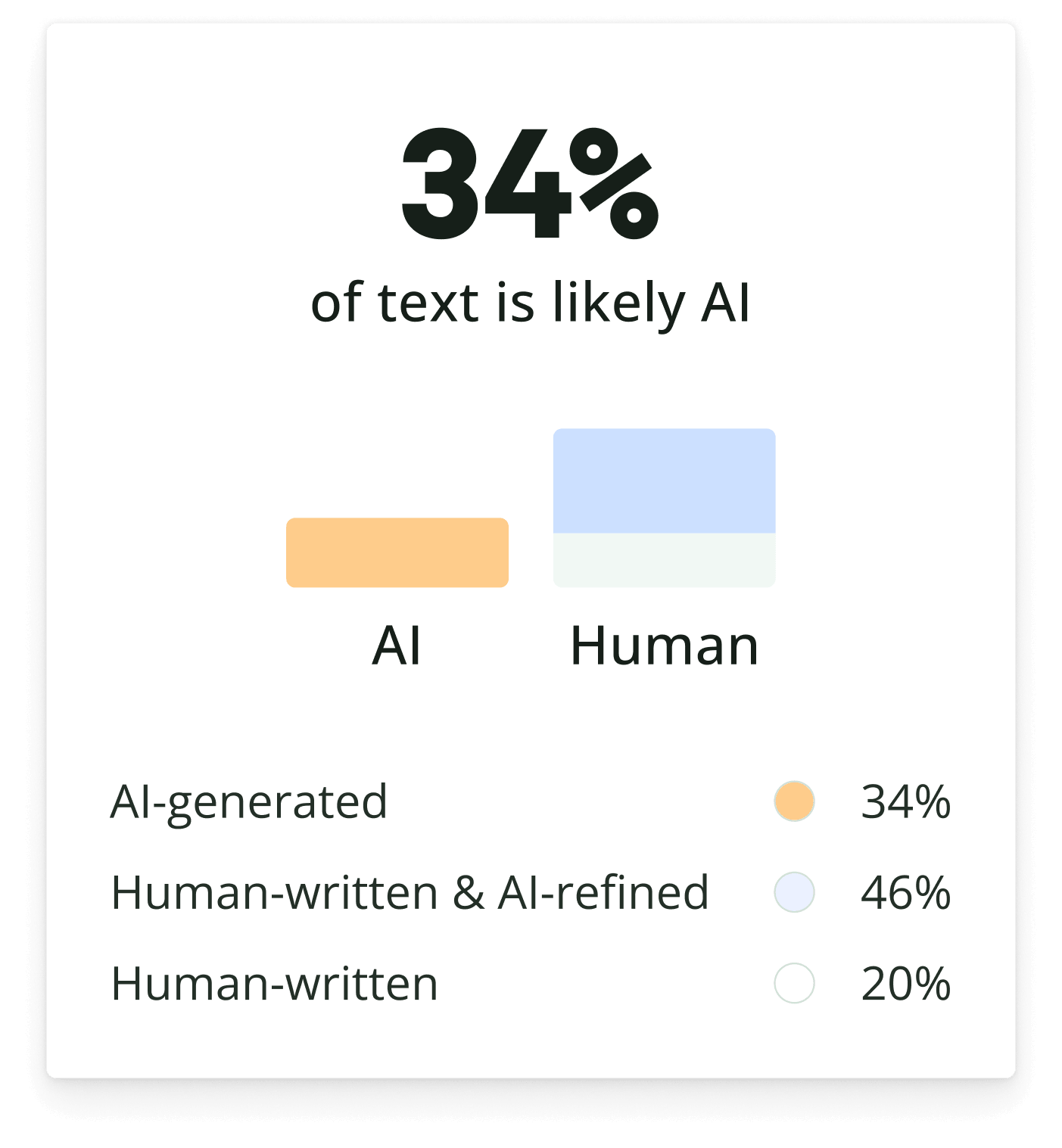
Some tools provide additional insights. For example, Quillbot’s AI Content Detector provides a detailed analysis that distinguishes between AI-generated and AI-refined text, giving you clearer insight into how a document was likely produced. This makes it easier to evaluate the originality of content and determine whether AI tools played a role in its creation.
Read this FAQ: How do I check if a document is AI generated?
One of the most reliable ways to see if an essay may contain AI-generated content is to run it through an AI detection tool. Tools like Quillbot’s AI Detector analyze the text for patterns commonly associated with AI writing (like predictability, limited variation in sentence structure, and other linguistic signals) and estimate how much of the text may be AI-written or AI-refined.
You can also review the essay manually. AI-generated writing may sometimes include unusually consistent tone, repetitive phrasing, or sentence structures that feel more formulaic than typical human writing, especially when compared with the author’s previous work.
However, it’s important to note that no AI detection method can guarantee 100% accuracy. For the most reliable assessment, combine automated analysis from tools like Quillbot’s AI Detector with human judgment and contextual evaluation.
Read this FAQ: How can I see if an essay is AI generated?