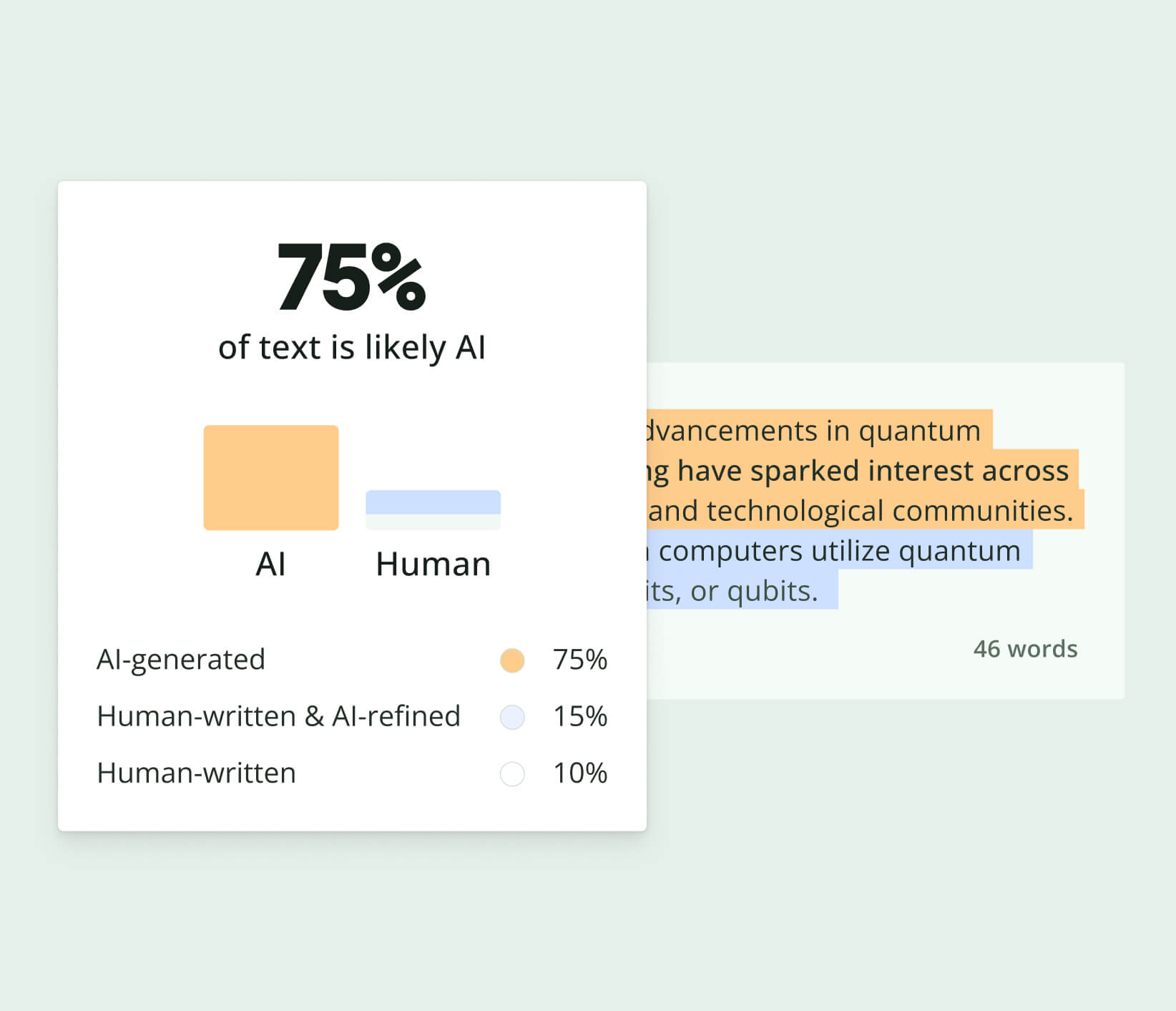
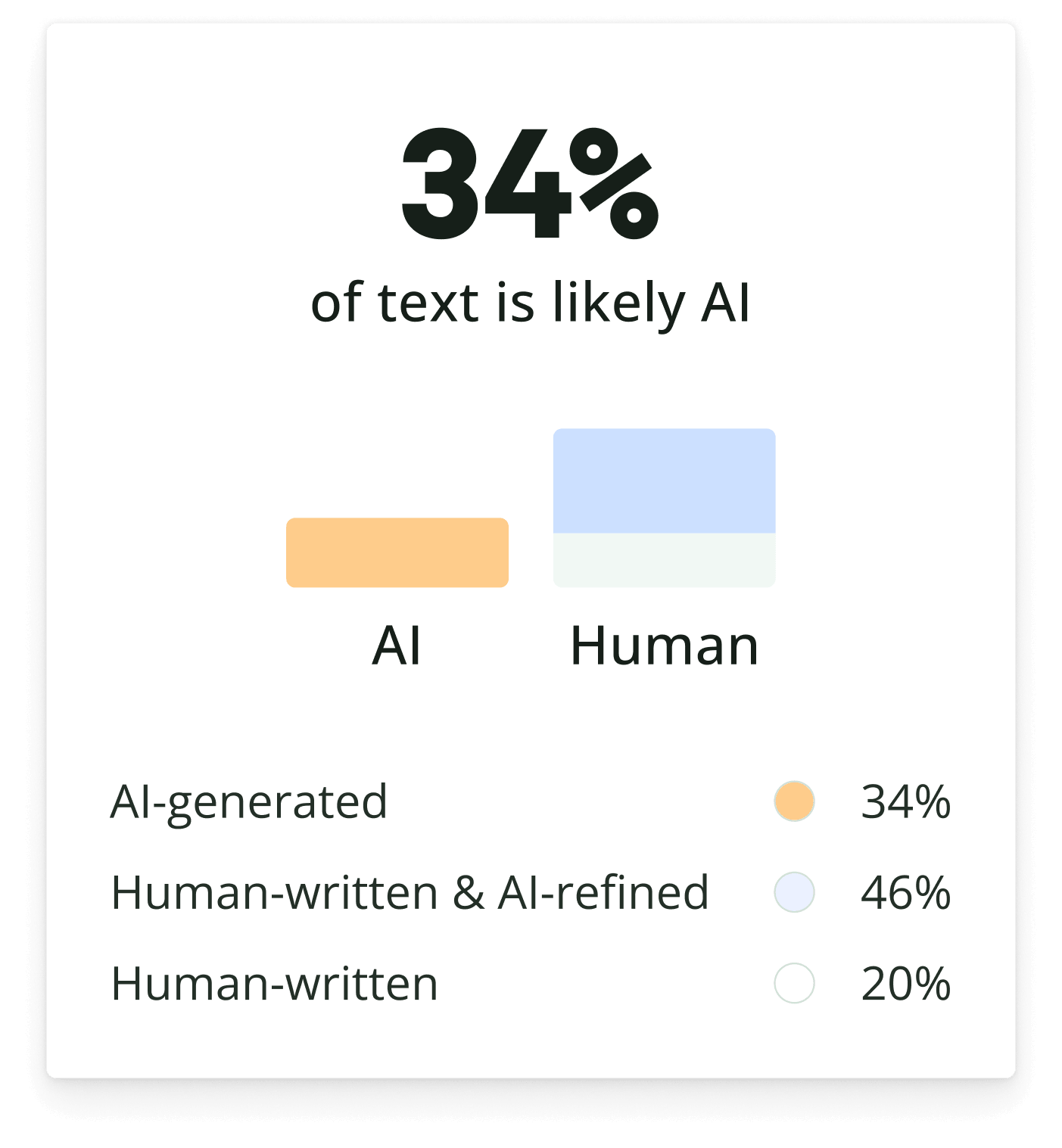
One easy way to spot AI-generated text is to use an AI Detector like Quillbot’s, which analyzes text features to determine whether they are more similar to human-written or AI-generated samples.
You can also sometimes spot features of AI-generated text on your own. AI content tends to be more predictable and formulaic than human content and sometimes has a stiff or formal tone.
When you’re trying to detect AI writing, keep in mind that no approach is 100% reliable. Quillbot’s free AI Detector provides a detailed report that gives percentages for both AI-generated and AI-refined content, which can help you make more informed decisions.
Read this FAQ: How do I spot AI-generated text?
The simplest way to check if AI wrote something is to use an AI Detector to analyze what percentage of text is AI-generated and what percentage is AI-refined.
You can also review the text manually. AI-generated content often shows predictable word choice, repetitive sentence structures, and a formal or unusually consistent tone compared with human writing.
Whatever method you use to detect AI writing, keep in mind that no approach is 100% reliable. A detailed report like the one provided by Quillbot’s AI Content Detector can provide more context for making decisions.
Read this FAQ: How do I check if AI wrote something?
AI agents are software programs that can perceive their environment. They can gather data, analyze it, and take action, working autonomously to achieve specific tasks.
A few examples of AI agents are:
- Self-guided vehicles
- Delivery drones
- Virtual assistants like Siri or Alexa
- Customer service chatbots
- An AI chess opponent
AI agents are one of the many types of AI (generative AI, analytics programs, AI detectors, etc.) and are quite common in modern society given their ability to help humans with everyday tasks.
Read this FAQ: What are AI agents?
AI hallucinations are errors where AI generates false or nonsensical information. They’re most common in large language models (LLMs), image generators, and other generative AI models.
These hallucinations may appear confident and correct at first, but closer inspection can reveal inaccuracies.
For example, an AI-generated image may look good overall, but details like hands or text may not be accurately generated. Or if you ask AI to provide information and cite sources, it may accurately relay the information, but cite a source where that information doesn’t appear.
Understanding what AI is helps explain why AI hallucinates. AIs are computer programs trained on datasets. Biases, gaps, inaccuracies, and ambiguities in this data can cause hallucinations.
Read this FAQ: What are AI hallucinations?
AI governance is the frameworks, policies, and practices intended to ensure that AI is developed, deployed, and used in ethical and transparent ways. It is related to AI ethics.
AI governance differs by jurisdiction. If you are studying or working in this field, it’s best to consult with experts in your jurisdiction for more detailed information.
Specific institutions and organizations may also have their own form of AI governance. For example, many universities now have published policies about how students can and cannot use generative AI and how teachers should work with AI detectors.
Read this FAQ: What is AI governance?
Before understanding what artificial general intelligence is, you need to understand what AI is in the general sense.
AI refers to computer programs designed to perform tasks requiring human-level intelligence, but usually limited to specific tasks.
For example, Quillbot’s free Paraphraser can rewrite sentences, but it cannot compute numbers or guide a vehicle.
Artificial general intelligence (AGI) is a theorized AI that can perform any human task, with cognitive abilities and adaptability to apply knowledge across diverse areas.
Read this FAQ: What is artificial general intelligence?
An AI model is a computer program designed to perform specific tasks while mimicking human intelligence.
AI models use algorithms to process input data and make predictions based on this data, and they work in areas like speech recognition, language interpretation, image analysis, or decision-making.
For example, Quillbot’s AI Humanizer is an AI model designed to understand and refine AI outputs to make them sound more human.
This field is developing each day, so understanding what AI is and how it works is more important than ever.
Read this FAQ: What is an AI model?
The ethics of AI art address the ethical consequences of generative AI tools that make images and videos. Some of the AI ethics that apply to art include the following
- Bias and stereotyping: AI tools might generate images that echo the stereotypes that are represented in the data sets on which they’re trained.
- Intellectual property: AI tools for art are often trained with the digital works of human artists without their knowledge or consent.
- Deepfakes: AI tools can generate fake images of real humans (e.g., celebrities), which can be used to spread misinformation and harm people’s reputations.
- Job displacement: AI-generated art could lead to fewer jobs or business opportunities for human artists.
Read this FAQ: What are the ethics of AI art?
Many job seekers use ChatGPT for job applications.
For example, you can include your cover letter along with the job description in a prompt that asks ChatGPT to add keywords that will increase your application’s chances of getting noticed by application scanning software.
You can ensure ChatGPT is safe for job applications with these strategies:
- To protect your privacy, delete contact information and other personal details from application materials that you include in ChatGPT prompts.
- Because recruiters often use AI detectors to check cover letters and resumes, always revise any text that ChatGPT generates in response to your prompts. Quillbot’s AI Humanizer tool can help you humanize AI outputs to match your preferred style.
- Look closely at specialized terms in ChatGPT outputs in case the chatbot misused any terminology.
Quillbot’s AI Checker Android App and AI Checker iOS App can also help you ensure that your application materials reflect your own writing voice.
Read this FAQ: Can I use ChatGPT for job applications?
ChatGPT is safe to use for school when students follow these precautions:
- Stay informed about potential risks such as ChatGPT plagiarism.
- Review and follow your instructor and/or school’s policies about generative AI (e.g., Some schools require students to disclose when they’ve used ChatGPT for assignment help).
- Avoid sensitive personal information in prompts (e.g., your name and contact information).
- Verify facts provided by ChatGPT with credible sources.
- Use ChatGPT for small pieces of an essay (e.g., a hook or thesis statement) or to brainstorm ideas. Don’t prompt ChatGPT to generate entire drafts.
- Revise any content that ChatGPT generates to ensure the writing assignments you submit are in your own writing voice.
Another way to use ChatGPT safely is by using Quillbot’s free AI Content Detector or AI Detector Mobile App for iOS to ensure that AI-assisted writing hasn’t been plagiarized.
Read this FAQ: Is ChatGPT safe to use for school?