
Top 10 Study Techniques for Exams
When a single exam can make or break your final grade, you need a variety of powerful yet practical study techniques.
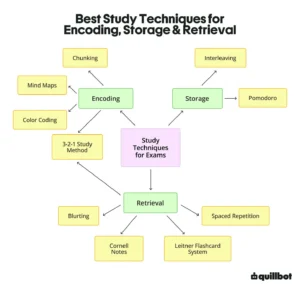
The best study techniques for exams are far more effective than rereading your textbook for hours at a time. They support the three main stages of the memory process:
- Encoding new information by organizing and connecting ideas in ways that make them easier to understand and remember
- Storing information in long-term memory by spacing out and scheduling study sessions to improve retention and avoid cramming
- Retrieving information through active recall, which helps you practice pulling information from memory during the actual test
To help you incorporate all of these elements into your study routine (and ace your exams), this guide covers 10 science-backed study techniques, including mind mapping, Cornell notes, and distributed practice.
Quillbot’s AI Chat is a fast and free resource for your study needs. You can prompt it to generate flashcard ideas, ask it about the concepts you’re studying, and more.
Key takeaways
- The most effective study techniques for exams enhance the three stages of the learning process: encoding, storage, and retrieval.
- Techniques like mind mapping and chunking help your brain encode information in a way that makes it easier to understand and remember.
- Spacing out study sessions and mixing topics strategically can significantly improve your brain’s ability to store information in long-term memory.
- Active recall strategies, like the Leitner flashcard system, help you practice retrieving details from memory while you’re taking a test.
Mind mapping
Mind mapping is an effective study technique for when you’re reading a textbook chapter or reviewing lecture notes for the first time. It involves making a visual diagram of a central topic with branches that show how concepts and details are connected. A mind map helps you encode new information by organizing it into a structure that’s easier for your brain to understand and remember. Here’s why:
- Instead of passively rereading, you’re actively turning the information into a structured visual map, which mirrors your brain’s filing system.
- Research on dual coding shows that studying is more effective when you process the information in two formats: words and images.
The next time you read a new textbook chapter, create a mind map by following these steps:
- Start by writing the chapter title or main topic in the center of a blank page (e.g., “Cell Division”).
- For each major section of the chapter, add a branch from the center, and label it with the chapter subheading (e.g., “Mitosis Phases”).
- For each branch and subtopic, add smaller offshoots for key definitions, examples, dates, or processes.
By the time you finish the chapter, you don’t just have notes. You have a visual structure of the entire topic, which makes the information easier to learn and understand from the start.
Chunking
Whether you’re taking a unit test or a final exam, memorizing all the information at once is overwhelming. Chunking breaks the information into smaller, more manageable categories that are easier to understand and remember. Like mind mapping, chunking mirrors the brain’s tendency to organize information into groups, which helps you encode it more efficiently.
Let’s say that a Spanish exam will cover a chapter on weather vocabulary. Instead of memorizing a long list of individual words, group them into categories like the following:
- Temperature words (hot, cold, warm, freezing)
- Weather conditions (rainy, sunny, cloudy, windy)
- Weather-related verbs (to rain, to snow, to forecast)
Once you break the material into smaller chunks, you can study one category at a time (and even schedule study breaks between categories). On the day of the test, you’ll be much more likely to remember what you learned.
Color coding
Color coding your study materials is yet another study technique that helps you encode information in a way that’s easier to process and remember on the day of the test. It builds on the chunking technique with a different color for each category:
- Start by breaking the content into categories.
- Choose a different color for each category.
- Stick with that color scheme when you make flashcards, highlight your notes, or mark textbook passages with sticky notes.
For example, if a business exam will cover material on different business functions, you could use blue index cards, highlighters, and sticky notes for everything about finance, yellow for operations, green for HR, and purple for marketing.
3-2-1 study method
The 3-2-1 study method is a structured way to actively engage with material by combining reading, speaking, and writing. Here’s how it works:
- Read the material three times to familiarize yourself with the content. For the first reading, skim the material to get the big picture, and do closer readings after that.
- Explain the material out loud twice in your own words, as if you’re teaching it to someone else.
- Write a short summary of the key ideas without looking at your notes. Compare your summary to the material and note any areas that require further review.
This study technique supports encoding because you’re processing information in three different ways. The “explain” and “write” parts of 3-2-1 also provide the memory retrieval practice that helps you answer test questions correctly.
Pomodoro study method
The Pomodoro study method is an evidence-based time-management system that improves your productivity and focus while studying. The simplest version is a 5-minute break for every 25 minutes of studying, which gives you consistent, realistic blocks of focus time and prevents fatigue. Here’s how it works:
- Set a timer for 25 minutes (or use a Pomodoro app), and decide what you’ll work on.
- Work for the entire 25 minutes without breaks or interruptions.
- When the timer goes off, take a 5-minute (timed) break.
- Repeat Steps 1–3 until the end of your fourth 25-minute session is over.
- If you’re going to continue working, take a 20–30-minute break, and repeat the process as needed (three 5-minute breaks and one longer break for every 2 hours of studying).
By reducing mental overload, the Pomodoro method helps you store information in long-term memory.
Interleaving study method
The interleaving study method involves studying different, but related, academic subjects during each study session.
For example, instead of studying algebra on Tuesday and physics on Wednesday, you mix both subjects within the same study session. Another version is to mix up concepts within the same unit of study rather than practicing them in the same order you learned them.
With the interleaving approach, your brain has to constantly adjust between different types of problems and concepts rather than relying on repetition. As a result, your brain is more likely to store the information in long-term memory.
Distributed practice (spaced repetition)
Distributed practice (aka spaced repetition) is a study technique that involves retrieving information from memory over multiple study sessions, with increasing gaps between each study session. As the gaps between study sessions grow, your brain has to work harder to retrieve the information. As a result, you’re more likely to recall the material during exams.
During each session, test yourself using active recall methods, like practice tests or flashcards. Space out each session as follows:
- Day 1: First study session (right after learning the material)
- Day 3: Second session to reinforce recall
- Day 7: Third session to strengthen long-term memory
Spreading out your study sessions with increasing intervals helps your brain become more efficient at accessing the information in high-pressure exam situations.
Cornell notes
The Cornell notes system helps you organize information in a way that makes studying and review more effective. This method turns your notes into a built-in study tool that supports active recall, giving you opportunities to retrieve information from memory before the exam.
To get started, divide the page into three sections: the notes column on the right, the cues column on the left, and a summary box at the bottom. (If you take notes on a laptop, you can also create a chart.) Then, fill in each section as follows:
- Notes: During the lecture or while reading, list the important ideas, details, and explanations. The goal isn’t to write everything word for word but to record just enough information that makes sense when you review it later. Focus on key points rather than full sentences.
- Cues: This is where you turn your notes into active recall practice. After you read the chapter or attend the lecture, write questions based on the material in the notes. When you’re studying later, cover the notes column, and use the cue column to test how well you remember the answers from memory. Try to phrase these as questions you would expect to see on an exam.
- Summary: After the lecture or reading, write a summary of what you learned in your own words without looking at the notes. Then, review the notes column, and add any details or corrections.
| Cues/questions | Notes |
|---|---|
| What were the effects of the Industrial Revolution? | Effects of Industrial Revolution:
|
| What factors led to the rise of factories? | Causes of factory system:
|
| Summary: The Industrial Revolution led to major economic and social changes, including rapid urbanization, factories, and the emergence of new social classes. Several other factors made the factory system possible, including the steam engine and power loom, a need for more production, capital investment, and raw materials, like coal and iron. | |
Leitner flashcard system
The Leitner flashcard system helps you practice memory retrieval more efficiently by prioritizing the material based on how well you know it.
To use this system, make flashcards with questions or vocabulary terms on one side and answers or definitions on the other. Go through your flashcards, and try to answer each one from memory before checking the other side. Then, sort the cards into three piles:
- Pile 1 (don’t know): Plan to review these every day. Once you answer them correctly, move them to Pile 2.
- Pile 2 (unsure): Review these every other day. Move them to Pile 3 once you consistently answer them correctly.
- Pile 3 (know well): Review these once a week to maintain memory.
The flashcards should gradually move to Pile 1 as your recall improves, allowing you to focus more time on the material you’re less familiar with.
Blurting study method
The blurting study method is a form of active recall where you write down everything you remember about a topic without looking at your notes first.
To use it, study a section of material, then close your notes and write down everything you can remember on a blank page. Afterward, compare your response to your notes, and identify gaps in your understanding.
This method helps you practice retrieving information from memory while also helping you identify gaps in your knowledge.
Frequently asked questions about study techniques for exams
- How do you study for a math test?
-
In most cases, to study for a math test, you need to memorize formulas and practice solving math problems. Practice doing these things from memory (active recall) instead of passively rereading your textbook or lecture notes.
- To study math formulas, try making flashcards. For example, you could write “quadratic equation” on one side and the formula on the other side.
- To practice solving math equations, look for practice quizzes or chapter review exercises in your textbook.
Plan to study at least a few times before each test. Research shows that most people need 20 hours of practice to learn a new skill. Also, strive for a day or more between each study session to help your brain put the information in long-term memory.
Have you tried Quillbot’s AI Chat for help with how to study for a math test? You can prompt the AI to make a practice test or share math study tips.
- How do you study for final exams?
-
A great way to study for final exams is by using active recall and the process of elimination to identify which areas you need to review or re-learn.
- Schedule several study sessions with at least one day in between to create repetition and mental breaks, which will both improve your testing performance.
- Make a list of everything that will be on the exam, and make flashcards or practice questions for all of the important terms and concepts you need to remember.
- Go through your flashcards and practice questions without looking at your textbook. Each time you answer correctly, cross that item off your study list.
- Use active learning strategies to review what you missed. For example, take notes while you reread the textbook, draw a chart or mindmap, or write more flashcards.
- During the next final exam study session, answer questions or flashcards for the concepts you missed last time, and repeat the other steps until you’ve crossed everything off your study list.
- On the day before your test, go back through your flashcard pile or practice questions one more time from start to finish.
Quillbot’s AI Chat can help you with how to study by making practice tests for a final exam. You can also prompt the AI to review your answers and give feedback.
Other interesting articles
If you want to know more about colors, letters, or the meaning of emojis, make sure to check out some of our other articles with explanations and examples.Cite this Quillbot article
We encourage the use of reliable sources in all types of writing. You can copy and paste the citation or click the "Cite this article" button to automatically add it to our free Citation Generator.
Routh, N. (2026, August 31). Top 10 Study Techniques for Exams. Quillbot. Retrieved September 15, 2026, from https://quillbot.com/blog/education/study-techniques-for-exams/