Top 20 Test-Taking Strategies for Academic Success
Knowing the material is only part of doing well on a test. Strong test-taking skills can help you manage your time, work through challenging questions, avoid common mistakes, and show what you actually know. Whether you’re taking a unit test, final exam, or a major, high-stakes assessment, the right test-taking strategies make all the difference.
In this guide, you’ll learn 10 strategies for taking tests more efficiently and improving your test-taking skills over time. You’ll also find 10 strategies that are specific to multiple-choice, short-answer, and essay questions.
Before the day of your test, ask Quillbot’s AI Chat to help you make study guides and practice tests.
Key takeaways
- A quick test preview and realistic time budget can reduce rushing and help students pace themselves effectively.
- Starting with easier questions and returning to challenging ones later can help students make better use of limited testing time.
- Multiple-choice strategies such as predicting answers, eliminating distractors, and reading questions carefully can make challenging questions more manageable.
- Reviewing test performance afterward can help students identify which study and test-taking strategies are most effective for future exams.
10 effective test-taking strategies
The best test-taking strategies help you make smart decisions before, during, and after you answer each question. Instead of rushing through the test from beginning to end, use the strategies below to plan your time, prioritize questions, retrieve information, and check your work. You may not use every strategy on every test, so experiment with different approaches to find the techniques that work best for you.
1. Start by scanning the entire test
Before you answer the first question, take a few minutes to skim the test from start to finish. As you’re scanning, look for these details:
- Total number of questions
- Concepts covered
- Which sections are easiest
- Types of test questions
This quick preview gives you two major advantages. It helps your brain retrieve the right information more efficiently, and it helps you budget your time.
- Multiple-choice
- True/false
- Matching
- Math equation
- Word problem
- Reading passage
- Short answer
- Essay
2. Budget your time
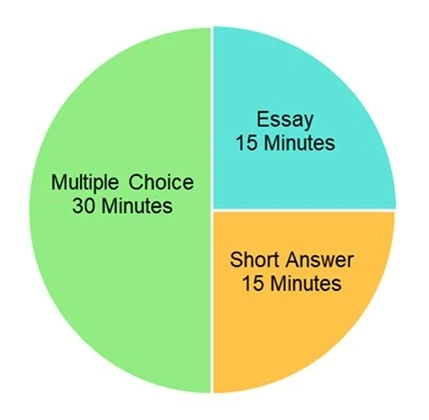
After you preview the test, decide how much time you should dedicate to each question.
- Decide how much time you need for the most time-consuming questions. For example, you might need 5 minutes for each short answer question and 15–20 minutes for an essay question.
- Determine how much time you need for each shorter question, like multiple-choice or true/false. For example, if you have 60 minutes and 45 multiple-choice questions, you can spend up to 90 seconds on each question.
- At the halfway point of the testing period, check to see if you’re half finished, and recalculate the time per question if needed.
3. Work on the easiest sections first
After you decide how to budget your time, consider doing the easiest sections first. For example, you might answer the multiple-choice or matching sections before the short answer questions. Similarly, if one short answer question is easier than the others, answer that one first. By starting with the easiest content, you’ll build confidence and momentum. This strategy also reduces time waste and increases your likelihood of finishing the whole test.
4. Skip or flag questions you’re unsure about
Don’t let yourself stay stuck on the same question for more than a minute. It’s perfectly natural to draw a blank and remember what you need to know later.
When you get stuck or feel uncertain, make a note in the margin, or use the testing platform’s tools to flag the question for later. If you’re taking a paper test, ask your instructor if you can use sticky notes or page-flagging tabs. Come back to these questions after you’ve finished the rest of the test.
5. Visualize your study environment
Visualizing your study environment helps you recall information more efficiently. When you acquire new information, your brain associates it with the place where you learned it. This strategy is especially effective when you’re stuck on a difficult question or drawing a blank.
- During studying, choose a familiar place, like your childhood home, and choose a different room or piece of furniture for each type of information. For example, if you’re taking a grammar test, the comma rules could go on the couch, and the apostrophe rules could go on the window.
- During the test, visualize each part of your memory palace that’s relevant to a question you’re answering. For example, think about the couch each time you see a question about commas.
6. Look for clues in other questions
For the challenging questions that you’ve saved for later, look for clues or hints in other parts of the test. For example, an essay question prompt on Page 2 might include details that are relevant to a multiple-choice question on Page 1.
7. Read questions before reading passages
Tests about grammar, writing skills, and literature often have questions about reading passages. In these situations, always read the questions first so that you know what to look for in the passage.
8. Check your answers carefully
Leave yourself a few minutes at the end of the testing period to look over your work, especially if you saved difficult questions for later. If the test included short answer or essay questions, look back over your responses to find and fix typos or add any details you might have missed.
9. Leave nothing blank
Even if you don’t know the answer to every question, always make an educated guess. For a true/false or multiple-choice question, there’s always a chance that you’ll guess right. If you run out of time to complete short answers and essay questions, you might be able to get partial credit for partial answers or a list of ideas.
10. Reflect on your performance
No matter what the outcome, every test that you take has the potential to become a powerful learning experience. After the test is over, consider which of your studying techniques and test-taking strategies were the most and least effective. Then, research or brainstorm habits you can add to your study routine, such as:
- Creating an outline or mind map of a textbook chapter
- Adding pictures or color coding to your flashcards
- Creating a study guide that you can periodically review and update
Test-taking strategies for multiple-choice questions
Several test-taking strategies are specific to multiple-choice questions, which have more information than other question types. Differentiating between the misinformation and the correct answer choice requires close attention to detail. What’s more, the incorrect choices often include word traps or details that are distracting by design. The five tips below make them a lot less challenging.
1. Try to answer without looking at the choices
One way to avoid the information overload is by answering the question from memory before reading the choices. Then, compare your answer to the list of choices to find the one that’s correct. This strategy makes the incorrect answers less distracting and keeps you from second-guessing your instincts.
2. Use the process of elimination
For the questions that you can’t answer from memory, review the answer choices, and cross out the ones that you’re certain are incorrect. The process of elimination makes it easier to choose or guess the correct answer. For example, if you narrow the choices to A and D, you have a 50/50 chance of guessing correctly.
3. Learn how incorrect answer choices work
Professional test makers receive special training on how to make the incorrect choices look more believable. That’s why the technical term for incorrect choices is “distractors.” The next time you’re taking a multiple-choice test, be on the lookout for these common types.
- Common misconception: An incorrect answer that’s based on a popular but untrue belief
- Partial truth: A statement that’s mostly true or completely true but irrelevant to the question
- Absolute statements: A statement that’s incorrect because it says “always” or “never” when it should say “usually” or “sometimes”
- Procedural error: A math solution that would be correct if the test question asked for a different type of equation, like division instead of multiplication
- To produce ATP, which provides usable energy for the cell
- To store genetic information in DNA
- To control what enters and leaves the cell
- To produce proteins using genetic instructions
[The correct answer is A. Choices B, C, and D are distractors because these are real cellular functions that don’t answer the question about mitochondria.]
4. Look for choices that are opposite
Test creators often include an answer choice that’s the polar opposite of the correct answer. When you see this, there’s a strong chance that one of those answers is correct. This gives you a 50/50 chance of guessing correctly if you truly don’t know the answer.
5. Reread the question after you choose an answer
A single word can change the entire meaning of a multiple-choice question, so read each question a second time to make sure you understood it correctly. Look closely for tiny words that make a big difference, like “not.”
Strategies for short answer questions
Short answer questions usually require a concise paragraph with a topic sentence and a few supporting details. Use the strategies below to create focused and relevant answers with the right amount of detail.
Write the question the form of a statement
Start with a topic sentence that rephrases the question as a statement, like this example:
- Short answer question: What are the main characteristics of dystopian literature?
- Topic sentence: The main characteristics of dystopian literature include an oppressive government, lack of individuality, propaganda, surveillance, and the illusion of a perfect society.
Elaborate with a few relevant details
Don’t make the mistake of answering with one short sentence. Follow the topic sentence with a transition, like “specifically” or “for example,” and describe a relevant detail from the reading assignments, lectures, or class discussions. To elaborate on the above topic sentence, you could explain how one dystopian novel that you read matches these criteria.
Essay question strategies
The biggest challenge of essay questions is knowing how much detail to include. An essay question is a shorter version of an essay assignment that you’d work on for multiple weeks outside of class. Essays on tests are generally less complex because you don’t have time to revise. Follow the tips below to create the right type of essay for a test.
Know the differences between test questions and assignments
The chart below outlines the most important differences between long-term assignments and writing prompts on a test. These aren’t hard and fast rules, though, so check with your instructor if you’re unsure about how long your response should be.
| Key Characteristics | Essay assignments | Essays for tests |
|---|---|---|
| Length | Usually three or more typed pages | Often one or two handwritten or typed pages |
| Introduction | Engaging hook, detailed background information, and thesis statement | Often just a thesis statement or a quick lead-in before the thesis |
| Body paragraphs | Usually more than three body paragraphs that are around ¾ page | Usually two or three body paragraphs that are around ½ page |
| Word choices | Lots of creative and sophisticated word choices that result from one or more revisions | Word choices that are accurate and relevant but not necessarily innovative or creative |
Analyze the prompt
Your success with an essay question depends largely on how well you understand the prompt (the instructions about what to write). Take a few minutes to determine what type of essay the prompt is asking for and what type of body paragraph topics are most appropriate. The chart below shows how to identify four essay question types and organize a response.
| Essay question type | Keywords to look for | Focus each body paragraph on … |
|---|---|---|
| Argumentative | Defend, evaluate, argument, position, opinion, reasoning, claim | Reason for your main opinion |
| Cause and effect | Cause, factors, affect, effect, impact, result, led to | Causes, effects, or a combination of both |
| Literary analysis | Analyze, author, theme, literary elements, literary devices | Literary devices or different examples of the most important literary device, depending on the prompt |
| Compare and contrast | Compare, similarity, resemble, contrast, similarity, differ, difference, versus | Similarities, differences, or a combination of both, depending on the prompt |
Outline the body paragraph topics
Before you start writing the body paragraphs, make a rough outline of which paragraph topics you’re going to include in the response. This might seem like an extra step, but it’s one of the best ways to prevent writer’s block and get your ideas flowing. Plus, if you run out of time, you might still be able to get partial credit for writing down your ideas.
Frequently asked questions about test-taking strategies
- Which test-taking strategy is best for multiple-choice exams?
-
A variety of test-taking strategies are ideal for multiple-choice exams:
- Answer the question from memory before looking at the answer choices.
- Cross out the choices you know are incorrect to use the process of elimination.
- Be on the lookout for deceptive answer choices, like extreme statements with “always” and “never” and common misconceptions.
- Take practice tests with multiple-choice questions, especially if they’re included with your textbook.
Quillbot’s AI Chat can generate custom study guides and test prep materials to help you prepare for the big day.
- How do you study for final exams?
-
A great way to study for final exams is by using active recall and the process of elimination to identify which areas you need to review or re-learn.
- Schedule several study sessions with at least one day in between to create repetition and mental breaks, which will both improve your testing performance.
- Make a list of everything that will be on the exam, and make flashcards or practice questions for all of the important terms and concepts you need to remember.
- Go through your flashcards and practice questions without looking at your textbook. Each time you answer correctly, cross that item off your study list.
- Use active learning strategies to review what you missed. For example, take notes while you reread the textbook, draw a chart or mindmap, or write more flashcards.
- During the next final exam study session, answer questions or flashcards for the concepts you missed last time, and repeat the other steps until you’ve crossed everything off your study list.
- On the day before your test, go back through your flashcard pile or practice questions one more time from start to finish.
Quillbot’s AI Chat can help you with how to study by making practice tests for a final exam. You can also prompt the AI to review your answers and give feedback.
- How do you study for a math test?
-
In most cases, to study for a math test, you need to memorize formulas and practice solving math problems. Practice doing these things from memory (active recall) instead of passively rereading your textbook or lecture notes.
- To study math formulas, try making flashcards. For example, you could write “quadratic equation” on one side and the formula on the other side.
- To practice solving math equations, look for practice quizzes or chapter review exercises in your textbook.
Plan to study at least a few times before each test. Research shows that most people need 20 hours of practice to learn a new skill. Also, strive for a day or more between each study session to help your brain put the information in long-term memory.
Have you tried Quillbot’s AI Chat for help with how to study for a math test? You can prompt the AI to make a practice test or share math study tips.
Other interesting articles
If you want to know more about colors, letters, or the meaning of emojis, make sure to check out some of our other articles with explanations and examples.Cite this Quillbot article
We encourage the use of reliable sources in all types of writing. You can copy and paste the citation or click the "Cite this article" button to automatically add it to our free Citation Generator.
Routh, N. (2026, September 25). Top 20 Test-Taking Strategies for Academic Success. Quillbot. Retrieved September 25, 2026, from https://quillbot.com/blog/education/test-taking-strategies/