What Is a Formative Assessment? | Definition, Tips & Examples
A formative assessment is an assignment or activity that helps you monitor students’ progress and align your lesson plans to their needs. Unlike a test or project at the end of a unit, a formative assessment gives you information while students are still learning. It shows you what to teach next, which skills to review, and which students may need additional support.
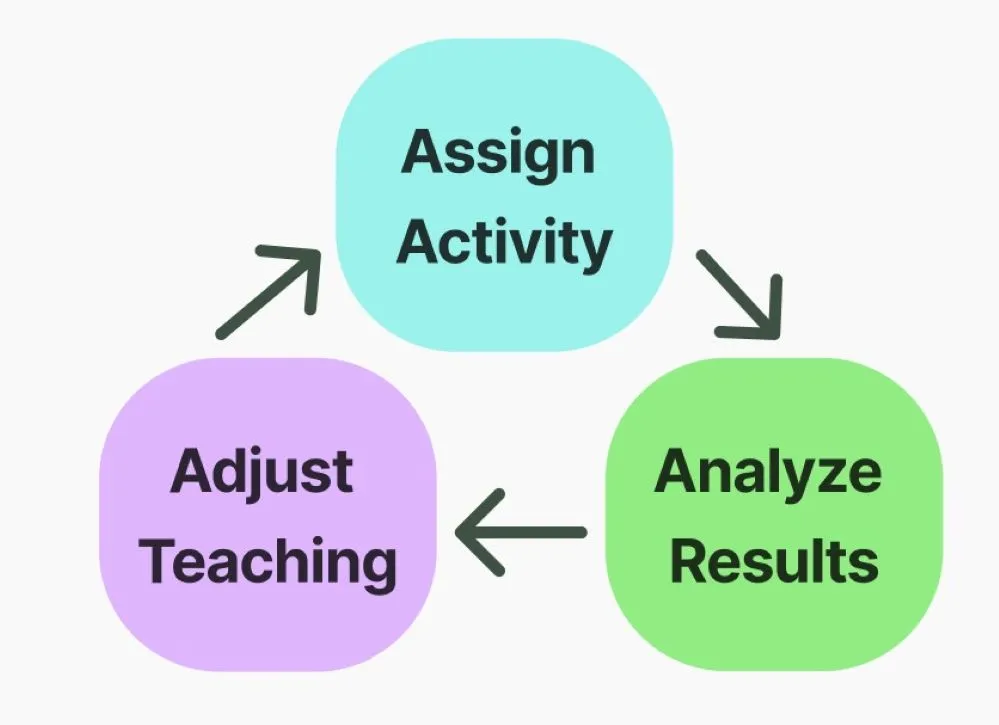
The formative assessment process generally follows three steps:
- Assign an activity
- Analyze the results
- Adjust future instruction
The most common examples of formative assessment include homework assignments, class discussions, quizzes, and informal writing prompts.
Key takeaways
- Formative assessment is an ongoing process of checking students’ understanding during learning and using what you learn to guide instruction.
- The goal is to identify learning gaps early so you can reteach skills, provide additional support, or move on when students are ready.
- Formative assessments can be simple and low-stakes, including homework, quizzes, class discussions, quick writes, and other classroom activities.
- The key difference between formative and summative assessment is how and when you use the results: Formative assessments inform instruction during a unit, while summative assessments measure learning at the end.
Formative assessment definition
Formative assessment has two closely related definitions:
- The ongoing process of monitoring your students’ learning and adjusting your teaching strategies to meet them where they are
- An activity or assignment that’s specifically designed for that purpose
Formative assessments include homework assignments, daily classwork, partial drafts, or other activities that don’t have a huge impact on the student’s overall grade. While most units include these activities, they become formative assessments when you:
- Use them to check students’ progress with a specific learning objective.
- Analyze students’ performance to find out how well they met the objective.
- Use that data to meet students where they are and fill in the gaps.
The key is what you do with the information.
This simple assignment becomes a formative assessment when you evaluate those thesis statements and use your findings to plan or adjust the next lesson. If most students are struggling, you might spend another day practicing thesis statements. Or, if most students learned the skill, you can move on to the next skill, like how to write body paragraphs.
Formative vs summative assessment
In order to understand how a formative assessment works, it’s helpful to think about how it differs from a summative assessment, which is a test, project essay, or other major assignment at the end of a unit. The biggest difference is how you use the information.
| Key differences | Formative Assessment | Summative Assessment |
|---|---|---|
| Formality | Informal | Formal |
| Purpose | To find out whether you need to reteach a specific skill or make other adjustments to target the learning gap | To measure students’ overall success with all of the objectives in the unit |
| Grading weight | Low (doesn’t make or break a final grade in the course) | High (affects a significant portion of the final course grade) |
| Frequency | Multiple days that a unit is in progress (and often daily) | Once at the end of a unit |
| When it happens | During learning | After learning |
Formative assessment process
Formative assessment works best as part of an ongoing cycle. You start with what students need to learn, check their progress along the way, and use what you learn to adjust your teaching strategies. The process typically looks like this:
- Identify the learning objectives. Determine what students should know or be able to know by the end of the unit.
- Design the summative assessment. Decide how students will demonstrate that they’ve met the learning objectives at the end of the unit.
- Design lesson plans with formative assessments for each objective. Plan activities or assignments that give you opportunities to check students’ progress toward each objective.
- Analyze student performance on each formative assessment. Look for patterns in what students understand, where they’re struggling, and which misconceptions need to be addressed.
- Adjust the next lesson plans accordingly. Use what you learned to decide whether to reteach a skill, provide additional practice, offer extra support, or move on.
- Deliver the summative assessment. Once students have practiced and demonstrated the skills, use the summative assessment to measure their overall success with the unit’s objectives.
The important thing to remember is this process isn’t always linear. You may move back and forth between instruction, assessment, and adjustment several times during a unit.
Formative assessment examples
Formative assessments don’t have to be complicated or time-consuming. A quick activity can give you valuable information about what students understand and where they need more support. Here are nine formative assessments you can use in your classroom.
Mind map
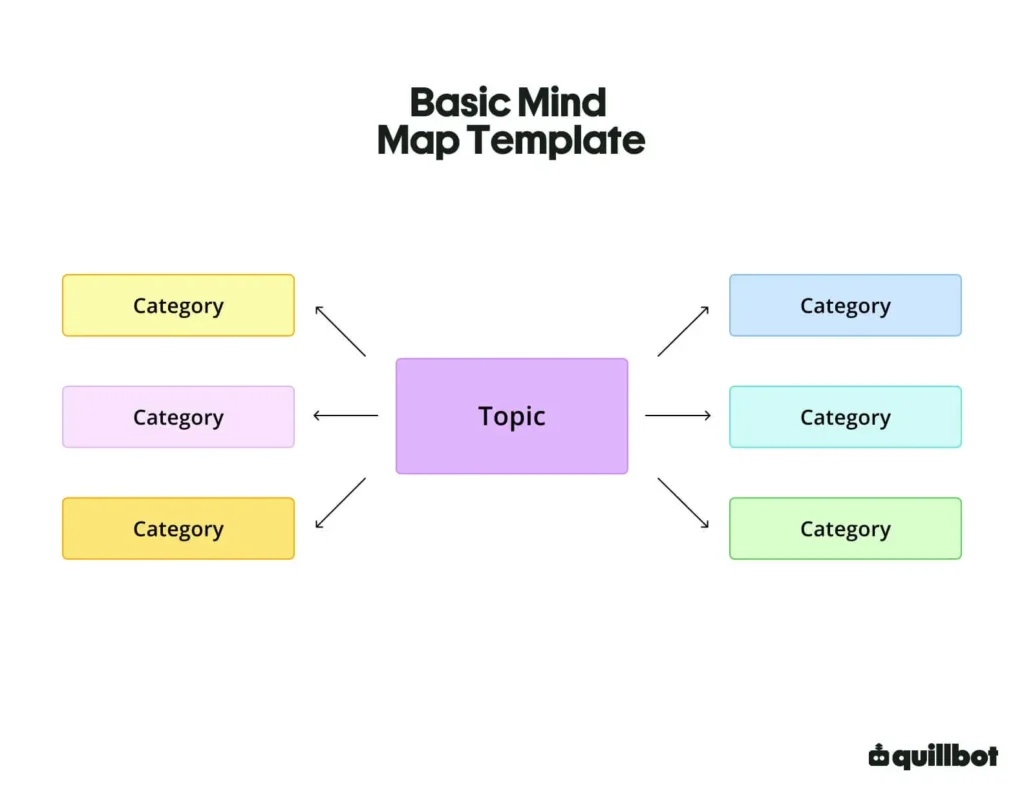
Ask students to create a mind map that shows what they know about a topic and how different concepts connect. To make a mind map, students start by writing the central concept in the middle of the page and then draw branches for different categories.
For example, after a history lesson on the stock market crash of 1929, students could map the causes and effects. For a biology lesson, they might map the process of cellular respiration, or for an essay-writing unit, they might map the reasons and evidence in a writing sample.
Reviewing their maps helps you see whether students understand the relationships between concepts, not just whether they can recall individual facts.
Quick write
Give students a question or prompt and ask them to write a short response in a few minutes. You might ask students to explain a new concept in their own words, summarize what they learned, or apply the concept to a new situation.
Quick writes are particularly useful because every student has to demonstrate their understanding. You aren’t relying on the students who volunteer answers during a class discussion.
Likert scale self-assessment
At the beginning of a lesson, give each student a list of the concepts that the lesson will cover with a column to rank how well they understand each concept on a Likert scale of 1–5. For example, a lesson on citing sources might cover these concepts:
- Signal phrases
- Parenthetical citations
- Citing sources without an author
- Paraphrasing
- Quoting
By rating their level of understanding, students get to reflect on their learning while giving you a quick overview of where the class may need additional support.
Empty outline
Give students an outline of a lecture, reading, or discussion topic with some of the details removed. Have them fill in the missing information as they learn.
An empty outline is a useful way to scaffold outlining while checking whether students understand the most important ideas. As the school year progresses, you might gradually guide students toward making outlines from scratch.
A variation of this formative assessment is an empty chart with rows and columns labeled or a graphic organizer with a different box for each category of information.
Venn diagram
Ask students to use a Venn diagram to compare and contrast two concepts, characters, texts, historical events, or other topics. The overlapping section gives students a visual way to identify similarities, while the outer sections show what makes each topic unique.
For example, after reading two short stories, students could compare the main characters or settings.
Reviewing their diagrams can help you see whether students can apply a concept or skill across different examples and recognize how it works in different contexts.
Mini whiteboards
Distribute mini whiteboards and dry erase markers to every student. Throughout the lesson, ask
students to answer a question or solve a problem and hold up their answers at the same time.
This gives you an immediate snapshot of the entire class’s understanding. If most students have the correct answer, you can keep moving. If many students are struggling, you can pause and address the gap before introducing a new concept.
Three facts and a lie
Have each student write three true statements and one false statement about a topic they’re studying, such as a historical event, novel, or scientific phenomenon.
This can be a fun way to review material while checking whether students understand important details and can distinguish accurate information from misconceptions.
You can also ask students to explain why the false statement is incorrect. That extra step can give you more insight into whether they understand the concept or are simply guessing.
Teach it to a beginner
Ask students to explain a concept as if they were teaching it to someone who has never learned about it before. For example, you might ask them to explain a scientific process or summarize a historical event.
Their explanations can reveal whether they truly understand the concept or are relying on memorized definitions. This type of reflection and explanation can make student thinking more visible.
Frayer model
Use a Frayer model to help students explore a new vocabulary word or concept. The model divides a page into four sections where students define the term, describe its characteristics, provide examples, and list non-examples.
For example, when learning about mammals, students could define the term, identify characteristics that mammals share, give examples of mammals, and provide examples of animals that aren’t mammals.
Reviewing students’ Frayer models helps you see whether they understand a concept beyond simply memorizing a definition. It can also reveal misconceptions or areas where students need more practice.
Frequently asked questions about formative assessment
- What is the difference between formative and summative assessment?
-
Formative assessment is an ongoing process that teachers use to monitor student learning and adjust instruction based on what they discover. It can include quizzes, writing prompts, discussions, exit tickets, and other activities that provide evidence of students’ understanding during a lesson or unit.
Summative assessment evaluates how well students have met learning objectives at the end of a unit or course, often through a final exam, project, or other graded assignment. While formative assessment helps teachers decide how to adjust instruction, summative assessment measures what students have learned.
Understanding the difference between formative and summative assessment helps teachers choose the best instructional strategies for their students. Quillbot’s AI Chat can help you brainstorm ways to use effective strategies in your classroom.
- What does formative assessment mean?
-
Formative assessment is an educational term for a low-stakes classroom activity or homework assignment that teachers use while a unit is in progress in order to understand what students have learned and how to tailor upcoming lessons to meet their needs.
For example, a quiz or an exit ticket becomes a formative assessment when the teacher:
- Gathers and analyzes data about the specific learning objectives that students met or struggled with
- Adapts upcoming lessons to target gaps or needs
- Gives targeted feedback to help students adjust their learning strategies
Looking for a quick way to make formative assessments? Ask Quillbot’s AI Chat to generate exit tickets, quizzes, writing prompts, and more.
- Is an exit ticket a formative assessment?
-
Yes, an exit ticket is a formative assessment that students submit at the end of a class period. An exit ticket is an answer to one or more questions that students turn in as they’re leaving so that the teacher can assess how well each student met the lesson plan objectives.
Teachers use exit tickets to gather data about student learning so that they can target gaps and address student needs by modifying upcoming lesson plans or conferencing with students one-on-one.
Looking for fresh exit-ticket ideas? Quillbot’s AI Chat can suggest questions or writing prompts to target specific learning objectives.
Other interesting articles
If you want to know more about colors, letters, or the meaning of emojis, make sure to check out some of our other articles with explanations and examples.Cite this Quillbot article
We encourage the use of reliable sources in all types of writing. You can copy and paste the citation or click the "Cite this article" button to automatically add it to our free Citation Generator.
Routh, N. (2026, September 11). What Is a Formative Assessment? | Definition, Tips & Examples. Quillbot. Retrieved September 15, 2026, from https://quillbot.com/blog/education/formative-assessment/