
Letter S | Origins, Fonts, Designs & Word Lists
The letter S is one of the most frequently used letters in English writing, partly because of its role in plurals, possessives, and present-tense verbs. More than 35,000 English words start with S, including “summer,” “star,” “silver,” and “salt.” With so many words, names, and designs that include S, understanding its shape and possibilities helps you make stronger choices in creative projects.
This guide takes a closer look at where the letter S came from, how typography affects its curves and proportions, and how designers can put their own spin on the letterform. You’ll also find a curated collection of words that start with S for inspiration.
With Quillbot’s Image Generator, you can quickly prototype letter S designs of all kinds.
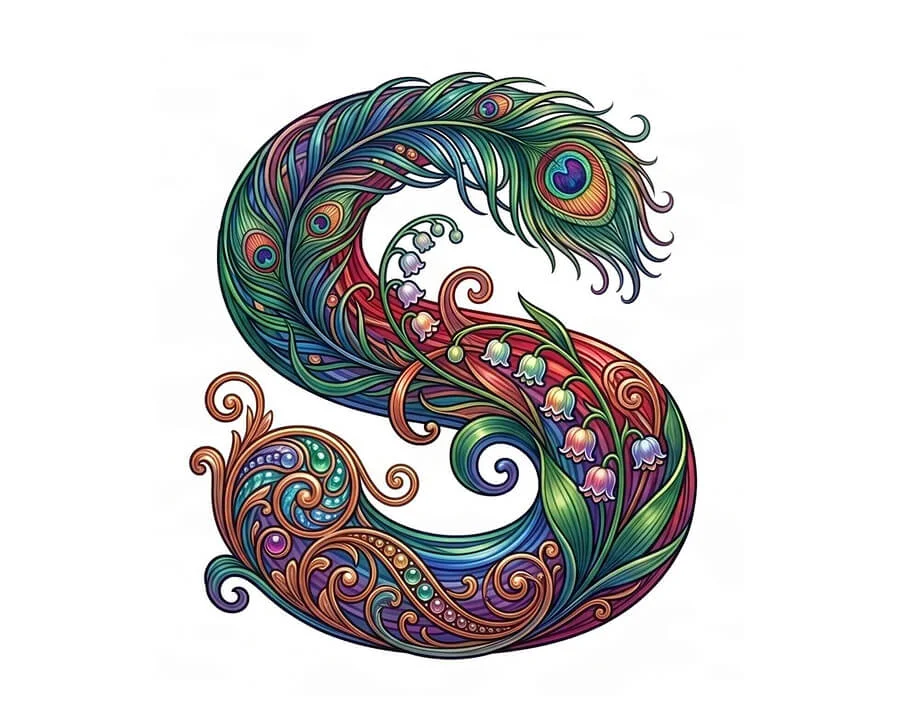
Key takeaways
- S has a distinctive signature curve. Its flowing shape gives the letter a unique personality that can look elegant, playful, bold, or sleek depending on the design.
- Small typographic details can transform S. Changes to its curves, proportions, stroke weight, terminals, and serifs can dramatically alter its appearance.
- Understanding S can strengthen your designs. Learning its anatomy and how typefaces interpret its shape can help you make more intentional lettering and typography choices.
- S offers endless creative inspiration. From decorative lettering and monograms to patterns, illustrations, and custom designs, its versatile shape provides plenty of ways to experiment.
Letter S history
The letter S has a long history that stretches from ancient writing systems to the modern Latin alphabet. Its Phoenician and Greek ancestors show how a letter can change in both shape and sound.
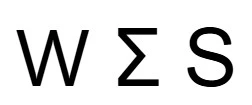
- Phoenician shin (around 1000 BCE): An early ancestor of the letter S was the Phoenician letter shin, which looked like the modern-day W and represented a “sh” sound. The name shin is related to the Semitic word for “tooth,” which is why the symbol looks like a simple side view of a molar.
- Greek sigma (around 800 BCE): When the Greeks adapted the Phoenician alphabet, they adopted shin as the ancestor of sigma (Σ). Because Ancient Greek did not have the /ʃ/ sound, sigma represented /s/ instead. Early Greek alphabets used several angular forms of the letter, including four-stroke and simplified three-stroke variants, creating an important link between the Phoenician sign and later S shapes.
- Etruscan and Latin S (around 700–500 BCE): The Etruscans adopted a Western Greek form of sigma, and the early Romans inherited the letter through the Etruscan and Western Greek tradition. Early Latin S could appear angular or curved, and the curved form gradually became more familiar. Over time, these variations developed into the uppercase S used in the modern Latin alphabet.
Phoenicia shin, Greek sigma, and capital S
Anatomy of the letter S
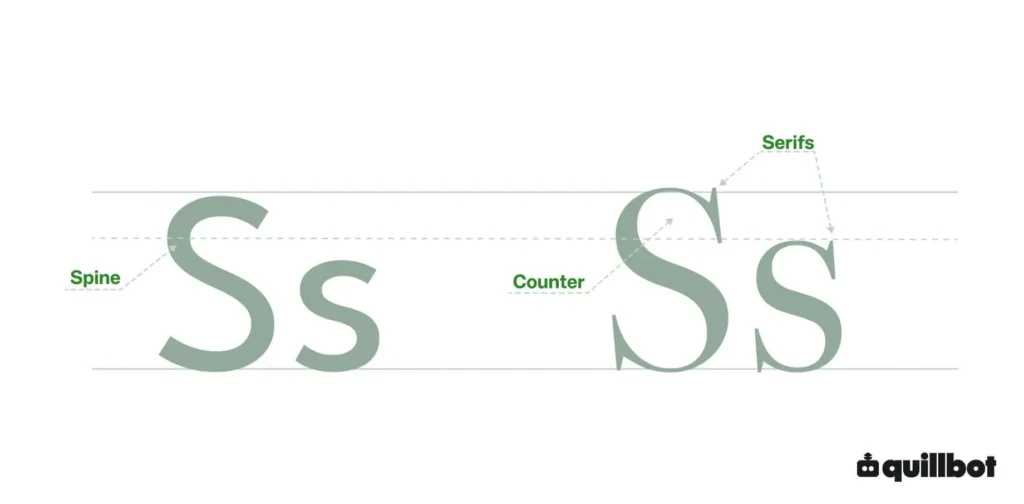
Understanding the structure of the letter S helps you choose typefaces and designs that match the mood of a project. The letter S is made of two opposing curves connected through a central spine. Unlike letters with straight stems, like T or L, the letter S depends heavily on curvature and visual balance. When working on a letter S design, pay close attention to these components:
- Upper curve: The top portion of the letter
- Lower curve: The lower portion of the letter
- Spine: The central portion that connects the two curves and determines much of the letter’s movement and personality
- Terminals: The ends of each curve, which can be blunt, angled, rounded, tapered, or decorated with serifs
- Counters: The open spaces inside the curves, which affect the letter’s legibility
- Stroke: The line that forms the letter, which can have a uniform or contrasted weight
Letter S in different typefaces
The shape and proportions of the letter S change from one typeface to another. When choosing a font for an S lettering project, consider the variations outlined below.
- Serif vs sans-serif fonts: Times New Roman and other serif fonts use decorative finishing strokes at each end of the letter S. The shape of these serifs also varies slightly across different serif fonts. Some serif fonts use bracketed serifs that taper at the ends, whereas slab serif fonts have serifs that are more of a straight line. Sans-serif fonts, like Arial and Helvetica, have clean terminals without serifs.
- Stroke contrast: In most sans-serif fonts, the letter S has a consistent weight, but in some serif fonts with stroke contrast, like Georgia, the strokes become thinner and thicker as the curves change direction.
- Spine angle: The angle and position of the spine also vary. For example, the wider proportions of Montserrat create a more open and expansive letter S.
- Counter proportions: The upper and lower interior spaces can be similar in size or intentionally different. A smaller upper counter and larger lower counter can make the letter S stand out.
- Terminals: The ends of the letterform may be flat, rounded, tapered, angled, or ornamental, adding another layer of personality.
| Arial |
Ss |
| Calibri |
Ss |
| Georgia |
Ss |
| Helvetica |
Ss |
| Lexend |
Ss |
| Montserrat |
Ss |
| Open Sans |
Ss |
| Roboto |
Ss |
| Times New Roman |
Ss |
| Verdana |
Ss |
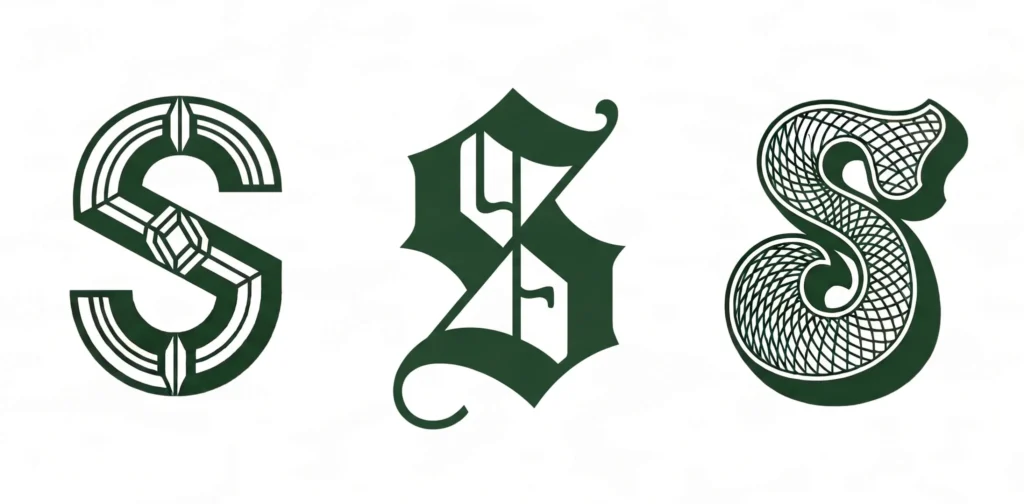
Creative letter S designs
In addition to the font variations, there are countless ways to transform the letter S into a visual design element. Consider these ideas for logos, crafts, posters, personalized gifts, or digital graphics.
- Animal-themed S: Create an S-shaped snake, salamander, swan, or other animal that starts with S, or design the letter with an animal print, like scales or feathers.
- Art Deco S: Combine graceful curves with geometric structure and symmetrical details for an elegant look inspired by the 1920s and 1930s.
- Cartoon S: Exaggerate the curves and proportions of the letter to create a lively character suitable for children’s illustrations, comics, stickers, and playful graphics.
- Decorative S: Embellish the letter with scrollwork, flourishes, ornamental details, or intricate linework for invitations, monograms, certificates, and display pieces.
- Floral S: Decorate the spine with vines, leaves, flowers, or other botanical elements.
- Geometric S: Build the letter from clean curves, straight segments, or repeated shapes for a modern, structured appearance in logos, posters, and contemporary designs.
- Retro S: Give the letter a nostalgic appearance with vintage-inspired curves, bold outlines, and period-specific details for signs, posters, logos, and throwback designs.
- Shadowed S: Pair the letter with offset shadows, layered outlines, or dimensional edges to create depth and make the form stand out from its background.
- Split monogram S: Divide the letter into sections and combine it with a name, initials, date, or other personalized text for a distinctive design suited to wedding stationery, gifts, family crests, logos, and personalized artwork.
- Textured S: Incorporate materials, surface effects, or visual details such as wood grain, marble, fabric, paint, or metallic finishes to give the letter a distinctive tactile quality.
Words that start with S
Looking for words that start with S to include in a project? The words below are organized by theme to help you find inspiration.
- Actions: Scatter, scratch, shatter, shift, shine, skip, slide, slip, slither, soar, sparkle, spin, spiral, sprinkle, spritz, squeeze, stroll, strut, swagger, sweep
- Art and design: Sculpt, sculpture, shadow, shape, sheen, shimmer, silhouette, spacing, spectrum, spiral, statue, stroke, structure, studio, style, surface, swatch, symmetry
- Animals and nature: Safari, sagebrush, salamander, salmon, sandhill, sandpiper, sapling, savannah, seed, seedling, sequoia, sparrow, sprout, sprig, spruce, stream, sunflower, sunlight, swallowtail, swan, sycamore
- Business and commerce: Salary, sale, scale, sector, service, shares, shareholder, showroom, software, solution, specialist, staff, stakeholder, startup, stock, store, strategy, streamline, success, supervisor, supplier, supply, synergy, system
- Coastal vibes: Sail, sailboat, sailor, saltwater, sand, sandbar, sandcastle, sea, seabreeze, seafoam, seashore, seashell, shark, shell, ship, shore, shoreline, splash, sunset, surfing,
- Communication and expression: Sarcasm, satire, saying, salutation, script, secret, semantics, sentence, sentiment, sign, signal, signature, simile, slang, slogan, speak, speech, statement, story, storytelling, subtext, suffix, suggestion, summarize, summary, syllable, syllabus, symbolism, synonym, syntax
- History and mythology: Sabertooth, Sagittarius, samurai, sarcophagus, Saturnalia, Shakespeare, siren, Socrates, sorcerer, sorcery, Sparta, sphinx, statue, Stonehenge, sword
- Food and dining: Saffron, sage, salad, salami, salmon, salsa, salt, sambuca, samosa, sandwich, sangria, sassafras, satiated, satisfying, sauce, sausage, sauté, savory, scallop, sesame, sizzle, silverware, smoothie, sorrel, soup, spaghetti, spearmint, spice, spicy, spoon, steak, stemware, stove, strawberry, streusel, strudel, sugar, supper, sushi, sweets
- Fashion and luxury: Sachet, salon, sandal, sapphire, sash, satin, scarf, sequin, silk, silver, skincare, sleek, slipper, sophisticated, spa, style, stylish, stunning, suave, suede, suit, sunglasses, supermodel
- Imagery: Scarlet, shadow, shine, smoke, snow, soap, sparkle, stars, steam, storm, suds, sunlight, swirl
- Music: Samba, saxophone, serenade, sing, singer, song, songwriter, soul, sound, soundtrack, stereo, stringband, swing, symphony
- Spirituality: Sabbath, sacral, sacrament, sacred, sacrifice, saint, salvation, sanctimony, sanctity, sanctuary, savior, scripture, sermon, shrine, soul, spirit, spiritual, spirituality
- Western vibes: Saddle, saloon, sheriff, showdown, silver, spur, stable, stagecoach, stallion, steer, Stetson, stirrups, stud
Sibilance works especially well in slogans, poetry, headlines, advertising, and creative writing. Pairing several S words creates a soft, flowing sound.
Other letters of the alphabet
For details about other letters of the alphabet, check out these articles.
| Letter A | Letter F | Letter K | Letter P | Letter V |
| Letter B | Letter G | Letter L | Letter Q | Letter W |
| Letter C | Letter H | Letter M | Letter R | Letter X |
| Letter D | Letter I | Letter N | Letter T | Letter Y |
| Letter E | Letter J | Letter O | Letter U | Letter Z |
Frequently asked questions about the letter S
- What are some adjectives starting with S to describe a person?
-
Some adjectives that start with S to describe a person include:
- Serious
- Sincere
- Shy
- Smart
- Studious
- Suave
- Silly
- Sassy
- Sarcastic
- Spirited
- Sweet
- Snuggly
- Sunny
- Sensitive
- Sentimental
- Sophisticated
- Strong
If you’re looking a specific adjective or word that starts with the letter S, ask Quillbot’s AI Chat for suggestions.
- What are some funny words that start with S?
-
When you need funny words that start with S, these ideas might do the trick, depending on the context:
- Sappy: Sweet and sentimental in a way that’s so extreme that it’s embarrassing or funny
- Sassy: Confident and energetic in a playful way
- Satire: The use of humor to criticize something you consider unfair, problematic, or corrupt
- Scamp: Playful and mischievous young person
- Schnozzle: A funny word for a nose
- Silly: Lighthearted and amusing
- Slapstick: A type of comedy with horseplay
- Snooker: To trick
- Snozzberry: A fictional fruit in Road Dahl’s book Charlie and the Chocolate Factory
- Supercalifragilisticexpialidocious: A word from Mary Poppins for when you have nothing else to say
Whether you’re writing a funny story or message, or seeking other words that start with the letter S, Quillbot’s AI Chat can help you brainstorm ideas.
- What are some letter S craft ideas?
-
Ideas for a letter S craft include:
- Fabric letter S with fiber filling for a throw pillow or playful wall decoration
- Wooden or MDF letter S decorated with paint, contact paper, découpage, or sticky gems
- Collage of words that start with S or related images cut from magazines, junk mail, or other printed materials
- Letter S made from fuse beads in a fun pattern, like stripes or flowers
- Letter S made from paper quilling (rolled strips of paper that are glued together to form shapes and designs)
- Friendship bracelet with a name or saying that starts with S
- Cross stitch or needlepoint wall art with a name or saying that starts with S
Quillbot’s Image Generator can help you prototype letter S designs so that your DIY projects go smoothly.
Other interesting articles
If you want to know more about colors, letters, or the meaning of emojis, make sure to check out some of our other articles with explanations and examples.