
What Is Triangulation in Research? | Definition & Examples
Triangulation in research is the process of using more than one source of data, method, theory, or researcher to investigate the same research question. By examining a topic from multiple perspectives, researchers can improve the credibility of their findings, strengthen validity, and minimize the impact of bias.
Although triangulation is most commonly associated with qualitative research, it is also widely used in quantitative studies. In mixed methods research, methodological triangulation is an essential part of the research design because it combines both qualitative and quantitative approaches.
- Qualitative research: Conduct in-depth interviews with different groups, such as employees, managers, and executives.
- Quantitative research: Conduct an observational study and have several researchers independently analyze the collected data.
- Mixed methods research: Begin with a quantitative survey, then follow up with semi-structured interviews to gain deeper insights.
Key takeaways
- There are four main types of triangulation: methodological, data, investigator, and theory triangulation. They each offer a different way to reduce bias and gain deeper insights.
- Triangulation strengthens research quality by combining multiple methods, data sources, researchers, or theories to produce more credible and reliable findings.
- Using triangulation improves validity and provides a more complete understanding of complex research questions, although it often requires more time, resources, and careful planning.
Types of triangulation in research
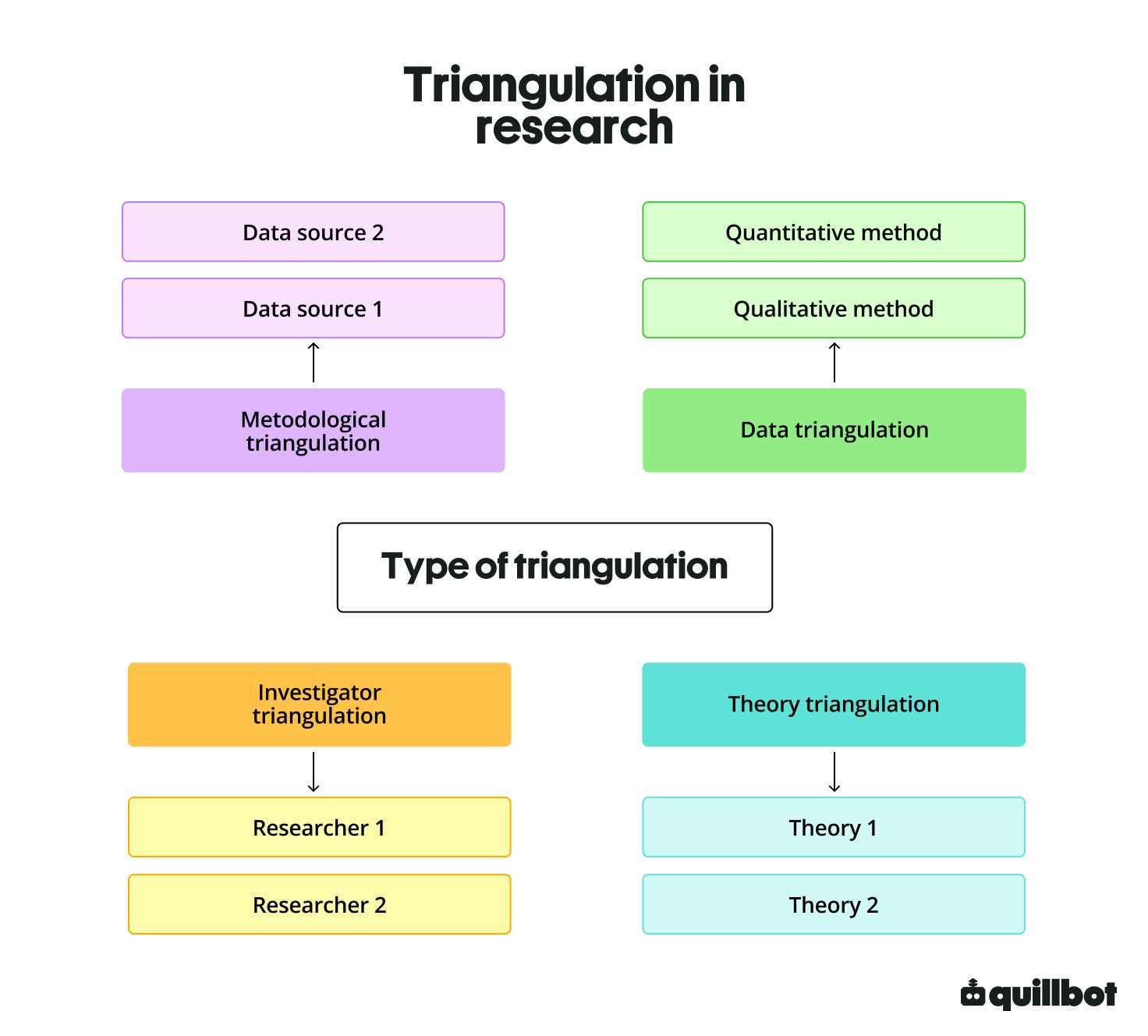
Researchers generally recognize four main types of triangulation in their research designs:
- Methodological triangulation: Using multiple research methods to examine the same research question
- Data triangulation: Collecting data from different people, locations, or time periods
- Investigator triangulation: Having multiple researchers collect or analyze the data
- Theory triangulation: Interpreting findings through different theoretical frameworks
To better understand these approaches, let’s use a practical example.
Methodological triangulation
When you use methodological triangulation, you use different methods to approach the same research question.
This is the most common type of triangulation, and researchers often combine qualitative and quantitative research methods in a single study.
- You administer standardized reading tests before and after the teaching program to measure improvements in reading ability.
- You observe classroom lessons to see how students interact with each reading method.
- You conduct a focus group for teachers and students to gather their experiences and opinions.
Each method provides unique insights. Test scores measure academic progress, classroom observations capture learning behaviors, and interviews reveal experiences that numbers alone cannot explain.
By combining these methods, you reduce the limitations of relying on a single research approach.
Data triangulation
Data triangulation involves collecting information from different sources, locations, or periods to strengthen your findings.
To determine whether your findings apply more broadly, you repeat the study in schools from different regions, including urban and rural communities. You also compare results across different grade levels, such as 2nd and 4th grade. age groups, such as Year 2 and Year 4 students.
Using data from multiple schools, age groups, and settings makes it easier to determine whether the effectiveness of each reading method is generalizable beyond a single classroom.
Investigator triangulation
Investigator triangulation involves multiple researchers participating in data collection or analysis to reduce individual bias, such as observation bias or experimenter bias.
Each observer records how engaged students appear, how often they participate, and how effectively teachers implement each reading strategy.
Afterward, the researchers compare their notes and discuss any differences in their observations before reaching a final interpretation.
Having multiple researchers evaluate the same lessons improves consistency and reduces the influence of personal opinions.
Theory triangulation
Theory triangulation means interpreting the same findings through multiple theoretical perspectives.
- Cognitive learning theory suggests the method is effective because it improves memory, decoding, and language processing.
- Social learning theory argues that students learn more successfully because the reading activities encourage discussion, collaboration, and peer support.
You analyze your findings from both perspectives to determine whether improvements are driven primarily by individual cognitive development, social interaction, or a combination of both.
Examining the data through multiple theoretical lenses provides a more balanced interpretation and may reveal that several factors contribute to children’s reading success.
What is the purpose of triangulation?
Researchers use triangulation to gain a broader understanding of complex topics while improving the overall quality of their research.
Verifying evidence
When findings come from only one source, it’s difficult to know whether they accurately represent reality.
Triangulation allows researchers to compare evidence from multiple sources or methods. If the results point to the same conclusion, confidence in the findings increases.
This strengthens the credibility of the research by showing that different forms of evidence support the same outcome.
To verify these findings, you also observe classroom lessons and interview teachers. During observations, you notice that students using phonics participate more confidently in reading activities. Teachers also report that these students are becoming more independent readers.
Because the test results, classroom observations, and teacher interviews all point to the same conclusion, you can be more confident that the phonics approach is genuinely improving students’ reading skills rather than the results being due to chance or bias.
Building a more complete understanding
Every research method has strengths and weaknesses. Depending on only one approach may leave important aspects of a problem unexplored.
- Standardized reading assessments to measure improvements in reading ability
- Classroom observations to see how students engage with reading activities
- Focus groups with teachers and students to explore their experiences and opinions
The reading tests reveal which teaching method leads to the greatest improvement in reading performance. Observations show which lessons keep students engaged and motivated, while focus groups explain why students enjoy certain activities or struggle with others.
Together, these methods provide a much richer understanding of the effectiveness of each reading approach than any one method could on its own.
Improving validity
Validity refers to how accurately a research method measures what it is intended to measure. Triangulation improves validity by combining methods that balance one another’s weaknesses.
Classroom observations allow researchers to see how students participate during reading lessons, but children may behave differently when they know they are being observed.
Interviews with teachers and students offer valuable insights into learning experiences, although responses may be influenced by personal opinions or memory.
By combining reading assessments, observations, and interviews, you create a more accurate evaluation of each reading method. The strengths of one method help offset the weaknesses of another, resulting in findings that are both more valid and more reliable.
Advantages and disadvantages of triangulation
Like any research strategy, triangulation offers both benefits and challenges.
-
Reduces research bias
Using multiple perspectives helps minimize the biases that can result from relying on a single method, theory, researcher, or dataset. This leads to a more balanced understanding of the research topic.
-
Improves validity, reliability, and credibility
Evidence collected through different methods and sources strengthens confidence in the results. Findings supported by multiple perspectives are generally considered more reliable and accurate.
-
Time and resource intensive
Triangulation often requires additional planning, larger datasets, multiple research methods, and collaboration among several researchers.
As a result, studies using triangulation typically demand more time, funding, and effort than projects using a single approach.
-
Conflicting findings
Different methods or data sources do not always produce consistent results.
While these inconsistencies can make interpretation more challenging, they may also reveal hidden complexities and generate valuable directions for future research rather than indicating that the study has failed.
Frequently asked questions about triangulation in research
- What are the 4 main types of triangulation in research?
-
The four primary types of triangulation used in research are:
- Methodological triangulation: Combining two or more research methods to investigate the same research question.
- Data triangulation: Collecting data from different participants, settings, or points in time.
- Investigator triangulation: Involving multiple researchers in collecting, interpreting, or analyzing data.
- Theory triangulation: Examining findings through different theoretical frameworks.
- What is triangulation in qualitative research?
-
Triangulation involves using a combination of data or techniques to answer a research question. Triangulation can help you confirm the validity of your findings. This can be helpful in qualitative research, which is often subjective and vulnerable to bias.
Types of triangulation include the following:
- Data triangulation: uses data from different sources
- Investigator triangulation: has multiple people analyze data
- Theory triangulation: uses different theoretical frameworks to analyze data
- Methodological triangulation: uses different approaches to study the same phenomenon
- What are the 4 main types of interviews?
-
The four most common types of interviews are:
- Structured interviews: Follow a predefined set of questions, with both the topics and order of questions determined in advance.
- Semi-structured interviews: Use a set of planned questions or themes while allowing the interviewer to introduce additional questions as the conversation develops.
- Unstructured interviews: Do not follow a predetermined list of questions, allowing the discussion to develop naturally based on participants’ responses.
- Focus group interviews: Involve asking questions to a group of participants rather than an individual, with the goal of exploring shared perspectives, discussions, and group dynamics.
Other interesting articles
If you want to know more about colors, letters, or the meaning of emojis, make sure to check out some of our other articles with explanations and examples.