Data Scientist Resume | Tips, Examples & Templates
The fundamentals of a strong resume are the same no matter what kind of job you’re applying for. But there can be slightly different conventions depending on the specific industry or profession.
Read on for practical tips on writing a data scientist resume, with examples for both experienced and entry-level candidates.
Key takeaways
- Tailor your data scientist resume to each role by highlighting the tools, methods, responsibilities, and business problems mentioned in the job posting.
- Use a clear technical skills section so recruiters can quickly see your programming languages, data science libraries, statistical methods, and visualization tools.
- Write achievement-focused bullet points that explain what you analyzed, modeled, automated, or improved—and what impact your work had.
- Keep your resume ATS-friendly by using simple formatting with no columns, tables, images, or overly complex design elements.
- Include relevant projects if you’re an entry-level candidate or need to show practical experience beyond your work history.
Data scientist resume tips
The tips below will help you write a resume that’s targeted to the role, easy for recruiters to scan, and focused on the skills and achievements most likely to get you an interview.
1. Tailor your resume to the role
Read the job posting carefully to identify the most important tools, methods, responsibilities, and business problems it mentions. Then make sure your professional summary, technical skills section, and experience bullet points highlight the parts of your background that are most relevant to those requirements.
Recruiters don’t have much time to read each resume. They’ll often give it a quick scan and may reject it if they can’t immediately see that you meet the basic requirements for the job. Make it easy for them to see why they should take a closer look by adapting your resume to the specific role you’re applying for.
2. Write achievement-focused bullet points
Your experience section doesn’t need to list every task and responsibility from each role. Instead, focus on selected projects and achievements that show why you are a good fit for the job. Remember that your job title will usually give the recruiter a basic idea of your responsibilities, so use your bullet points to highlight the most relevant and impressive details.
For each bullet point, clearly state:
- What you analyzed, predicted, modeled, automated, or improved
- What tools, algorithms, or statistical methods you used to do this
- What positive result your work had (including a metric where possible)
For example, instead of writing “Built machine learning models for support tickets,” write something like, “Built a logistic regression ticket scoring model using NLP features, increasing escalation precision from 62% to 72% and helping support teams prioritize urgent cases faster.”
3. Make your resume ATS-friendly
Many employers use applicant tracking systems to process resumes before a recruiter reads them. To make your resume easier for these systems to read, use simple formatting without columns, tables, and images.
Adapt the resume so it uses the same terminology as the job posting where it accurately reflects your experience. For example, if the posting says “Apache Airflow,” use “Apache Airflow” rather than only writing “workflow orchestration.” If it says “NLP,” include “NLP” as well as “natural language processing” if space allows. This way, your resume is more likely to include the keywords that the ATS is looking for.

Data scientist resume example
Maya, a fictional data scientist, has written the resume below to apply for a position at a technology company. In this role, she would use machine learning, NLP, generative AI, and cloud-based model workflows to automate log analysis, support technical incident investigations, improve customer satisfaction analytics, and help technical support teams identify and prioritize recurring issues.
MAYA BENNETT Professional Summary Technical Skills Professional Experience Data Scientist | Generical Systems | Chicago, IL | July 2024–Present Junior Data Scientist | Examplify Software | Chicago, IL | June 2023–June 2024 Education
Chicago, IL
maya.bennett@email.com | 312-555-0184 | [LinkedIn profile link] | [GitHub/portfolio link]
Data scientist with 3 years of experience building NLP and classification models for support operations, customer satisfaction analysis, and technical incident prioritization. Strong working knowledge of Python, SQL, Airflow, and log analysis, with experience supporting AWS-based model workflows, generative AI prototypes, clustering, and CI/CD-enabled batch inference.
Python | SQL | NLP | Classification | Apache Airflow | ETL pipelines | Log analysis | Customer satisfaction analytics
Generative AI | LLMs | Retrieval-augmented generation | Clustering | AWS ML services | Docker | GitHub Actions | CI/CD | Incident analysis
Bachelor of Science in Statistics | Pinewoods University | Chicago, IL
When recruiters are scanning a data scientist’s resume, they’re looking for evidence that the candidate has the right technical skills and has applied them to solve relevant business problems and contribute to meaningful business outcomes.
Maya has made it easy for a recruiter to scan for this information by:
- Tailoring her resume to the job posting by emphasizing skills including generative AI, AWS cloud deployment, log analysis, and root cause analysis. Maya’s resume directly reflects these priorities by using keywords such as “NLP,” “classification,” “Apache Airflow,” “ETL pipelines,” and “log analysis.” Using these keywords from the job posting also helps with ATS screening.
- Focusing her experience section on achievements that match the requirements of the position. Instead of describing every task from her current and previous roles, Maya highlights the work most relevant to this job, such as clustering log-message patterns and incident metadata, building an NLP-based ticket scoring model, and creating Airflow pipelines for log and customer satisfaction data.
- Showing how her data science work supports real operational goals. Her bullet points are not just lists of tools and techniques; they explain how her work helped technical support teams identify recurring issues, prioritize urgent cases, reduce manual reporting work, summarize long support tickets, and predict cases at risk of missing response-time targets.
- Using specific metrics to make her achievements more concrete. For example, she says that her ticket-scoring model increased escalation precision from 62% to 72% and that her Airflow pipelines reduced manual reporting work by roughly 8 hours per week.
- Keeping the resume length to one page. Maya does this by limiting her professional experience section to selected highlights and the education section to brief details about her highest degree.
Entry-level data scientist resume
Caleb, a recent statistics graduate, has written this resume for cold applications to companies he believes may have entry-level data science opportunities. Caleb Mitchell Statistics graduate with a strong foundation in Python, SQL, statistical analysis, machine learning, and data visualization. Skilled in cleaning and analyzing datasets, building predictive models, interpreting results, and communicating findings clearly. Python | SQL | R | Pandas | NumPy | scikit-learn | Statistics | Regression analysis | Classification | Exploratory data analysis | Data cleaning | Data visualization | Tableau | Matplotlib | Jupyter Notebook | Git | Excel Data Analytics Intern | Northside Health Network | Chicago, IL | June 2025–August 2025 Statistics Department Peer Tutor | Pinewoods University | Chicago, IL | September 2024–May 2026 Bachelor of Science in Statistics | Pinewoods University | Chicago, IL | Graduated May 2026 Relevant coursework: Regression Analysis, Statistical Computing, Machine Learning, Data Mining, Database Systems, Experimental Design, Probability
Chicago, IL
calab.mitchell@email.com | 312-555-0148 | [LinkedIn profile link] | [GitHub/portfolio link]Professional Summary
Technical Skills
Work Experience
Projects
Education
Caleb’s resume shows he has the skills for an entry-level data scientist role, emphasizing a strong foundation in statistics, programming, data analysis, and machine learning.
- The professional summary is short and focused. It introduces his statistics background and highlights the main tools and skill areas recruiters will look for.
- The technical skills section includes programming languages, libraries, statistical methods, visualization tools, and workflow tools relevant to early-career data science work.
- In his work experience section, Caleb uses his internship to show that he has already worked with real organizational data. His bullet points focus on practical data tasks, demonstrating that he can apply classroom knowledge in the workplace. He also includes his peer tutor role as evidence of formal work experience and to show that he can communicate technical concepts clearly.
- He includes a project section to show that his degree program included practical work relevant to the responsibilities of a data scientist. The projects also help compensate for his limited professional experience by showing how he has applied statistical and programming skills to realistic data problems.
Data scientist resume template
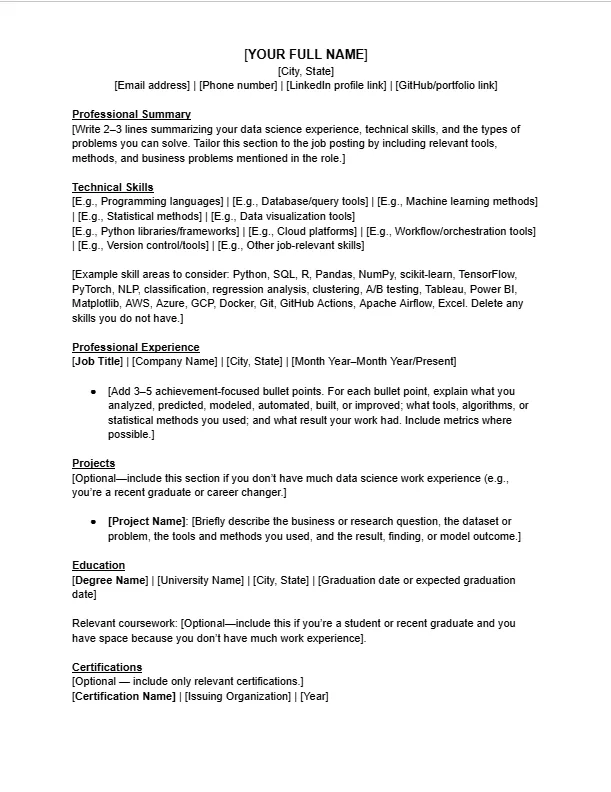
Use this data scientist resume template to create a simple, ATS-friendly resume in the same format as the examples above. The template uses only simple formatting—with no columns, tables, or images—making it easy for applicant tracking systems to read.
Frequently asked questions about a data scientist resume
- How long should a resume summary be?
-
A resume summary (aka a professional summary) should be a few lines at the top of the resume just below your name and contact information.
In 3–5 lines or a few phrases, summarize the following:
- Your professional role and years of experience (e.g. “Resourceful and results-driven retail manager with over 5 years of experience exceeding revenue goals and mentoring sales associates”)
- The main accomplishments or strengths that are relevant to the job you’re applying for (e.g., “Spearheaded recruiting and training programs that increased employee retention by 50%”)
This section used to be called an objective, but a resume summary is the current standard practice.
When you’re revising a resume to achieve the ideal resume length of 1–2 pages, Quillbot’s free Paraphraser can help you with concise word choices.
- Should I bold keywords in my resume?
-
No, you should not bold the keywords in your resume. The purpose of using keywords is to pass the initial ATS screening and to help recruiters quickly assess your fit.
However, bolding the keywords makes it look like you’re trying to trick the ATS or exaggerate your experience. Plus, an ATS doesn’t treat bold words any differently than words in plain font.
Instead, format the keywords on your resume the same way you would format other words (e.g., bold for headings, plain font for skills and work experience bullet points, etc.).
It’s always a good idea to get feedback about how well your resume uses keywords, though. Quillbot’s AI Chat is a fast and free way to check your resume for strong use of keywords.
Other interesting articles
If you want to know more about colors, letters, or the meaning of emojis, make sure to check out some of our other articles with explanations and examples.