STAR Method Interview Questions | Examples & Tips
STAR method interview questions are designed to get you to explain how you approached a specific task or challenge at work in the past. The interviewer’s goal is to gain meaningful information about one or more of your skills.
STAR stands for Situation or Task, Action, and Result, and STAR questions—also sometimes called behavioral or competency-based questions—often start with the phrase, “Tell me about …”
So, if the job requires good problem-solving skills, instead of asking, “How good are you at solving problems?” the interviewer might ask a question like, “Tell me about a difficult problem you helped to solve,” with the aim of prompting you to:
- Give an example of when you had to solve a problem at work or in another relevant setting (situation or task)
- Explain what you did to solve the problem and why (action)
- Evaluate how successful you were at solving the problem and what you learned from it (result)
The idea is that how you acted to solve a problem in the past will reveal information about your problem-solving abilities. For example, whether you’re able to identify the root causes of problems, come up with practical or creative solutions, and evaluate if your approach worked.
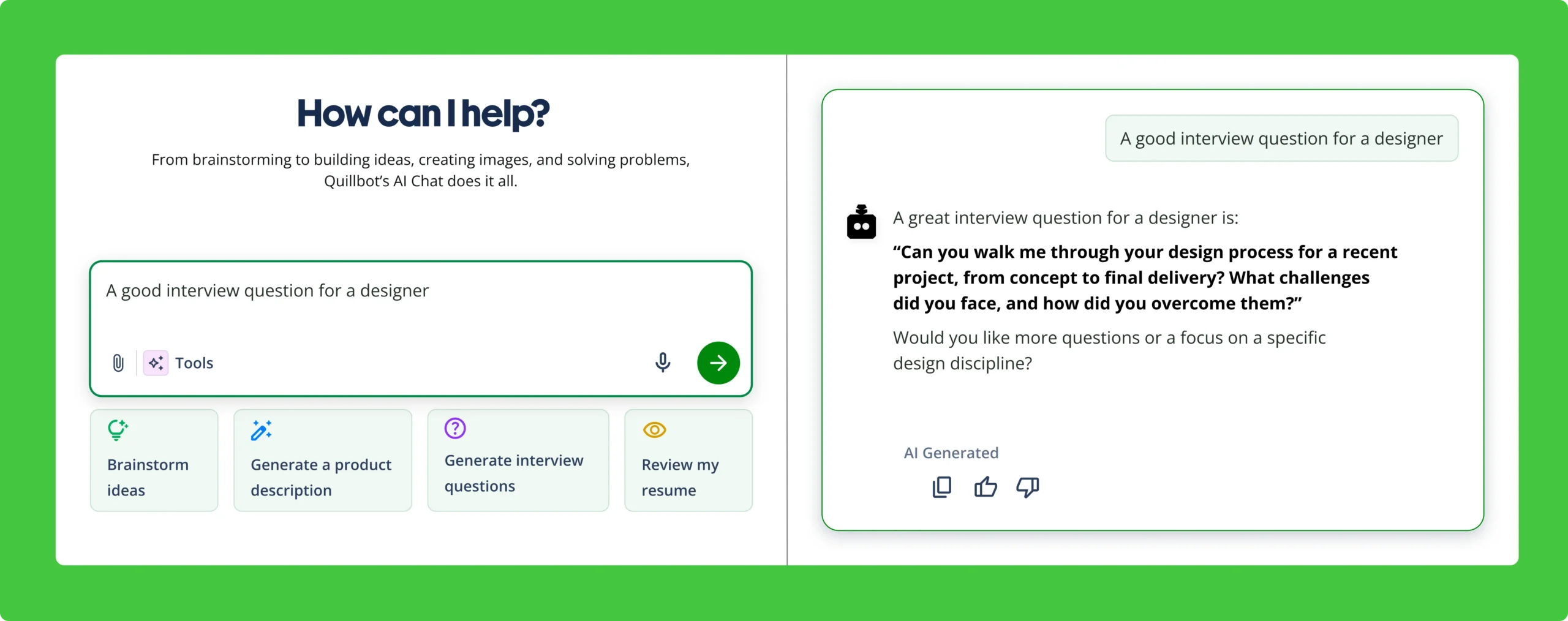
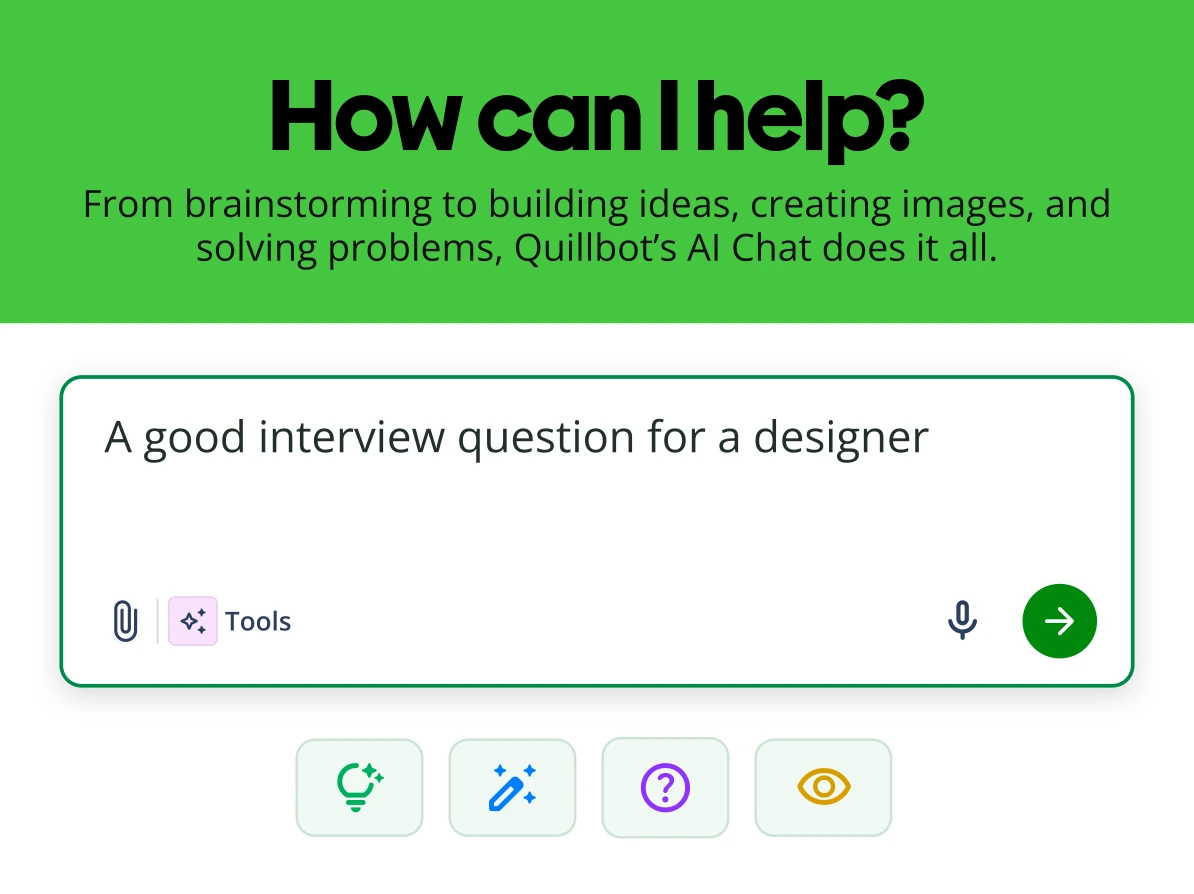
You can use tools like QuillBot’s AI Chat to help you predict the kind of STAR questions you might get asked at an interview for a specific job.
Follow-up questions: What made it especially challenging? What was your role? Why did you decide to approach it like that? What was the outcome?
Main question: Tell me about a situation where you had to use your communication skills to deal with a misunderstanding.
Follow-up questions: What caused the misunderstanding? How did you handle the conversation? What did you do to make sure the issue was resolved?
Main question: Tell me about a time when you had to use [software/tool required for the job, e.g., Excel] to complete a task or solve a problem.
Follow-up questions: What specific features or functions did you use? Why did you choose that approach? What was the result?
Main question: Tell me about a time when it became clear that you were going to miss a deadline.
Follow-up questions: How did you realize the deadline was at risk? Who did you inform? What did you do to manage the situation? What was the final outcome?
Main question: Tell me about a time when you were given more work than you could realistically handle.
Follow-up questions: How did you decide what to prioritize? What did you communicate to your manager or team? What action did you take? What happened as a result?
Key takeaways
- STAR interview questions ask you to describe a real past experience so employers can understand how you handle situations, solve problems, and apply key skills.
- The STAR method helps you structure strong answers by briefly explaining the Situation, clarifying the Task, focusing on the Action you personally took, and ending with the Result.
- Strong STAR answers are specific, relevant to the job, and focused on your individual contribution, positive outcomes, and what you learned.
- Preparing a few flexible STAR stories in advance can help you answer a wide range of behavioral interview questions with confidence.
How to answer STAR method interview questions
Since the introduction of STAR method interviewing in the 1970s, the STAR method has actually become more widely known as a way of answering interview questions rather than asking them.
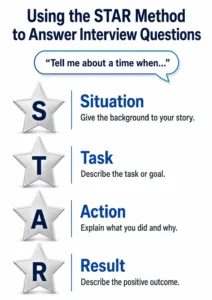
When using the STAR technique to answer questions, it helps to break down the “Situation or Task” stage into separate steps:
- Situation: Briefly give the background to the example “story” you’re going to tell.
- Task: Briefly describe the task you had to complete or the goal you had to achieve.
- Action: Talk about what you did and why you decided to do it like that in a way that showcases the skill or skills specified in or implied by the question.
- Result: Briefly describe the outcomes, focusing on positive results and what you learned.
STAR method answers
Here’s an example of how Jane Applicant, an imaginary candidate interviewing for an administrative assistant position, uses the STAR method to answer an interview question.
A: [Situation] In my second year working as a summer camp counselor, I helped with the camper registration process. This involved collecting forms from parents with important information about each child, such as allergies, medical needs, and emergency contacts.
During my first year at the camp, I had noticed that some of these forms were not always completed clearly or thoroughly. Some parents had misunderstood certain questions, while others had left out key details. I also remember that quite a few campers had arrived without important items, such as sunscreen or appropriate shoes.
[Task] My goal was to make the registration process clearer for parents and reduce the number of issues staff had to deal with after campers arrived—when we were very busy and it was difficult to solve them.
[Action] I reviewed the questions that were most often misinterpreted and suggested clearer wording. Before the start of camp, I also checked the forms carefully and contacted parents if important details were missing. And I emailed parents a packing checklist a week before the start of camp.
[Result] As a result, we spent much less time contacting parents to solve problems during the first couple of days of camp. I learned that even small improvements to a process can make a big difference to the outcome.
Jane provides a strong answer to the interviewer’s question about a specific situation from her work experience using the STAR method by:
- Giving a clear example that is relevant to the question
- Briefly explaining the situation and why the process needed improving
- Describing the specific goal she was trying to achieve
- Focusing on the actions she personally took (using “I,” not “we”)
- Showing skills relevant to the position she’s applying for, such as organization, attention to detail, and communication
- Showing that her actions led to a positive result
- Ending with something she learned, which shows she can reflect on experiences to draw conclusions that will help her going forward
How to prepare for STAR method questions
You can prepare for behavioral interview questions by making sure you have a selection of situations to draw on and then practicing how to shape them into STAR answers.
The good news is that one strong story can often be adapted to answer questions about a variety of different skills, so you don’t need as many examples as you might think. For instance, Jane’s summer camp story above could be used to answer any of the questions in the following table.
Example of using the same story for different questions
| Example STAR method interview question | Focus of Jane’s answer using her summer camp story |
|---|---|
| Tell me about a time when you showed attention to detail | How she checked the forms carefully before camp started and followed up with parents when important information was missing |
| Tell me about a time when you took initiative. | How she acted on a problem she had noticed the previous year, rather than waiting for someone else to fix it |
| Tell me about a time when you had to communicate clearly | How she made the form questions easier for parents to understand and contacted parents to clarify details |
| Tell me about a time when you solved a problem | How she identified the cause of repeated registration issues and put practical solutions in place |
| Tell me about a time when you helped prevent problems before they happened | How she checked forms in advance and created a packing checklist so staff would have fewer issues to deal with once campers arrived |
How to identify strong STAR stories
Aim to go into an interview with about five strong stories that are relevant to the role you’re applying for. These tips will help you identify them:
- Review the job posting. Identify the key skills and qualities mentioned in the posting, then think of times when you showed them in the past.
- Look back at your old resumes and cover letters. Read through any resumes or cover letters you’ve prepared for similar jobs and underline relevant details, such as notable achievements, challenging situations, or examples of responsibilities you handled well.
- Think about problems you’ve solved. Good STAR stories often involve a problem, obstacle, or challenge, such as handling a difficult customer, improving a process, meeting a tight deadline, or dealing with a mistake.
- Consider positive feedback you’ve received. Think about times when a manager, coworker, teacher, customer, or client praised your work. You can often turn these moments into strong STAR examples.
- Look for examples with clear results. Choose stories where you can explain what happened because of your actions, such as saving time, reducing errors, improving customer satisfaction, helping a team, or learning an important lesson.
- Choose stories that show different skills. Try to prepare examples that cover a range of common interview topics, such as teamwork, problem-solving, communication, leadership, initiative, adaptability, and conflict resolution.
How to practice telling STAR stories
Once you’ve chosen the situations you want to practice talking about, make brief notes for each one under the headings Situation, Task, Action, and Result.
As you make your notes, think about how each example can demonstrate the skills mentioned in the job posting. For example, if the job description emphasizes communication, problem-solving, or teamwork, choose details that show how you used those skills in the situation.
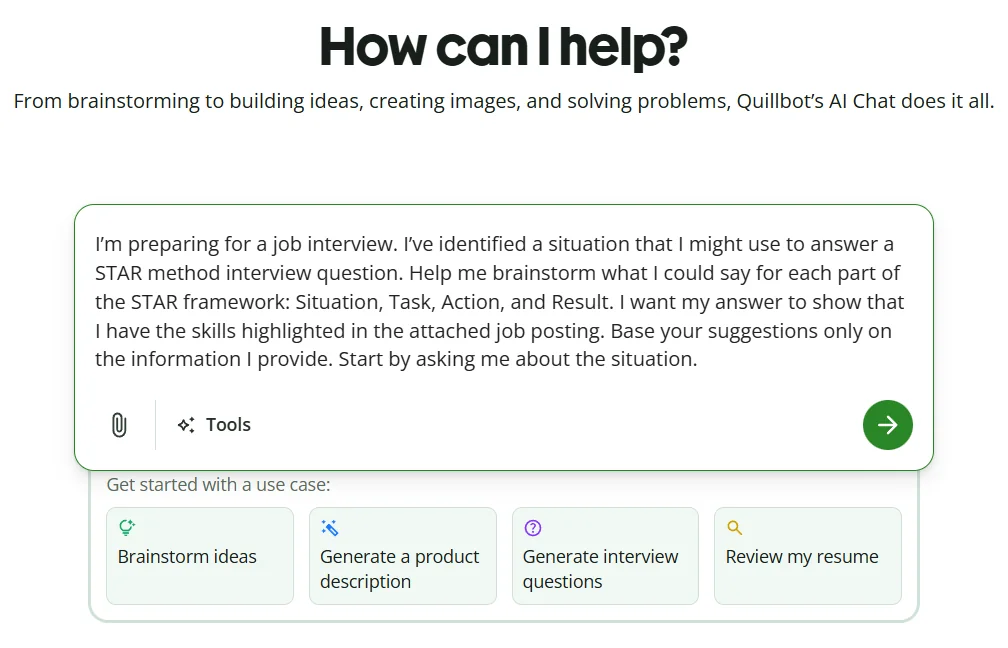
You can also use QuillBot’s AI Chat to help you brainstorm what to include. Try starting your chat with a prompt like this:
“I’m preparing for a job interview. I’ve identified a situation that I might use to answer a STAR method interview question. Help me brainstorm what I could say for each part of the STAR framework: Situation, Task, Action, and Result. I want my answer to show that I have the skills highlighted in the attached job posting. Base your suggestions only on the information I provide. Start by asking me about the situation I have identified.”
You’re now ready to start practicing answering questions using your STAR stories. Here are some tips:
- Make a deck of cards with possible behavioral interview questions for the job you’re interviewing for. Mix them up, draw a card, and practice answering the question. You can use the example interview questions in the next section to help you write the questions.
- Record your answers on your phone. This makes the practice feel more realistic and allows you to listen back and think about how you could improve your answer.
- Ask a friend to interview you. Give them the job description and ask them to think up questions starting with “Tell me about a time when …” that focus on key requirements for the job, such as attention to detail, working under pressure, or advising customers.
Examples of STAR method interview questions
You can use the following example STAR method interview questions to help predict the kinds of questions you may be asked in an interview and to think of relevant stories that showcase your skills.
STAR questions about working with other people
Many STAR questions focus on how you interact with colleagues, managers, customers, or other stakeholders. These questions help interviewers assess skills such as teamwork, communication, and conflict resolution.
- Tell me about a time when you had to work with someone whose working style was very different from yours.
- Describe a situation where you had to deal with a colleague, customer, or stakeholder who you thought was being unreasonable.
- Give me an example of a time when your actions helped resolve a disagreement.
- Tell me about a time when you helped a new coworker.
STAR questions about solving problems
Problem-solving questions are common because most jobs require you to identify issues, make decisions, and find practical solutions.
- Tell me about a time when you were faced with a difficult problem at work.
- Describe a situation where you identified and fixed a problem before it had significant consequences.
- Tell me about a time when you had to make a decision despite not having all the information you needed.
- Describe a time when your solution to a problem didn’t work.
STAR questions about leadership and responsibility
Even if you’re not interviewing for a management role, the interviewer may still ask questions that help them understand your leadership skills, such as decision-making, taking responsibility, and mentoring others.
- Tell me about a time when you took the lead on a task or project.
- Describe a situation where you had to motivate or support another person.
- Give me an example of a time when it was your responsibility to make an important decision.
- Tell me about a time when you took responsibility for something that was not going to plan.
- Describe a time when you helped a coworker or team member learn something new.
STAR questions about applying technical or role-specific skills
STAR questions can also be used to assess how you’ve applied technical or role-specific skills in real situations. These questions are especially useful when the interviewer wants to understand not just what you know but also how you use your expertise to solve problems or complete tasks.
- Tell me about a time when you used [technical skill required for the job] to solve a work-related problem.
- Describe a situation where you used [software tool or system required for the job] to complete an important task.
- Give me an example of a time when your specialist knowledge of [knowledge required for the job] helped you make a good decision.
- Tell me about a time when you had to explain technical information about [technical knowledge required for the job] to someone without your level of expertise.
STAR questions about learning, improvement, or growth
Some STAR questions focus on whether you can learn from experience. These questions help interviewers assess self-reflection, openness to feedback, and your ability to improve over time.
- Tell me about a time when you made a mistake.
- Describe a situation where it was important for you to learn something new quickly.
- Give me an example of a time when you used feedback to help you improve your work.
- Tell me about a time when you changed the way you were doing something because you realized there was a better way.
Frequently asked questions about STAR method interview questions
- What is the STAR method?
-
STAR is an acronym for “Situation or Task, Action, and Result.” The STAR method is a structured way for interviewers to gather information about candidates’ work-related skills by asking how they behaved in real situations in the past.
STAR method interview questions often start with phrases such as:
- “Tell me about a time when…”
- “Describe a situation where you had to…”
- “Give an example of how you…”
The interviewer leads the candidate to:
- Talk about a situation or task from their work experience that required them to use a specific skill or competency related to the job they’re applying for
- Describe what they did to deal with the situation or complete the task (action)
- Evaluate how successful they were at dealing with the situation or completing the task (result)
Applicants can also use the STAR method to structure strong answers to these “behavioral” or “competency-based” interview questions (e.g., “Tell me about a time when you had to work to a tight deadline”)
You can ask Quillbot’s free AI Chat to help you prepare for answering STAR questions at an interview.
- What is the STAR technique?
-
The STAR technique is another name for the STAR interviewing method.
STAR method interview questions prompt you to talk about a Situation or Task from your work experience, the Action you took to manage the situation or complete the task, and the Result of your actions (e.g., “Tell me about a time when you acted quickly to solve a problem”).
Quillbot’s free AI Chat can help you brainstorm the kind of STAR questions you might be asked in an interview.
- What is a competency-based interview?
-
A competency-based interview is an interview where you’re asked to give examples of how you dealt with situations or tasks at work in the past with the aim of revealing information about your skills, behaviors, and competencies.
STAR method interview questions are very common at this type of interview. STAR questions prompt you to talk about a Situation or Task from your work experience, the Action you took to deal with the situation or complete the task, and the Result of your actions (e.g., “Tell me about a time when you found it difficult to make a decision because you didn’t feel that you had enough information”).
Aim to go into a competency-based interview with about five situations or tasks to talk about. You can brainstorm the kind of questions that are likely to come up and the examples you can give with the help of Quillbot’s free AI Chat.
Other interesting articles
If you want to know more about colors, letters, or the meaning of emojis, make sure to check out some of our other articles with explanations and examples.