75+ Behavioral Interview Questions | Example Answers
Behavioral interview questions ask you to describe how you handled a specific work situation in the past. They often start with a phrase like “Tell me about a time …” and are sometimes called STAR interview questions or competency-based interview questions.
When interviewers ask behavioral-based interview questions, they’re typically looking for evidence of your soft skills, such as how you communicate, approach challenges, prioritize tasks, and collaborate with others.
This article includes example behavioral interview questions and answers, as well as tips on how to prepare for them and a list of common mistakes.
QuillBot’s free AI Chat can help you prepare for interviews by identifying relevant stories from your work experience that you can use to answer behavioral questions.
Key takeaways
- Behavioral interview questions are designed to uncover how you’ve handled real workplace situations, especially around soft skills like communication, teamwork, problem-solving, leadership, and adaptability.
- Strong answers use a clear structure like STAR or CAR to explain the situation, your specific actions, and the result without adding too much background.
- You don’t need to memorize dozens of answers. Preparing around five flexible work stories can help you respond confidently to a wide range of behavioral questions.
- The best responses show evidence of your skills instead of simply describing them, so focus on concrete examples, positive outcomes, and what you learned.
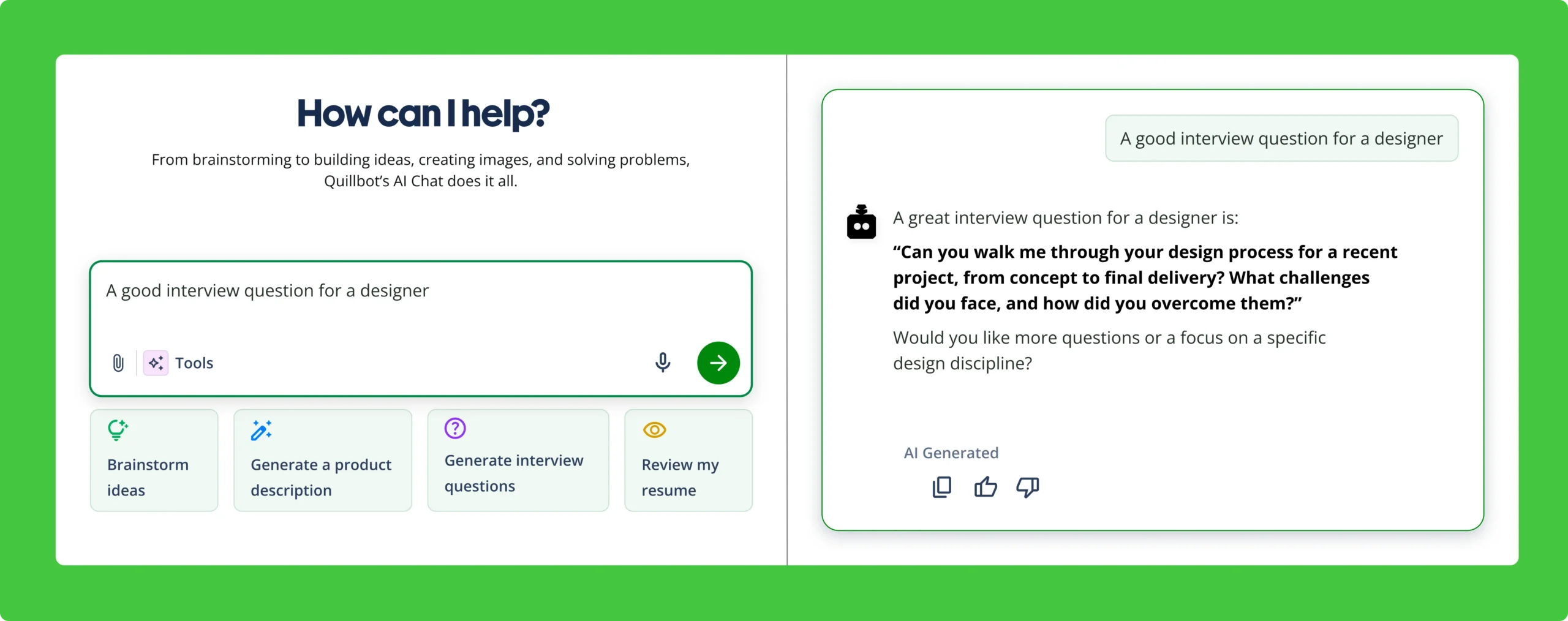
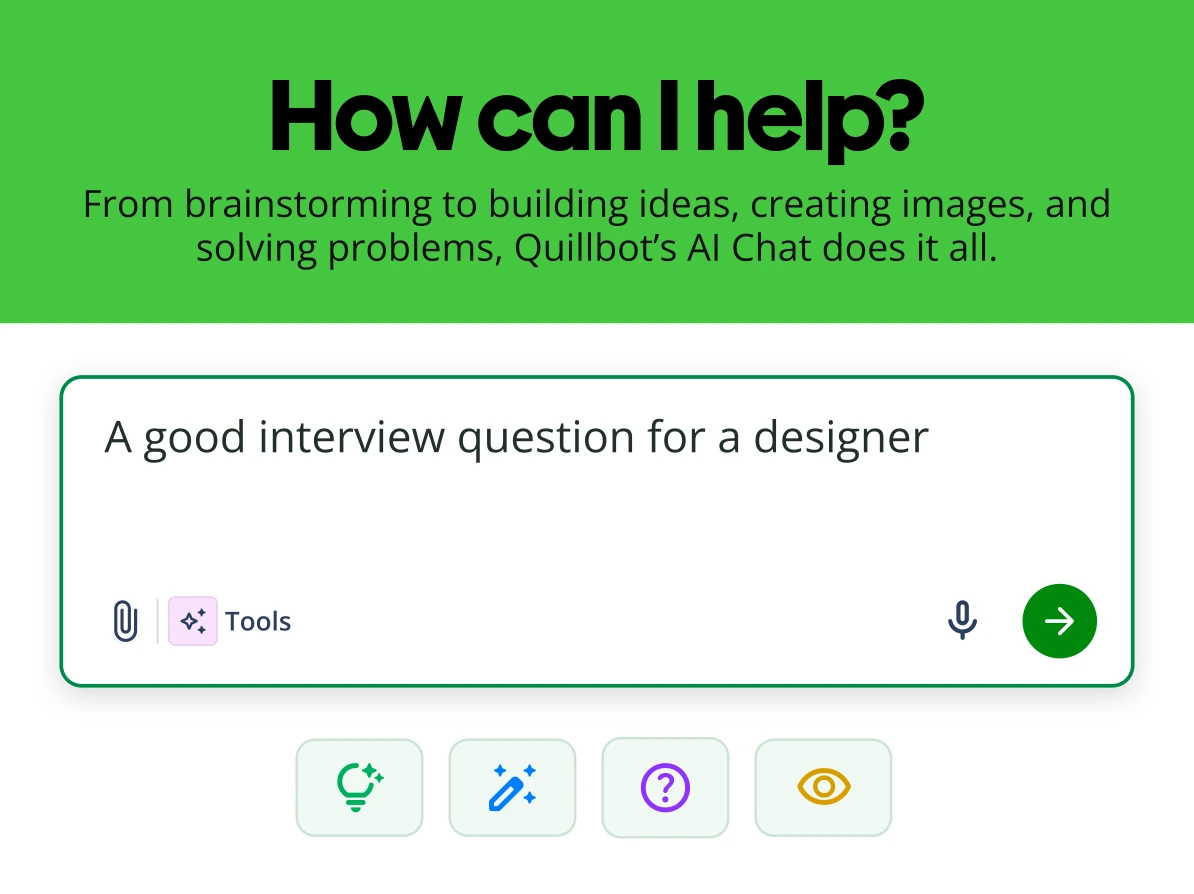
Table of contents
- What are behavioral interview questions
- Common behavioral interview questions
- Example behavioral interview questions
- How to answer behavioral interview questions
- How to prepare for behavioral interview questions
- Common behavioral interview mistakes
- Frequently asked questions about behavioral interview questions
- Other interesting articles
What are behavioral interview questions
Behavioral interview questions prompt you to talk about how you “behaved” in a real work situation in the past to reveal insights about your soft skills and personality traits.
For example, instead of asking, “Are you a team player?” an interviewer might ask, “Tell me about a time you helped a coworker succeed.” By asking this question, the interviewer is looking for evidence of the kinds of behaviors that contribute to team success, such as noticing when others need support and sharing knowledge effectively.

Common behavioral interview questions
Here are some common behavioral interview questions, along with the types of evidence an interviewer may be looking for in your answer.
| Example behavioral question | What the interviewer is looking for … |
|---|---|
| Tell me about a situation where you went above and beyond. | Initiative, taking responsibility, and acting with the team or business goal in mind |
| Give me an example of a time you had a disagreement with a coworker. | Handling conflict professionally, listening to another perspective, and working toward a constructive resolution |
| Tell us about a time when you failed to achieve a goal. | Accountability, self-awareness, resilience, and ability to learn from setbacks |
| Describe a time when you handled an especially difficult challenge at work. | Problem-solving, resilience, sound judgment, and staying calm under pressure |
| Tell me about a time you showed leadership without having formal leadership responsibilities. | Initiative, influence, confidence, and awareness of personal leadership strengths |
| Walk me through a situation where you made a mistake. | Accountability, honesty, self-awareness, and ability to learn from mistakes |
| Give me an example of a time you had to adapt to change. | Flexibility, resilience, and openness to change |
| Tell me about a time when you were expected to meet an unrealistic deadline. | Prioritization, clear communication, sound judgment, and ability to stay focused under pressure |
| Describe a situation in which you had to learn something quickly. | Adaptability, initiative, and resourcefulness |
| Give an example of when you had to work under pressure. | Resilience, composure, and prioritization |
| Tell me about a situation where you disagreed with your manager. | Professional communication, sound judgment, and confidence to discuss concerns with senior colleagues |
| Tell us about a time when you persuaded someone to see things your way. | Persuasive communication, reasoning, and empathy |
| Can you give an example of when you received critical feedback? | Self-awareness, openness to feedback, professionalism, and willingness to improve |
| Describe a professional experience where you dealt with a difficult customer or client. | Ability to act professionally in difficult customer-facing situations, patience, empathy, and problem-solving |
| Describe a time when you had to complete a task with limited resources. | Resourcefulness, creative problem-solving, and prioritization |
| Describe a situation where you used data to help you solve a problem. | Evidence-based decision-making, analytical thinking, ability to interpret data |
| Tell us about a time when you had to prioritize competing tasks. | Prioritization, time management, and sound judgment |
| Tell us about a project where you worked successfully on a team | Collaboration, communication, reliability, and self-awareness |
| Describe a time when you took initiative. | Initiative, proactivity, taking responsibility |
| Tell me about a time when you were faced with an ambiguous situation. | Problem-solving, adaptability, and ability to deal with uncertainty |
Example behavioral interview questions
The example behavioral interview questions below are grouped by skill area to help you identify relevant work experience stories to use in an interview.
Teamwork behavioral interview questions
- Tell me about a time you helped a coworker succeed. [Helping others]
- Describe a time when you helped resolve a disagreement within a team. [Conflict resolution]
- Tell us about a time you had to work alongside someone with a very different working style from yours. [Working style differences]
- Tell me about a time you had to integrate into a new team environment. [Team integration]
- Tell me about a time you worked with a team to achieve a difficult goal. [Collaboration]
Conflict behavioral interview questions
- Describe a time when you had a disagreement at work. [Workplace disagreement]
- Tell me about a time you had to manage tension between two people. [Mediation]
- Give an example of when you had to deliver difficult feedback. [Giving feedback]
- Tell me about a time you received feedback you did not agree with. [Receiving feedback]
- Describe a time when you stayed professional in a frustrating situation. [Professional composure]
Leadership behavioral interview questions
- Tell me about a time you inspired a team. [Team motivation]
- Describe a project you led from beginning to end. [Project leadership]
- Give an example of a time you had to make a decision that was unpopular. [Decision-making]
- Tell me about a time you coached or mentored a colleague. [Coaching and mentoring]
- Describe a time when you delegated work effectively. [Delegation]
- Tell me about a time you took ownership of a team’s results. [Accountability]
Communication behavioral interview questions
- Tell me about a time you had to explain a complex topic in a simple way. [Explaining complex ideas]
- Describe a time when you had to deliver difficult or disappointing news. [Communicating bad news]
- Give an example of a time you adapted your communication style for a specific audience. [Communication adaptability]
- Tell me about a time when clear communication helped you prevent a problem. [Preventing misunderstandings]
- Describe a time when you presented information to a group. [Presentation skills]
Problem-solving behavioral interview questions
- Describe a time when you solved a challenging problem. [General problem-solving]
- Tell me about a time you spotted a problem before anyone else did. [Proactive problem identification]
- Give an example of a time you used data to solve a problem. [Data-driven problem-solving]
- Tell me about a creative solution you developed to address a problem. [Creative thinking]
- Describe a time when you improved an existing process. [Process improvement]
- Tell me about a time you had to troubleshoot an urgent issue. [Urgent troubleshooting]
Adaptability behavioral interview questions
- Tell me about a time your priorities shifted unexpectedly. [Changing priorities]
- Describe a time when you had to adapt to a new process, tool, or system. [Adapting to new systems]
- Give an example of a time you had to move forward with incomplete information. [Working with uncertainty]
- Tell me about a time you handled an unexpected change in plans. [Handling change]
- Describe a time when you changed your approach after receiving new information. [Adjusting course]
Time management and prioritization behavioral questions
- Tell me about a time you had to manage several deadlines at once. [Managing multiple deadlines]
- Describe a time when you had more work than time available. [Workload management]
- Give an example of a time you had to say no to a request. [Setting boundaries]
- Give an example of a time you had to organize and prioritize your work to meet an important deadline. [Workload management]
- Describe a time when you missed a deadline or came close to missing one. [Deadline management]
Failure and feedback behavioral questions
- Tell me about a time you failed and what the experience taught you. [Learning from failure]
- Describe a time when you made a mistake at work. [Owning mistakes]
- Give an example of a time you took responsibility when something went wrong. [Accountability]
- Tell me about a time you learned from critical feedback. [Learning from feedback]
- Describe a situation you would handle differently if you faced it again. [Self-reflection]
Initiative and ownership behavioral questions
- Tell me about a time you noticed a problem and fixed it without being asked. [Proactive problem-solving]
- Describe a time when you created a new process or system. [Process creation]
- Give an example of a time you went beyond what was expected of you. [Exceeding expectations]
- Tell me about a time you took ownership of a difficult task. [Task ownership]
- Describe a time when you improved something outside your usual responsibilities. [Taking initiative]
Customer service behavioral interview questions
- Tell me about a time you helped a frustrated customer. [Handling unsatisfied customers]
- Describe a time when you turned a negative customer experience into a positive one. [Service recovery]
- Give an example of a time you had to manage a customer’s expectations. [Expectation management]
- Tell me about a time you found a creative solution to a customer problem. [Creative problem-solving]
Modern workplace behavioral questions
- Tell me about a time you worked effectively with a remote or hybrid team. [Remote collaboration]
- Describe a time when you collaborated with people from another department. [Cross-functional collaboration]
- Give an example of a time you used AI, automation, or a new tool to improve your work. [Technology adoption]
- Tell me about a time you made progress despite uncertainty or ambiguity. [Dealing with ambiguity]
How to answer behavioral interview questions
To answer behavioral interview questions well, you need two things: a relevant example and a clear structure.
The best stories to tell are typically from your work experience, but you can also draw on examples from school or volunteering or other activities like theater or sports.
A strong behavioral interview answer demonstrates one or more positive qualities or soft skills, such as communication, adaptability, or prioritization, and should explain:
- What the situation was
- What problem, task, or goal you were dealing with
- What action you personally took
- What happened as a result
- What you learned
The key is to be specific without giving too much background. Interviewers don’t need every detail, just enough context to understand the challenge, the steps you took, and the outcome.
Behavioral questions can be part of a formal competency-based interview process, where all candidates are asked the same core questions. But interviewers may also just mix in a few behavioral questions as an alternative to a more direct style of question:
- Maybe they want evidence of a requirement mentioned in the job posting. For instance, if they ask, “Tell me about a time when you had to learn how to use a new process,” it could be another way of asking, “Do you think you’ll be able to quickly learn the software systems mentioned in the job description?”
- Maybe they want evidence that you’re a good fit for the team. A general behavioral question like, “Tell me about a time when you faced a conflict,” could be a way of judging whether you would respond well to the company’s direct communication style.
Bear in mind the intent behind the question and provide specific evidence of the qualities or skills you think they’re looking for.
You can use an answer framework to help structure your answers, like the STAR method or the CAR method.
STAR method for interview questions
The STAR method is probably the best-known framework for answering behavioral interview questions. STAR is an acronym for:
- Situation: Give the background to your story.
- Task: Specify the task, goal, or problem you needed to address.
- Action: Explain what you did.
- Result: Describe the outcome and what you learned.
Using a framework like STAR helps you give a clear, complete answer that includes how you approached the problem and what your contribution was.
Tell me about a time you found a creative solution to a customer’s problem
Answer:
[Situation] In my previous role in customer support, a customer contacted us because they needed a replacement product urgently for an event the next day. Our usual replacement process would have taken three to five business days, so the standard solution would not have helped them in time.
[Task] I was responsible for finding a way to resolve the issue quickly while still following company policy and avoiding unnecessary cost.
[Action] I checked our internal inventory system and noticed that one of our retail partners near the customer had the same product in stock. I contacted the store, confirmed availability, and worked with my manager to approve a store pickup instead of a standard shipment. I then called the customer back, explained the solution, and sent them the pickup details.
[Result] The customer was able to collect the replacement that afternoon and use it for their event. They later left a positive review mentioning how quickly the issue had been resolved. The solution also helped our team create a new internal note for similar urgent cases.
CAR method for interview questions
Another behavioral answer framework is CAR, which stands for:
- Challenge: Describe the problem, goal, or task
- Action: Explain what you did
- Result: Talk about the outcomes
An advantage of CAR is that it helps you avoid getting bogged down in background detail, which keeps your answer focused on the information the interviewer is looking for.
Tell me about a time you found a creative solution to a customer’s problem
Answer:
[Challenge] A customer needed a replacement product urgently for an event the next day, but our normal replacement process would have taken several business days.
[Action] Instead of only offering the standard shipping option, I looked for alternatives. I found that a nearby retail partner had the product in stock, confirmed availability, and got approval for the customer to collect the replacement directly from the store. I then gave the customer clear pickup instructions and followed up to make sure everything went smoothly.
[Result] The customer received the replacement the same day and was able to use it for their event. They thanked us for the fast support and later left a positive review.
How to prepare for behavioral interview questions
You can often use the same story to answer several different behavioral interview questions. For example, the customer problem story above could also work for questions about taking initiative, going above and beyond, adapting to change, or being resourceful.
So, the number of stories you need is probably fewer than you think. For most interviews, around five well-chosen stories should be enough.
To identify strong stories, try the following:
- Analyze the job posting. Look for soft skills and traits mentioned in the description, then think of times you demonstrated those qualities at work.
- Review your resume and cover letters for past applications. Look for achievements, projects, challenges, or responsibilities that could be turned into interview stories.
- Think about positive feedback you have received. This could include comments from managers (e.g., as part of a performance review), coworkers, customers, clients, or teachers.
- Use example questions as prompts. Read through common behavioral interview questions and think about which stories you could use to answer them.
To prepare, you could write brief notes for each story, make flashcards with possible questions, ask a friend to run through a mock interview, or record yourself answering questions on your phone.
Common behavioral interview mistakes
Make sure you don’t weaken your answers by giving too much background, skipping the outcome, or trying to sound like the “perfect” candidate. Here are some common mistakes to avoid.
1. Giving too much context
The interviewer just needs enough background to understand the situation. The most important parts of your answer are what you did, why you did it, what happened, and what you learned.
Keep the setup brief and spend most of your answer on your actions and the result.
2. Forgetting to mention the result
The result shows that you understand how your work affected the team, customer, project, or organization, so even if it seems obvious, it’s still worth talking about the outcomes.
3. Focusing too much on the negative
Many behavioral questions ask about conflict, pressure, mistakes, or failure, and it’s easy to fall into the trap of giving an answer that sounds like a complaint.
Focus on how you responded constructively. Avoid criticizing individuals, blaming coworkers, or sounding resentful.
4. Scripting your answers too heavily
Preparation is important, but memorizing full answers can make you sound unnatural and unconvincing. Instead of scripting every word, prepare a few strong stories and remember the main points you want to cover.
Research the role and company culture so you know which qualities to emphasize, but keep your answers flexible enough to sound conversational.
5. Describing your skills instead of demonstrating them
Avoid direct statements about your strengths like “I’m good under pressure.” Instead, prove it through examples: describe how you handled pressure by recognizing it, prioritizing the most important work, communicating tradeoffs, or delegating tasks, for example.
6. Reusing the same story too often
Thinking about how one story could answer several different behavioral questions is a useful way to prepare. However, try not to rely on the same example for every answer in the interview. Prepare a variety of stories that show different strengths, such as teamwork, leadership, problem-solving, adaptability, and ownership.
7. Giving up when you cannot think of the perfect example
You may be asked a question that doesn’t immediately bring a story to mind. Try not to panic or say, “I can’t think of anything.”
Instead, you can talk about a related example (“I haven’t faced that exact situation, but I can think of a similar time when…”). And if you can’t think of a related example, you can give a hypothetical answer (“I haven’t been in that exact situation, but if I were, I would…”).
8. Letting frustration show
Some candidates dislike behavioral interview questions because they can feel artificial or insincere. If you’re one of these people, avoid letting that frustration come through in the interview.
Treat behavioral questions as just one part of the application process. Prepare well to boost your confidence level, and don’t feel pressured to present yourself as someone you’re not.
Remember that your hard skills, work experience, and personality all matter, and a strong team usually needs a variety of working styles.
Frequently asked questions about behavioral interview questions
- What are common behavioral interview questions for software engineers?
-
Common behavioral interview questions for software engineers include questions about:
- Problem-solving, such as “Tell me about a time you debugged a difficult issue.”
- Collaboration, such as “Describe a time you worked with product managers, designers, or other engineers.”
- Adaptability, such as “Give an example of a time you had to learn a new technology quickly.”
Quillbot’s free AI Chat can help you prepare for interviews for software engineering roles by identifying relevant stories from your work experience that you can use to answer behavioral questions.
- What are common behavioral interview questions for project managers?
-
Common behavioral interview questions for project managers include questions about:
- Managing scope and trade-offs, such as “Tell me about a time you had to adjust a project plan because of changing priorities or constraints.”
- Stakeholder communication such as, “Describe a time you had to manage conflicting expectations.”
- Leadership, such as “Give an example of a time you kept a project team motivated during a difficult project.”
You can use Quillbot’s free AI Chat to help prepare for interviews for project management roles by identifying relevant stories from your work experience that you can use to answer behavioral questions.
Other interesting articles
If you want to know more about colors, letters, or the meaning of emojis, make sure to check out some of our other articles with explanations and examples.