
Flag of El Salvador | Meaning, Symbolism & History
El Salvador is a small Central American nation known for its great surfing, tasty pupusas, and rapidly growing tourism industry.
In this guide, you’ll learn all about the flag of El Salvador—from its history to the symbolism behind it. You’ll also discover some fun facts about El Salvador that you may not know.
Try Quillbot’s Image Generator to create fun graphics of your favorite country flags.
Key takeaways
- Discover the story behind El Salvador’s flag, a blue-and-white horizontal triband adopted in 1916 and inspired by the former Federal Republic of Central America.
- Learn what the flag’s colors and symbols represent, including the blue stripes, white band, five volcanoes, red Phrygian cap, rainbow, and national motto, “Dios, Unión, Libertad.”
- Explore the flag’s history and evolution, including the different design El Salvador used before the current flag.
- Go beyond the flag with fun facts about El Salvador, from its volcanoes and surfing culture to its ancient Mayan heritage and densely populated geography.
Flag of El Salvador overview
Learn the basics about the flag of El Salvador, including the year it was adopted, its colors, and what inspired it.
| Feature | Details |
|---|---|
| Official name | Bandera Magna (Spanish for Great Flag) |
| Use | State and war flag, national ensign |
| Adopted | 24 March 1916 |
| Proportion | 3:5 |
| Colors | Blue and white |
| Coat of arms | Features five volcanoes, red phrygian cap, and national motto |
| Inspired by | The flag of the former Federal Republic of Central America |
Flag of El Salvador meaning and symbolism
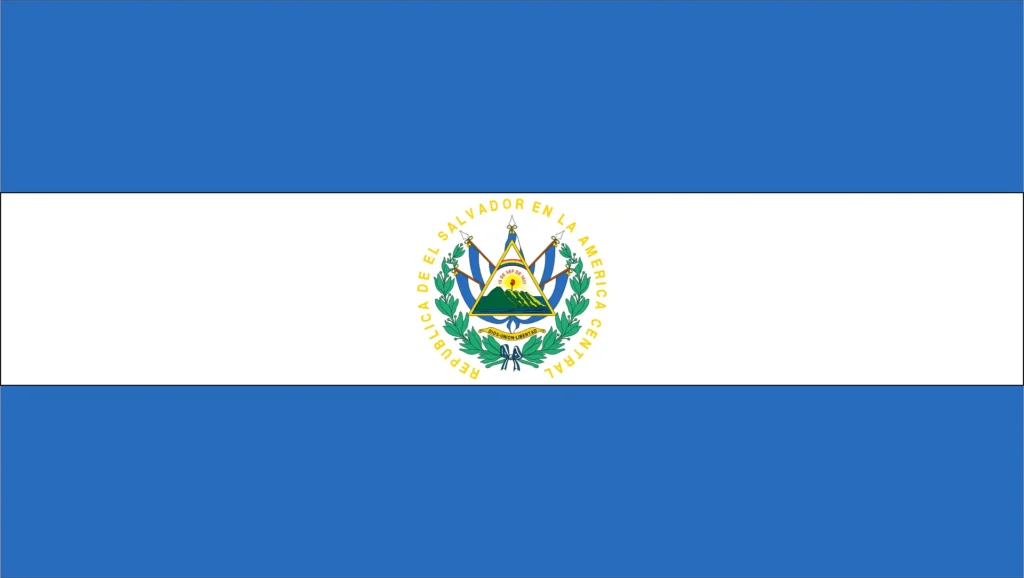
The flag of El Salvador consists of a horizontal triband with two blue stripes and one white stripe in the middle. The flag also bears a coat of arms at the center. Here’s what each component means:
- Blue stripes: Represent the Pacific and Atlantic Oceans. Although El Salvador has only one coast on the Pacific side, the stripes allude to Central America as a whole.
- White stripe: Stands for peace.
- Coat of arms: Features an equilateral triangle for the three branches of government, five volcanoes for the former members of the United Provinces of Central America, a red phrygian cap for freedom and the end of slavery, sun and rainbow, laurel wreath, and the national motto “Dios, Unión, Libertad” (“God, Union, Liberty”).
Flag of El Salvador history
The flag of El Salvador was adopted in 1916, and its design was inspired by the flag of the former Federal Republic of Central America—the predecessor nation for several Central American countries including El Salvador. Moreover, the flag of the Federal Republic of Central America was inspired by the flag of Argentina, and all these nations bear a horizontal triband of two blue and one white stripe.
Prior to 1916, El Salvador had a different flag that looked similar to the United States flag. It featured nine blue horizontal stripes and a red canton in the upper left corner.
Interesting facts about El Salvador
Find out some fun facts about El Salvador’s geography, culture, and demographics.
- El Salvador’s capital, San Salvador, is nicknamed the valley of the hammocks. Due to earthquakes, the residents began using swinging beds, and today hammocks remain a popular fixture in many homes.
- El Salvador is both the smallest and most densely populated country in Central America.
- El Salvador is home to more than 100 volcanoes, with the most recent eruption just a few years ago in 2023.
- El Salvador is also a surfer’s paradise that has hosted major international surfing championships.
- El Salvador has been inhabited for 10,000 years and is home to ancient Mayan cities.
Frequently asked questions about the flag of El Salvador
- What flag has purple?
-
Three country flags have purple: the flag of Nicaragua, the flag of El Salvador, and the flag of Dominica.
Another flag, the Wiphala, also has purple. The Wiphala is a co-official flag of Bolivia and represents the indigenous peoples of the Andes.
If you have more questions about flags, ask Quillbot’s AI Chat.
- Why do many Central American countries have similar flags?
-
The flags of Central American countries like El Salvador, Nicaragua, Guatemala, and Honduras look alike because they were originally part of the Federal Republic of Central America.
In the first half of the 19th century, Central American nations established a joint republic after gaining their independence from Spain. Interestingly, the flag design was inspired by the blue and white triband flag of Argentina.
For the Central American nations, the two blue stripes represented the Pacific and Atlantic Oceans, while the white stripe signified the land between them—thus mimicking the geography of Central America itself.
Plan your next trip to Latin America with Quillbot’s free Itinerary Generator.
- Why do the Argentinian and El Salvadorian flags look alike?
-
The Argentinian and El Salvadorian flags look alike because the former inspired the latter.
El Salvador adopted its blue and white triband flag from the joint Federal Republic of Central America, to which it previously belonged.
The Federal Republic of Central America based its flag on Argentina’s design, thanks to its independent spirit and revolutionary ideals.
Create customized graphics of your favorite country flags using Quillbot’s Image Generator.
Other interesting articles
If you want to know more about colors, letters, or the meaning of emojis, make sure to check out some of our other articles with explanations and examples.