
Flag of Jordan | Meaning, History & Fun Facts
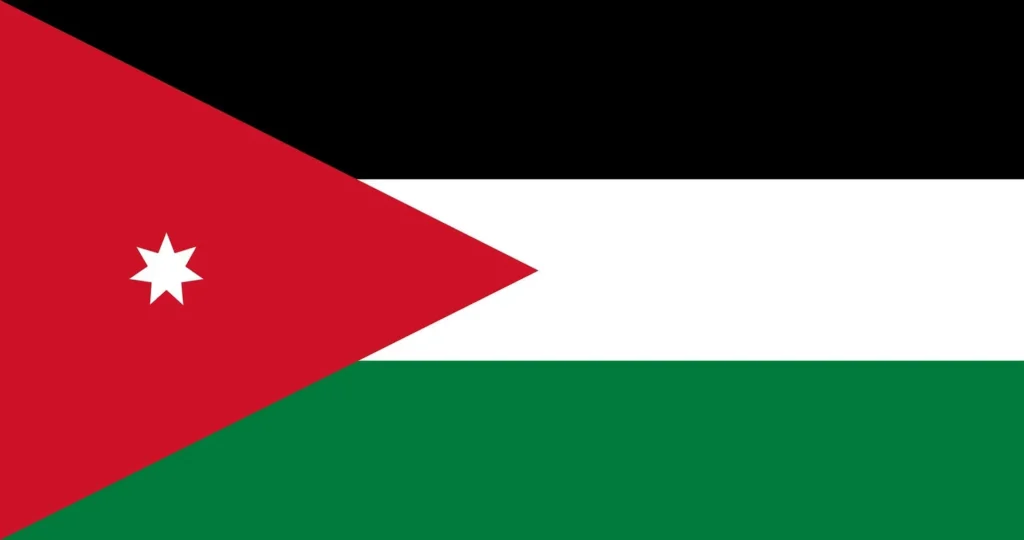
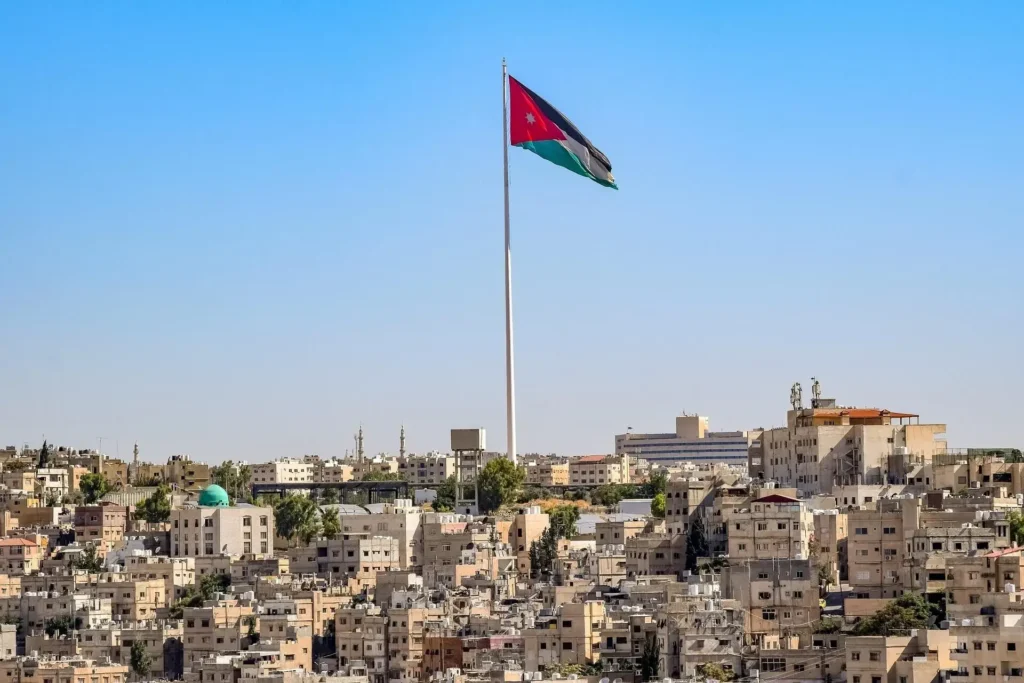
The flag of Jordan shows horizontal stripes of black, white, and green connected by a red chevron, which bears a seven-pointed white star. The Jordanian flag was officially adopted on April 16, 1928.
In this article, learn about the appearance, symbolism, and history of the Jordan flag, plus some fun facts about the flag and the country. Want to learn even more about the Jordanian flag? Ask Quillbot’s AI Chat.
Key takeaways
- The flag of Jordan was officially adopted on April 16, 1928 and features three horizontal black, white, and green stripes with a red chevron and a seven-pointed white star inspired by the Arab Revolt.
- Every color and symbol has meaning. The stripes represent historic Islamic caliphates, the red chevron symbolizes the Hashemite dynasty and the Arab Revolt, and the seven-pointed star represents Arab unity and the seven verses of Al-Fātiḥah, the opening chapter of the Quran.
- Learn how the flag evolved from the 1916 Arab Revolt flag and how it compares with the similar-looking flag of Palestine.
- Explore quick facts and trivia about Jordan’s flag, its unique design, and fascinating facts about the country’s history, landmarks, and culture.
Quick facts about the flag of Jordan
Want the basics about the flag of Jordan? Find key facts, like its adoption date, proportion, and official name, below.
| Feature | Detail |
|---|---|
| Official name | Flag of the Hashemite Kingdom of Jordan |
| Use | Civil and state flag and ensign (maritime flag) |
| Adopted | April 16, 1928 |
| Proportion | 1:2 |
| Colors | Red, green, white, and black |
| Symbols | Seven-pointed star |
| Inspired by | The flag of the Arab Revolt |
Jordan flag appearance
The Jordan flag consists of three horizontal stripes of equal size in black, white, and green. These stripes are connected by a red chevron on the “hoist” (left) side of the flag. This chevron occupies 50% of the flag’s length and bears one seven-pointed white star.
Below you can find the colors used in the Jordan flag. Color names and codes may vary slightly by source and color standard.
| Element | Color name | Hex code | RGB code |
|---|---|---|---|
| Stripe | Black | #000000 | 0, 0, 0 |
| Stripe | Green | #007A3D | 0, 122, 61 |
| Stripe and star | White | #FFFFFF | 255, 255, 255 |
| Chevron | Red | #CE1126 | 206, 17, 38 |
Jordanian flag meaning and symbolism
Each element of the Jordanian flag symbolizes something related to Jordan’s history, faith, and people:
- White represents the Umayyad Caliphate, the second Islamic caliphate. It also stands for a bright and peaceful future.
- Black represents the Abbaside Caliphate, the third Islamic caliphate.
- Green represents the Fatimid or Rashidun Caliphate, other caliphates that once ruled the area known today as Jordan.
- Red symbolizes the Hashemite dynasty (the royal family of Jordan since 1921) and the country’s bloody struggle for freedom during the Arab Revolt.
- The seven-pointed star signifies Arab unity, with the seven points also referencing the seven verses of the Al-Fātiḥah, the first book of the Quran.
Flag of Jordan history
The flag of Jordan was inspired by the flag of the 1916 Arab Revolt. Here’s a very brief history of the Jordanian flag:
- June 10, 1916: The Arab Revolt began. Arab tribes, led by Hussein bin Ali and backed by British forces, rose against the Ottoman Empire with the primary goal of establishing an independent and unified Arab state.
- December 1917: The Arab Revolt hoisted its flag for the first time in Jerusalem. The flag introduced the four Pan-Arab colors (black, white, green, and red) which later inspired the flags of several Arab nations, including Jordan. It looked very similar to Jordan’s flag today, but didn’t include the white star.
- April 11, 1921: The Emirate of Transjordan was established as a result of the Arab Revolt. It chose a flag based on the Arab Revolt flag as its national banner, adding the white star and changing the order of the stripes.
- April 16, 1928: The Emirate of Transjordan officially adopted a standardized version of its flag. This is the design still used today.
- May 25, 1946: Transjordan gained independence from the United Kingdom and became the Hashemite Kingdom of Jordan. It retained the same flag.
- 14 February to 2 August 1958: The Hashemite Arab Foundation is formed between Jordan and Iraq. It used the same flag as Jordan without the white star.
Today, the Jordanian flag remains unchanged from the original Transjordan flag and continues to symbolize the country’s Hashemite heritage, Arab identity, and independence.
Jordan flag vs Palestine flag
The Jordan flag and the Palestine flag look very similar. The only difference between the two is that the flag of Palestine has a smaller red chevron and doesn’t include the white star.
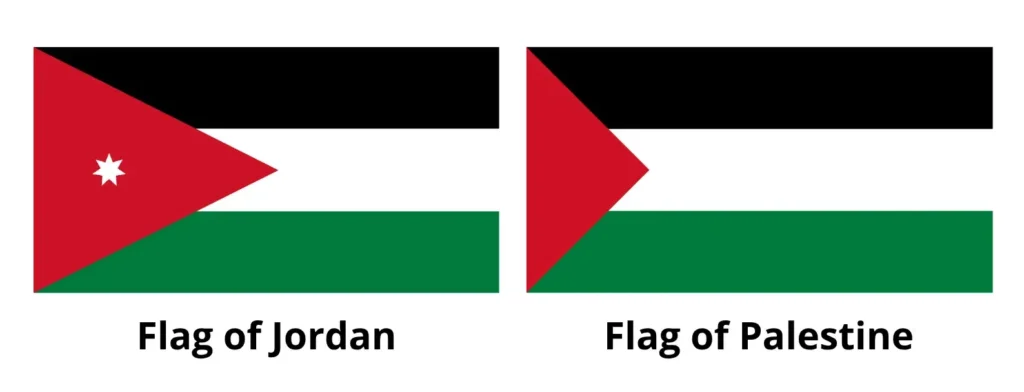
Both of these flags were based on the flag of the Arab Revolt. They both feature the pan-Arab colors (black, white, green, and red), each of which represents a certain aspect of the Arab people. Other flags that use these colors include the flags of Kuwait, Syria, the United Arab Emirates, Sudan, and Iraq.
Fun facts about Jordan and its flag
These fun facts about Jordan and its flag may help you out one day in a trivia game or just be something new you learned today:
- Only two national flags feature seven-pointed stars: Jordan and Australia. Many flags feature five-pointed stars, but seven-pointed ones are rare.
- Its proportions are longer than many national flags. The Jordanian flag has a 1:2 ratio, making it twice as long as it is tall and longer than most other national flags, which use a 2:3 or 3:5 proportion. Some other flags that use the 1:2 ratio are the United Kingdom, Canada, Australia, and New Zealand.
- Petra, an ancient city, is one of the New 7 Wonders of the World and a UNESCO World Heritage Site. It remained hidden for several centuries until it was rediscovered in 1812. It’s appeared in many books and films, including Indiana Jones and the Last Crusade.
- The Jordanian shore of the Dead Sea sits at about 1,410 to 1,443 feet below sea level. It’s the lowest land elevation on Earth. The Dead Sea is also about 10 times saltier than the world’s oceans.
- The Ain Ghazal statues found in Amman date back to around 7500 BCE and rank among the oldest statues of humans ever discovered.
- The city of Jerash has some of the best Roman architecture outside of Rome.
- The “three times rule” is considered polite in Jordanian culture. Guests may deny food and drink three times so as to not appear greedy. Once the host insists the third time, custom dictates you should then eat or drink.
Frequently asked questions about the flag of Jordan
- What flag is red green white and black?
-
Some flags that are red, green, white, and black are the flag of Jordan, Palestine, Iraq, Sudan, Kuwait, Libya, Syria, and the United Arab Emirates.
These are the “pan-Arab colors” used on many flags connected to the Arab world. Some other countries outside the Arab world that use these colors on their flags are Kenya and Malawi.
If you want to discover more flags that are red, green, white, and black, ask Quillbot’s AI Chat.
- When is Jordan Independence Day?
-
Jordan celebrates its Independence Day every year on May 25. On this day in 1946, the Emirate of Transjordan gained its independence from the United Kingdom, and the Hashemite Kingdom of Jordan was founded.
While the government and name of the country changed, the flag of Jordan did not. The Jordanian people celebrate their independence with official ceremonies, military parades, public holidays, and cultural events across the country.
To learn more about Jordan’s Independence Day, ask Quillbot’s AI Chat.
Other interesting articles
If you want to know more about colors, letters, or the meaning of emojis, make sure to check out some of our other articles with explanations and examples.