
Hawaii Flag | Meaning, History & Design
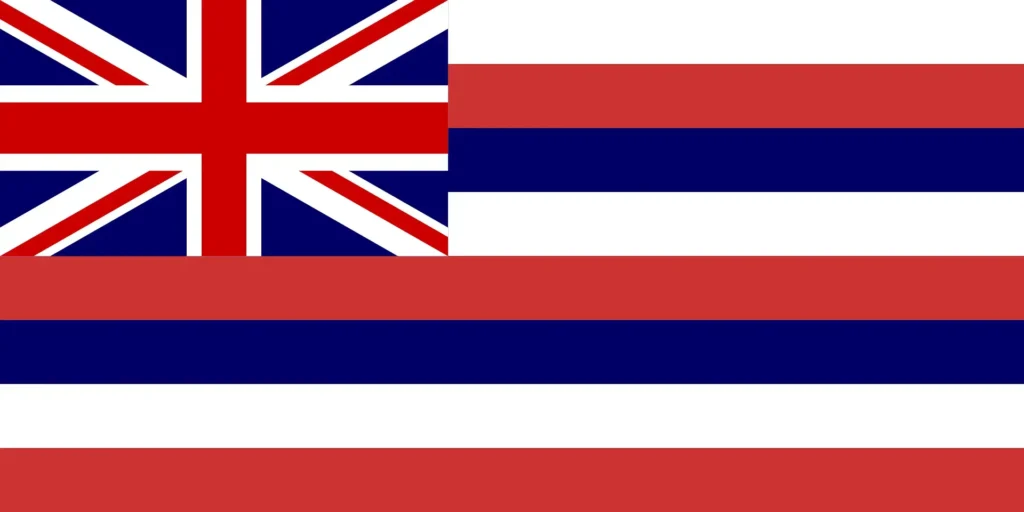
The Hawaii flag is the official flag of the U.S. state of Hawaii. It has four horizontal stripes in white, red, and blue and a British Union Jack flag depicted in the top left corner. The Hawaiian flag has been in use since 1845.
This article discusses the design, meaning, and history of the Hawaiian flag as well as some fun facts about Hawaii and its flag.
Key takeaways
- The Hawaii flag’s eight red, white, and blue stripes represent Hawaii’s eight main islands, while the Union Jack reflects the islands’ historical ties with Britain.
- Despite its British appearance, Hawaii was never a British colony. The Union Jack was included as a symbol of friendship between King Kamehameha I and Britain.
- The flag has endured through major changes in Hawaii’s history, remaining essentially unchanged from the Kingdom of Hawaii in 1845 through annexation by the United States and Hawaii’s statehood in 1959.
- There’s more to Hawaii’s flags than the familiar state flag. Learn about the unofficial Kānaka Maoli flag, the meaning behind Hawaii’s flag colors and symbols, and fun facts about the islands.
Quick facts about the flag of Hawaii
This table includes a quick overview of the flag of Hawaii.
| Feature | Detail |
|---|---|
| Official name | Ka Hae Hawaiʻi (“the flag of Hawaii”) |
| Use | State flag |
| Adopted | 1845 |
| Proportion | 1:2 |
| Colors | Red, white, and blue |
| Symbols | British Union Jack |
| Inspired by | The Kingdom of Hawaii’s relationship with Britain |
What does the flag of Hawaii look like?
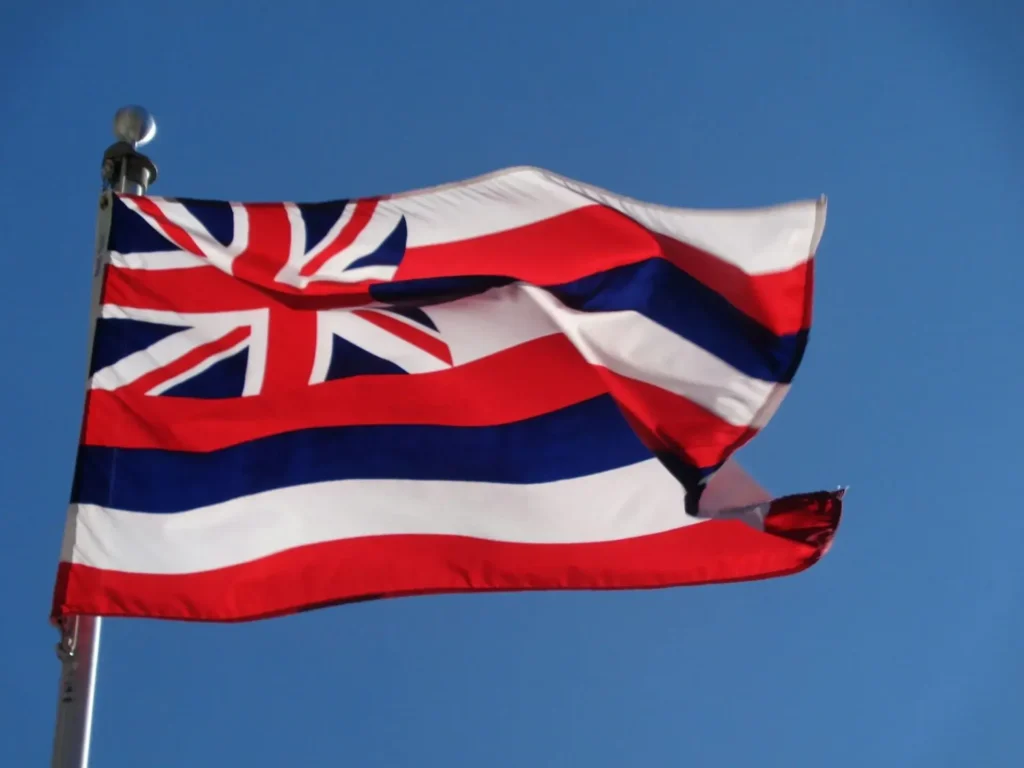
The Hawaiian flag includes eight horizontal stripes in white, red, and blue. There are three white, three red, and two blue stripes. It also features the Union Jack (the national flag of the United Kingdom) as a “canton,” or rectangular emblem, in the upper left corner. The Hawaii flag respects a 1:2 proportion, meaning its length is twice as long as its height.
Why does the Hawaiian flag look British?
The Hawaiian flag looks British because the Kingdom of Hawaii had a close relationship with Great Britain. However, these ties were diplomatic, and Hawaii was never a British colony.
In 1794, British explorer Captain George Vancouver visited Hawaii and presented King Kamehameha I, the first king of a united Hawaii, with a British flag. Kamehameha flew the British flag over his residence as a symbol of his kingdom’s friendship with Britain. The origins of the current Hawaiian flag are uncertain, but its design reflects Hawaii’s historical relationships with both Britain and the United States.
Hawaiian flag colors
The Hawaiian flag uses three colors. Find their color codes in the table below.
| Color name | Hex code | RGB code | Pantone code |
|---|---|---|---|
| Dark blue | #00237D | 0, 35, 125 | 2147 C |
| Fire engine red | #CF142B | 207, 20, 43 | 186 C |
| White | #FFFFFF | 255, 255, 255 | N/A |
It features green, red, and yellow stripes with a crest that shows a kahili (a chief’s insignia) crossed by two paddles. The Kānaka Maoli flag was first introduced to the public in 2001.
What does the Hawaii flag symbolize?
The eight stripes on the Hawaiian flag represent the eight main islands that make up Hawaii: Hawaiʻi, O’ahu, Maui, Kauaʻi, Lānaʻi, Niʻihau, Molokaʻi, and Kahoʻolawe.
Meanwhile, the canton featuring the Union Jack reflects Hawaii’s historical ties with Great Britain. The flag’s design also reflects Hawaiʻi’s history and relationships with both Britain and the United States.
What’s the history behind the Hawaiian flag?
Want to know how the Hawaiian flag came to be? Here’s a brief summary of its history:
- 1794: Captain George Vancouver visited Hawaii and presented Kamehameha I with a British flag, which Kamehameha flew over his residence as a gesture of friendship.
- 1816: Kamehameha I introduced a distinct Hawaiian flag featuring the Union Jack in a canton and horizontal stripes.
- 1817–1845: Different versions of the Hawaiian flag were reported, with variations in the number of red, white, and blue stripes. The Union Jack remained a consistent feature.
- May 25, 1845: The current eight-stripe design was officially unfurled at the opening of the Hawaiian Kingdom’s legislative council. The design has remained essentially unchanged ever since.
- 1893: Queen Liliʻuokalani was overthrown, ending the Hawaiian monarchy.
- 1894: The Republic of Hawaii was established. The Republic maintained the same flag used by the Kingdom of Hawaii.
- 1898: The United States annexed Hawaii, and the islands became a U.S. territory. The same Hawaiian flag continued to be used.
- 1959: Hawaii became the 50th U.S. state, and its flag became the official state flag.
- 1990: Governor John Waiheʻe made July 31 Lā Hae Hawaiʻi, or Hawaiian Flag Day. Each year on this day, Hawaiians honor their flag and what it means with flag ceremonies and cultural events.
Fun facts about Hawaii and its flag
Want to brush up on your trivia? Prepare a quiz? Just learn something new? Check out these fun facts about Hawaii and its flag:
- The Hawaii flag is the only U.S. state flag that features a foreign country’s symbol.
- Only two U.S. state flags have previously served as the official flags of independent nations: those of Hawaii and Texas.
- The Hawaii flag predates U.S. statehood by more than a century. Its current design was officially unfurled in 1845 and Hawaii became a state in 1959.
- Hawaii is the southernmost U.S. state.
- The Hawaiian alphabet has only 13 letters: A, E, I, O, U, H, K, L, M, N, P, W, and the ʻokina (ʻ), a glottal stop that functions like a consonant.
- Hawaii sits on top of a shifting tectonic plate, which means the islands drift northwest a few inches per year.
- Hawaii is the only U.S. state that commercially produces coffee.
- Hawaii is home to Mauna Loa, the largest active volcano on the planet.
- It’s illegal to own or import snakes to Hawaii because they could threaten local ecosystems. There are no native land snake species in Hawaii, although there are a few invasive species.
- Hawaii is widely recognized as the birthplace of surfing. Some surfing terms, like “aloha” and “shaka” come from the native Hawaiian language.
Frequently asked questions about Hawaii Flag
- How many islands are there in Hawaii?
-
There are eight main islands in Hawaii:
- Hawai’i (also known as “Big Island”)
- O’ahu (where the state capital Honolulu is found)
- Maui
- Kaua’i
- Moloka’i
- Lānaʻi
- Niʻihau
- Kahoʻolawe (which is uninhabited)
These eight islands are represented as the eight stripes on the Hawaiian flag. Technically, the Hawaiian island chain has 137 islands, but most of these are small islets and atolls.
To learn more about the Hawaiian islands and their history, ask Quillbot’s AI Chat.
- When did Hawaii become part of the US?
-
Hawaii became a part of the U.S. on August 12, 1898, when the United States annexed the Republic of Hawaii and made it an incorporated territory.
Hawaii became the country’s 50th state years later on August 21, 1959. The state flag of Hawaii became the flag that had previously been used by the Kingdom, Republic, and Territory of Hawaii.
To learn more about how Hawaii entered the U.S., ask Quillbot’s AI Chat.
- Is there a Hawaiian flag emoji?
-
No, there is no standalone Hawaiian flag emoji. You may see an emoji tag sequence for the Hawaiian flag online, but this combination of symbols very rarely renders correctly.
Some other emojis you can use in content about Hawaii include the United States flag emoji 🇺🇸, the palm tree emoji 🌴, the desert island emoji 🏝️, or the hibiscus emoji 🌺.
Or, if you want to create an emoji version of the Hawaiian flag, use Quillbot’s Emoji Generator.
Other interesting articles
If you want to know more about colors, letters, or the meaning of emojis, make sure to check out some of our other articles with explanations and examples.