
Kazakhstan Flag | Design, Symbolism & History
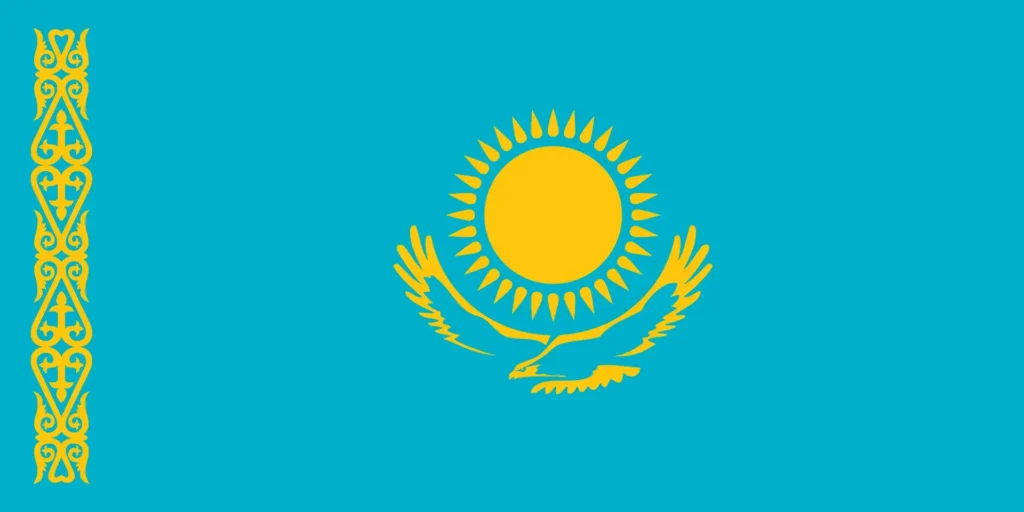
The Kazakhstan flag is turquoise with a gold sun and eagle near the center and a traditional ornamental pattern (called the koshkar-muiz) along the left side. The flag was designed by Shaken Niyazbekov and adopted in 1992 to replace the country’s Soviet-era flag.
This article explains the design, symbolism, and history of the flag of Kazakhstan. You can also learn some fun facts about Kazakhstan and its flag. If you have additional questions about Kazakhstan’s flag, ask Quillbot’s AI Chat.
Key takeaways
- The Kazakhstan flag features a turquoise-blue background with a golden 32-ray sun, a soaring steppe eagle, and the traditional koshkar-muiz ornamental pattern.
- Each element has cultural symbolism: the sun represents life, energy, and prosperity; the eagle represents freedom and aspiration; and the koshkar-muiz reflects Kazakh nomadic heritage and artistic traditions.
- Kazakhstan adopted its current flag on June 4, 1992, shortly after gaining independence from the Soviet Union. Artist Shaken Niyazbekov designed the flag.
- The flag’s history reflects Kazakhstan’s political changes, including its transition from Russian and Soviet rule to an independent republic.
Quick facts about the Kazakhstan flag
Learn the basics about the Kazakhstan flag with this table.
| Feature | Detail |
|---|---|
| Official name | Қазақстан Республикасының Мемлекеттік туы (romanized as Qazaqstan Respublikasynyñ memlekettık tuı, meaning “State flag of the Republic of Kazakhstan”) |
| Use | National flag and civil ensign (maritime flag for civilian vessels) |
| Adopted | June 4, 1992 |
| Colors | Turquoise and gold |
| Symbols | Sun with rays, soaring golden steppe eagle, and the koshkar-muiz (a traditional Kazakh ornamental pattern) |
| Designed by | Shaken Niyazbekov |
That said, some people may also use “Kazakh” to refer to all people of Kazakhstan. The country has a blend of many cultures and languages, so different speakers may use different words. When in doubt, clarify!
Design of the flag of Kazakhstan
The flag of Kazakhstan uses a proportion of 1:2, meaning it is twice as long as it is high. It has a turquoise-blue background with three golden-yellow symbols. Near the center, a steppe eagle soars under a 32-ray sun. On the left side (i.e., “hoist” or flagpole side), sits the koshkar-muiz, an ornamental pattern that is also used in Kazakh folk art.
This table shows the color codes for the colors of Kazakhstan’s flag. Keep in mind that color names and codes may vary slightly based on source and the color system used.
| Color name | Hex code | RGB code | CMYK code | Pantone code |
| Turquoise blue | #00ABC2 | 0, 171, 194 | 94%, 0%, 19%, 0% | 3125U |
| Canary yellow | #FFEC2D | 255, 236, 45 | 0%, 0%, 100%, 0% | 102U |
Symbolism of the Kazakhstan flag
Each color and symbol of Kazakhstan’s flag represents something related to Kazakhstani history, culture, and values. Kazakhstan is made up of diverse peoples, many of whom are of Turkic origin (e.g., Kazakhs, Tatars, Mongols, and Uyghur) and who were historically nomadic, moving from place to place across the Eurasian steppe.
Turquoise blue is an important color for these people. Blue symbolizes their ancient sky god Kök Tengri and the endless sky itself, which the Turkic nomads historically saw as a reflection of sacred order, divine control, and truth. Turquoise also symbolizes water, life, and growth. Further, it represents unity among the diverse peoples of Kazakhstan and, according to designer Shaken Niyazbekov, peace, tranquility, and well-being.
Gold corresponds to a bright future for the Kazakhstani people. Three important symbols appear in gold on Kazakhstan’s flag, and each has its own meaning:
- Sun: The sun represents life, energy, and wealth. Its rays look like grain, which is a basis for plenitude and prosperity in Kazakhstani culture. The sun’s 32 rays may also symbolize 32 different Turkic ethnicities that help make up Kazakhstan.
- Eagle: The steppe eagle is a large bird of prey native to the steppes and grasslands of Central Asia. It represents freedom, power, dignity, self-determination, and aspiration to a better future. The steppe eagle has been used as a heraldic device for various Central Asian peoples for centuries.
- Koshkar-muiz: This national pattern’s name translates as “the horns of the ram” and represents the Kazakh people’s nomadic history, cultural identity, and artistic traditions. It was often used as a talisman to bring grace and good fortune to the bearer. The koshkar-muiz also symbolizes abundance and fertility, as the ram was a valuable animal in nomadic pastoral life, and sacred power and energy, due to how horned animals were seen in Turkic mythology.

History of the flag of Kazakhstan
Kazakhstan’s flag has changed several times since the early 20th century, reflecting the political changes the country went through under Russian and Soviet rule. Here’s a brief overview of the history of the flag of Kazakhstan:
- 1456–1780: The Kazakh Khanate, a nomadic state, is said to have used a light blue flag symbolizing the open sky.
- 18th century: The Russian Empire conquered the Kazakh Khanate and other parts of present-day Kazakhstan.
- 1916: During the Central Asian Revolt against Russian colonial rule, associates of Kazakh revolutionary leader Amankeldy Imanov used a red flag featuring yellow Arabic-script text, a blue crescent moon, and crossed weapons.
- 1917–1920: The Alash Autonomy, an autonomous Kazakh state established during the Russian Revolution, did not have one universally agreed-upon flag. Several designs were proposed, including a green, yellow and red tricolor and a white flag featuring a yellow yurt.
- 1920: Following the Russian Civil War, the Soviets established the Kazakh Autonomous Socialist Soviet Republic (Kazakh ASSR). Its flag featured yellow text in the canton identifying the republic.
- 1937: The Kazakh ASSR became the Kazakh Soviet Socialist Republic (Kazakh SSR) within the Soviet Union, and its flag was redesigned to feature Soviet symbols and the republic’s name in Kazakh and Russian.
- 1940: The Kazakh SSR changed its writing system from Latin to Cyrillic, resulting in another modification to the text on its flag.
- 1953: The Kazakh SSR adopted its final Soviet-era flag, featuring a red background, a light blue horizontal stripe, and the Soviet symbols of the hammer and sickle.
- December 1991: Kazakhstan became independent following the dissolution of the Soviet Union. The Soviet-era flag remained in use until the following year.
- June 4, 1992: Kazakhstan officially adopted its current national flag, designed by Shaken Niyazbekov. The koshkar-muiz ornamental pattern on the left side was originally red.
- July 1992: The ornamental pattern on the new flag was changed from red to the gold color used today.
Fun facts about Kazakhstan and its flag
Want to learn some interesting tidbits about Kazakhstan and its flag? Look no further. Here are some fun facts to satisfy your curiosity:
- In a March 2026 tournament hosted on Reddit, Kazakhstan’s flag was voted to be the most beautiful national flag by users. It defeated Kiribati, whose flag also features a bird and a sun.
- Kazakhstan is one of only two UN member states whose national flag uses turquoise or aquamarine as a principal color, alongside The Bahamas.
- Kazakhstan’s flag is one of a small group of national flags featuring a sun with rays. Other examples include Uruguay, the Philippines, Kiribati, Argentina, and Namibia.
- Kazakhstan is one of 16 UN member states whose national flag features a bird, and it’s one of eight flags that feature an eagle specifically. Other flags with eagles include Albania, Egypt, and Zambia.
- Kazakhstan is the largest landlocked country in the world by area.
- Kazakhstan has the world’s longest continuous land border: its 4,254-mile border with Russia. The border between the United States and Canada is actually longer, but it’s divided into two segments.
- The word “Kazakh” comes from a Turkic root that means “free man” or “wanderer.”
- Kazakhstan has been inhabited since the Paleolithic era, and the Botai are credited with being the first people to domesticate horses.
- Almaty, the largest city in Kazakhstan, is recognized as the birthplace of the modern apple. The city’s former name, Alma-Ata, translates as “Father of Apples.”
Frequently asked questions about the flag of Kazakhstan
- Which countries have a light blue and yellow flag?
-
Countries that have a light blue and yellow flag are Kazakhstan and Palau. The flag of Kazakhstan is a light blue field with a golden eagle, sun, and ornamental vertical band. The flag of Palau features a blue field with a yellow disc that represents the moon.
Other countries have blue and yellow flags but use royal blue or dark blue shades. Some examples include Sweden, Ukraine, Bosnia and Herzegovina, and Democratic Republic of Congo. The flag of the European Union is also blue and yellow.
To learn more about blue and yellow flags, ask Quillbot’s AI Chat.
- Which countries have a flag with a sun in the middle?
-
Countries that have a flag with a sun in the middle include Argentina, North Macedonia, Japan, Bangladesh, and Kyrgyzstan.
Some flags feature suns that aren’t exactly in the middle. The flag of Kazakhstan, for example, features an off-center sun, and the Uruguay flag shows a sun in its canton.
Learn more about flags with suns, or other categories of flags, with Quillbot’s AI Chat.
Other interesting articles
If you want to know more about colors, letters, or the meaning of emojis, make sure to check out some of our other articles with explanations and examples.