
Flag of Colombia | Meaning, History & Fun Facts
Colombia is a proud and diverse nation in South America. It is home to remarkable biodiversity and unique geography, along with rich cultural traditions.
In this guide, you’ll discover the history, meaning, and symbolism behind the flag of Colombia. You’ll also learn some fun facts about what distinguishes this nation.
Try Quillbot’s free Image Generator to create custom graphics of your favorite country flags.
Key takeaways
- Discover the history and symbolism of Colombia’s horizontal yellow, blue, and red tricolor flag, officially adopted in 1861.
- Explore the flag’s origins in Gran Colombia and how its design evolved into the national flag used today.
- Get fascinating facts about Colombia’s remarkable biodiversity, natural resources, geography, and cultural identity.
Flag of Colombia overview
Below you’ll learn the basics about the flag of Colombia—including when it was adopted, its colors, and what inspired it.
| Feature | Details |
|---|---|
| Official name | The flag of the Republic of Colombia |
| Use | National and civil purposes |
| Adopted | 26 November 1861 |
| Proportion | 2:1:1 |
| Colors | Yellow, blue, and red |
| Coat of arms | Shield with an Andean condor perched on top (only used in official, diplomatic, and military contexts) |
| Inspired by | The flag of Gran Colombia |
Flag of Colombia meaning and symbolism
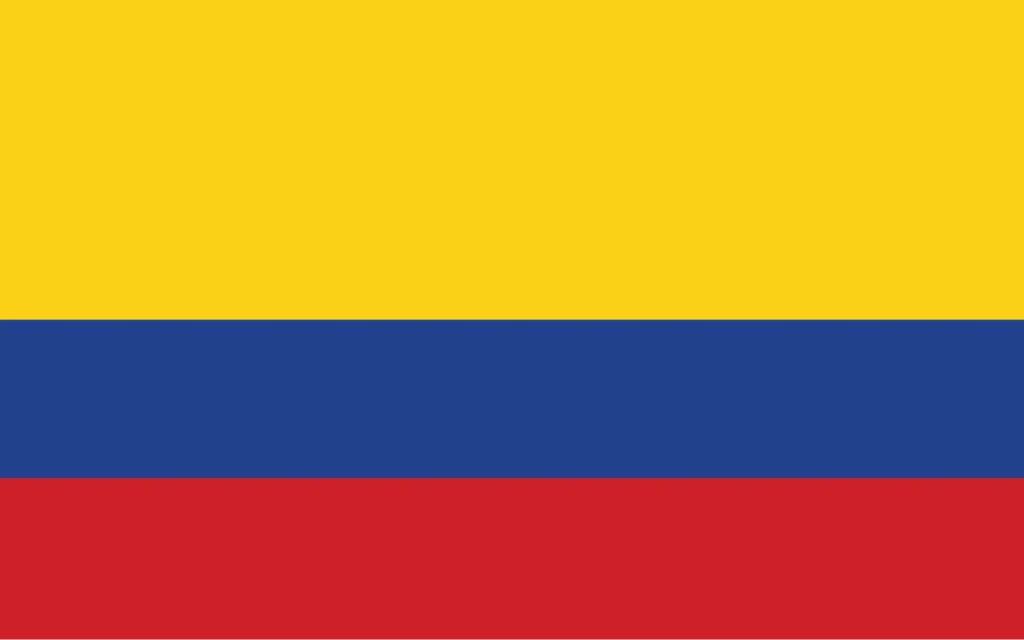
The flag of Colombia has a red, blue and yellow tricolor design with a 2:1:1 proportion where the yellow stripe is twice the size of the others.
- Yellow stripe: Signifies Colombia’s many riches, including its gold and its agriculture, along with the Sun. The yellow color also represents values of justice, harmony, and sovereignty. Its relative size also underscores the nation’s resource abundance.
- Blue stripe: Symbolizes the sky, the sea on Colombia’s shores, and the rivers that run through it.
- Red stripe: Stands for the blood shed for Colombia’s independence, as well as the perseverance and determination of the Colombian people.
The flag of Colombia features a coat of arms only in certain official and institutional contexts. It depicts a shield draped in the Colombian tricolor with an Andean condor perched atop. Displayed on the shield are various symbols including cornucopias, which represent the nation’s wealth. In addition, the coat of arms features a scroll that says “Libertad y Orden” (liberty and order).
History of the flag of Colombia
The flag of Colombia bears its origins in the initial design of the First Republic of Venezuela. It was then adopted in 1819 by Gran Colombia—the newly independent state from Spain that encompassed what is now the Republic of Colombia, Venezuela, Ecuador, Panama, and parts of Brazil and Peru.
Gran Colombia dissolved in 1831, and Colombia adopted its current flag design in 1861. However, it continues to bear likeness to the flags of Ecuador and Venezuela.
Fun facts about Colombia
Learn some additional facts about Colombia’s natural resources and geography.
- Colombia is home to more bird species than any other nation on Earth, with over 1900 types including toucans, flamingos, macaws, and Andean condors.
- The Caño Cristales River in Colombia turns rainbow due to its unique aquatic plants.
- Colombia supplies 90% of the world’s emerald market and is the third largest coffee producer.
- The Cocora Valley in Colombia’s department of Quindío contains the world’s tallest palm trees.
- Colombia is the only country in South America with coastlines on both the Pacific and Atlantic Oceans.
Frequently asked questions about the flag of Colombia
- Why do the Colombian, Ecuadorian, and Venezuelan flags look alike?
-
The Colombian, Ecuadorian, and Venezuelan flags look alike because they bear a common origin in the flag of Gran Colombia—their predecessor nation that gained independence from Spain.
Following the dissolution of Gran Colombia, the countries adopted variations on the flag. For example, the modern state and civilian flag of Colombia no longer contains a coat of arms.
Create personalized graphics of your favorite country flags using Quillbot’s free Image Generator.
Other interesting articles
If you want to know more about colors, letters, or the meaning of emojis, make sure to check out some of our other articles with explanations and examples.