
Flag of Guatemala | Meaning & Interesting Facts
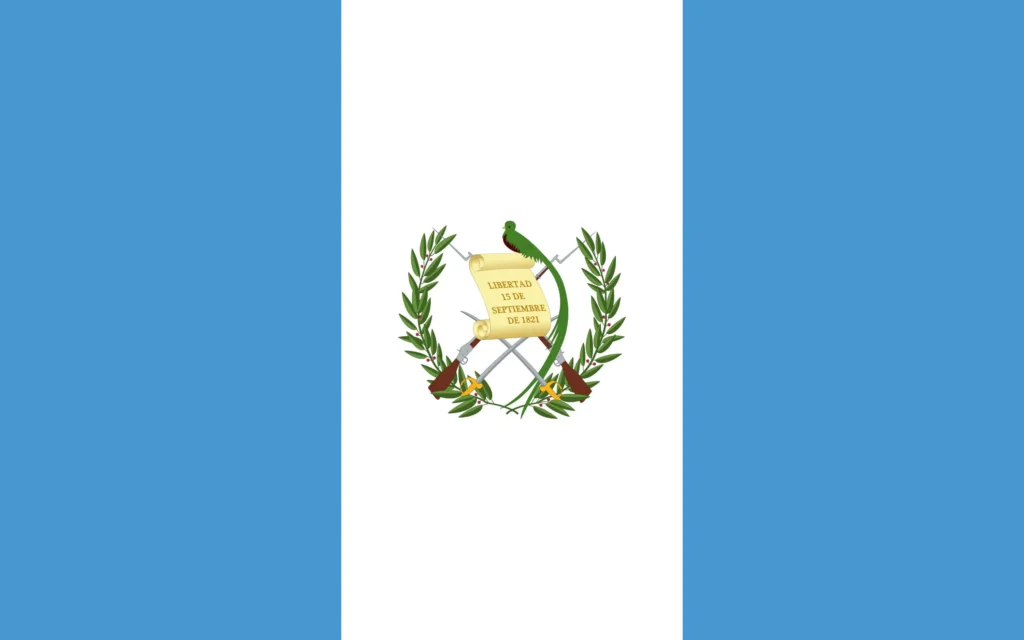
The flag of Guatemala, also known as the Pabellón Nacional (National Pavilion) or Azul y Blanco (Blue and White), features three vertical stripes in two colors: sky blue and white. The two blue stripes appear on either side of a white stripe, which holds the country’s coat of arms at its center.
Key takeaways
- Guatemala’s flag (Azul y Blanco) features blue-and-white vertical stripes with the coat of arms at the center.
- The flag’s colors symbolize values such as justice, loyalty, purity, and peace.
- The coat of arms represents Guatemala’s independence and national identity through symbols like the quetzal and laurel wreath.
- Guatemala’s flag shares its blue-and-white design with other Central American countries due to their shared history.
Flag of Guatemala colors and symbolism
The sky blue and white flag of Guatemala was adopted on 17 August 1871. Each color carries symbolic meanings defined in Guatemala’s official regulations for its national flag.
- Sky blue: The two blue stripes represent strength, justice, truth, and loyalty.
- White: The white stripe in the center symbolizes purity, integrity, firmness, and peace.
The colors also have a geographical connection:
- The sky-blue stripes are often associated with Guatemala’s skies and its location between the Pacific Ocean and the Caribbean Sea.
- The white band between them reflects the country’s aspirations for peace and unity.
The blue-and-white combination also has historical roots, as it was inspired by the flag of the former Federal Republic of Central America, the regional union that Guatemala belonged to after gaining independence from Spain.
What does the Guatemalan coat of arms represent?
The coat of arms in the center of the flag contains several symbols connected to Guatemala’s independence and national identity.
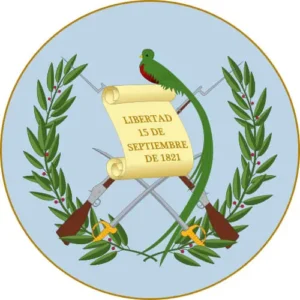
- Resplendent quetzal: Guatemala’s national bird represents liberty and freedom.
- Parchment scroll: The scroll displays the date September 15, 1821, marking Central America’s independence from Spain.
- Crossed rifles: These symbolize Guatemala’s willingness and ability to defend itself.
- Crossed swords: These represent honor.
- Laurel wreath: The wreath surrounding the emblem symbolizes victory and achievement.
Together, these elements commemorate Guatemala’s independence and highlight values such as liberty, defense, and national pride.
Flags similar to Guatemala’s
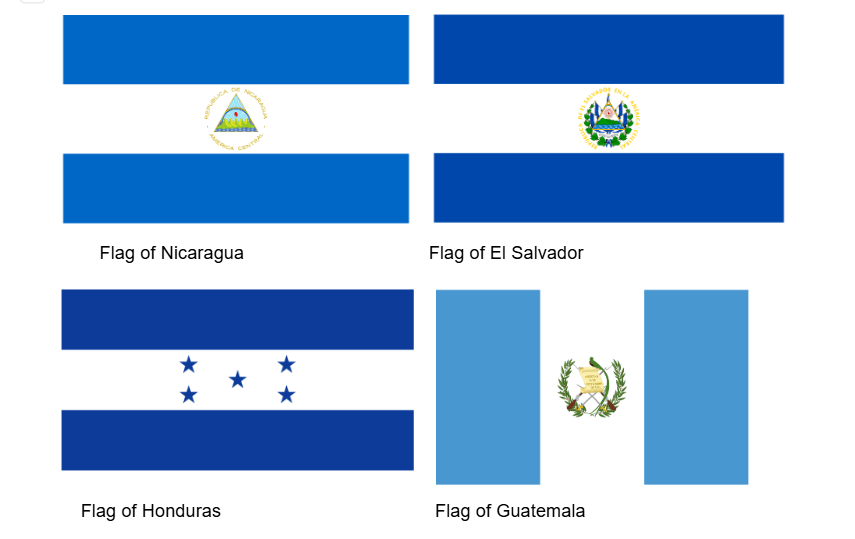
The flags of Guatemala, Nicaragua, Honduras, and El Salvador all feature blue and white as their dominant colors. This shared design reflects a common history: all four countries were once part of the Federal Republic of Central America, a sovereign state that existed from 1823 to 1841. After the federation dissolved, each nation adopted its own flag based on the republic’ blue-and-white design, while adding distinctive elements to reflect its national identity.
Interesting facts about Guatemala’s flag
Beyond its colors and symbols, Guatemala’s flag has several interesting details that reflect the country’s history and culture.
- Guatemala is one of the few countries with a firearm on its flag. The others are Mozambique, Haiti, and Bolivia.
- Guatemala’s flag uses a 5:8 ratio, one of only a handful of national flags with this proportion. Others include Argentina, Palau, Poland, and Sweden.
- The blue shade of Guatemala’s flag is sometimes called “Maya blue,” highlighting the country’s connection to Mesoamerican heritage. The term is also used for an ancient blue pigment developed by Maya civilizations.
- The resplendent quetzal on the coat of arms gives its name to Guatemala’s currency. According to Maya legend, the bird was the spirit guide of ruler and hero Tecún Umán, and its red breast feathers were said to have been stained by his blood after his death during the Spanish conquest.
Frequently asked questions about the flag of Guatemala
- What is the bird on the Guatemalan flag?
-
The bird on the Guatemalan flag is the resplendent quetzal, a colorful species native to Central America and Guatemala’s national bird. It appears on the country’s coat of arms, where it represents liberty and freedom.
The quetzal also has strong ties to Maya culture, where it was associated with light, goodness, and the divine. Today, it remains an important national symbol and lends its name to Guatemala’s official currency.
If you’re curious about the symbols on other flags, Quillbot’s AI Chat can answer your questions.
- Why do Guatemala and Argentina have similar flags?
-
Guatemala and Argentina share similar blue-and-white colors. Argentina’s flag influenced the design of the flag of the former Federal Republic of Central America, which later inspired Guatemala’s flag.
The two flags are easy to tell apart: Argentina’s has horizontal stripes and a Sun of May emblem, while Guatemala’s has vertical stripes and a coat of arms in the center.
If you want to explore more about the history and symbolism of world flags, use Quillbot’s Article Rewriter to summarize and compare information from different sources.
Other interesting articles
If you want to know more about colors, letters, or the meaning of emojis, make sure to check out some of our other articles with explanations and examples.