
Flag of Kenya | Design, Symbolism & History
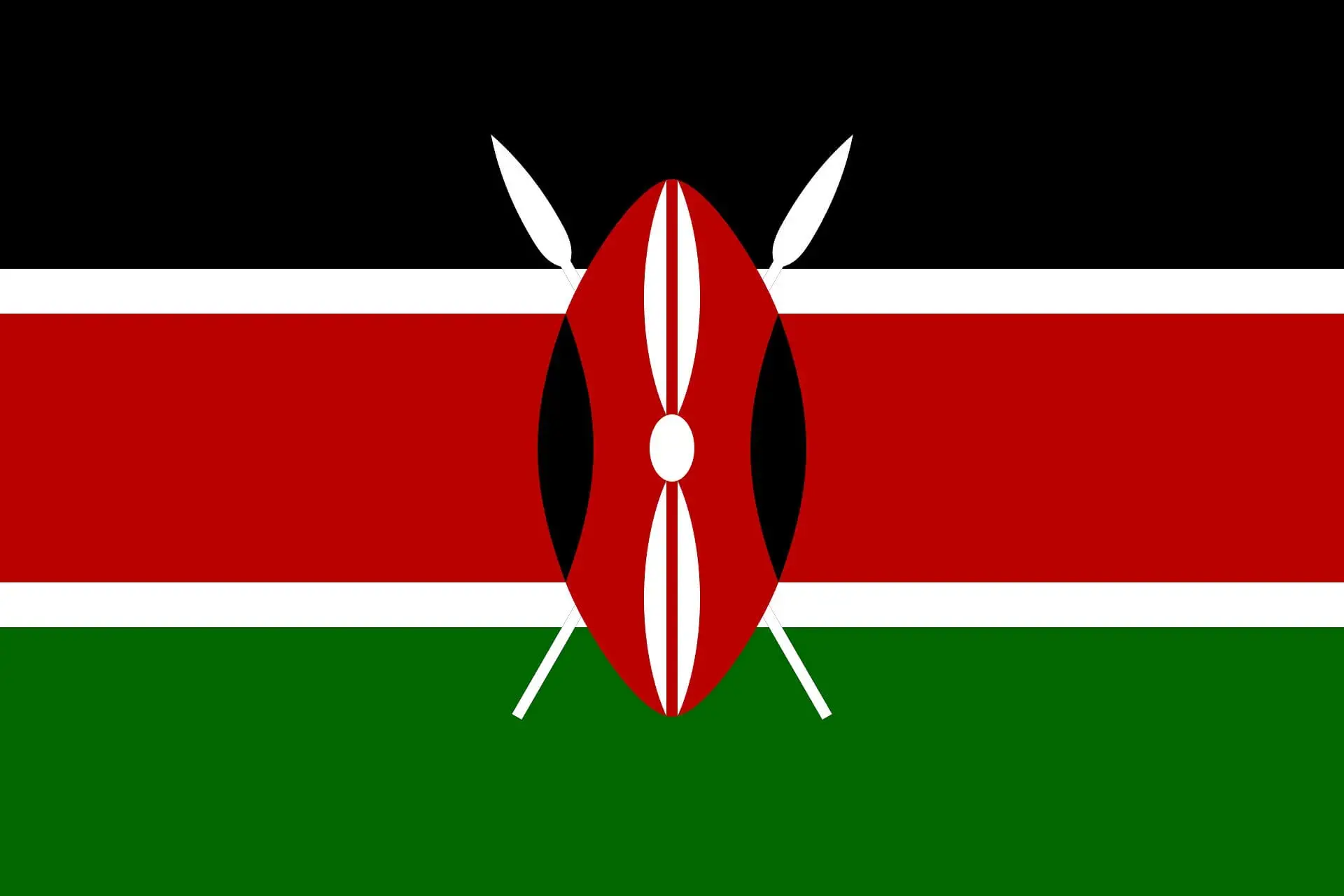
The flag of Kenya is a tricolor flag with horizontal stripes of black, red, and green with two thin white stripes between them. A red, white, and black Maasai shield and two crossed spears are superimposed over the stripes. The Kenyan flag was officially adopted on December 12, 1963, upon the nation’s independence from the United Kingdom.
To find out more about the flag of Kenya or the country, its history, and its culture, ask Quillbot’s AI Chat.
Key takeaways
- Discover the flag of Kenya, from its distinctive black, red, and green stripes to its traditional Maasai shield and crossed spears.
- Learn what each color and symbol represents, including Kenya’s people, independence, natural wealth, and commitment to peace.
- Explore the history of the Kenyan flag, from its political party origins to its adoption on December 12, 1963, when Kenya gained independence.
- Get quick facts about the flag’s design, colors, and proportions, plus fascinating trivia about Kenya’s culture, geography, and wildlife.
Quick facts about the flag of Kenya
Want to know the basics about the Kenyan flag? This table covers the most important details.
| Feature | Detail |
|---|---|
| Official name | Bendera ya Kenya (“flag of Kenya” in Swahili) |
| Use | National flag and ensign (maritime flag) |
| Adopted | December 12, 1963 |
| Proportion | 2:3 |
| Colors | Black, red, green, and white |
| Symbols | Maasai shield and spears |
| Inspired by | The flag of the Kenya African National Union, a political party |
Design of the Kenyan flag
The Kenyan flag features three horizontal stripes of equal weight in black, green, and red. There are two white fimbriations, or thinner border stripes, interspersed between these. A shield and crossed spears sit in the very middle of the flag superimposed over the stripes. The flag has a proportion of 2:3, meaning its height is two-thirds its width.
Kenya flag colors
The colors in the table below show the values used to represent the Kenyan flag in digital environments. Color codes may vary slightly based on the system and source used, and you may also note variations between these colors and those used in print environments.
| Color name | Hex code | RGB |
|---|---|---|
| Black | #000000 | 0, 0, 0 |
| Dark red | #BB0000 | 187, 0, 0 |
| Dark green | #006600 | 0, 102, 0 |
| White | #FFFFFF | 255, 255, 255 |
Symbolism of the Kenyan flag
Each of the colors of the Kenyan flag symbolizes a different aspect of Kenyan culture, geography, or history:
- Black represents the Kenyan people.
- Red stands for the blood shed during the nation’s fight for independence.
- Green symbolizes the country’s land.
- White signifies peace.
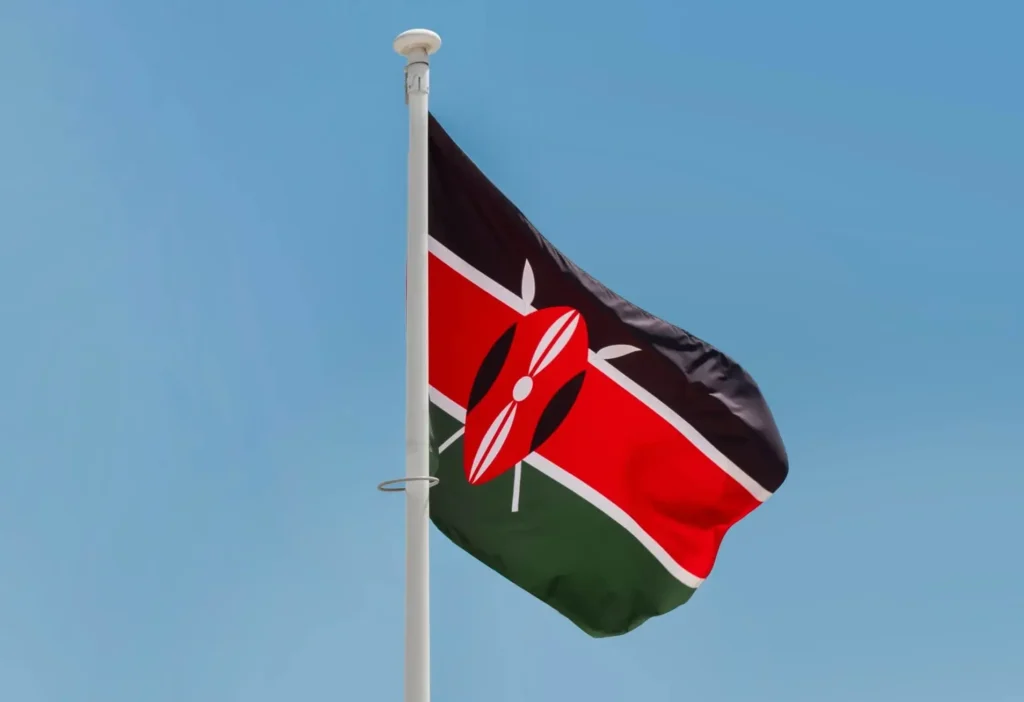
The shield and two spears symbolize Kenya’s ongoing will to defend itself. The shield was based on the traditional shields of the Maasai, an indigenous people of Kenya, and thus also represents the traditional ways of life found in the country.
History of the Kenyan flag
If you want to understand the origins of the Kenyan flag, this section walks through a brief history of how it came to be:
- Prehistory: The land that today makes up Kenya was one of the regions where modern humans were believed to have first lived.
- 1st–17th centuries: Arabs, Persians, Omanis, Germans, and Portuguese made contact and traded with people who live in what is now Kenya. Some of these groups controlled parts of the coastal regions of Kenya.
- 18th–19th centuries: The Maasai people moved into what is now central Kenya and disrupted trade routes for foreigners.
- 1880s: European nations, including Germany, Britain, Italy, and France, participated in the “Scramble for Africa,” carving up East Africa.
- July 1, 1895: Britain proclaimed the East Africa Protectorate, which included present-day Kenya.
- July 23, 1920: Britain transformed the East Africa Protectorate into a Crown Colony and Protectorate of Kenya.
- September 3, 1951: The Kenya African Union (KAU), a political organization in colonial Kenya who wanted to advance African interests, introduced an organizational flag featuring a black-and-red bicolour with a central shield and arrow.
- 1952: The KAU revised its flag into a black, red, and green tricolour. The design featured a shield crossed with a spear and arrow, along with the initials “KAU.”
- 1960: The Kenya African National Union (KANU) succeeded the KAU and adopted its flag, changing the central emblem to a rooster holding a battle axe.
- 1960: The Kenya African Democratic Union (KADU), another organization, introduced its own party flag, retaining the tricolour structure but replacing the red central band with white.
- 1963: As Kenya moved toward independence, proposals to use the KANU flag as the national flag raised concerns about political neutrality. A committee developed a compromise design incorporating elements associated with both the KANU and KADU.
- December 12, 1963: Kenya became independent from the United Kingdom, and the new national flag was adopted. It retained the black, red, and green tricolor associated with KANU, added white fimbriations associated with KADU, and featured a Maasai shield and crossed spears as its central emblem.
- 2010: The revised Constitution of Kenya formally specified the national flag’s design, including its proportions, colour arrangement, and central emblem.
Fun facts about Kenya and its flag
Boost your trivia, learn something new, or get ideas for a quiz about Kenya with these fun facts:
- Many flags feature coats of arms with heraldic shields, but few flags include standalone shields. A few of these are Kenya, Eswatini, Croatia, Fiji, and Portugal.
- The flag of Kenya features the Pan-African colors, each of which symbolizes an aspect of Africa: black (its people), red (blood), and green (natural wealth).
- Kenya is a world-renowned safari destination because you can see all “Big Five” animals: lions, leopards, rhinos, elephants, and buffalos.
- Mount Kenya is the second-highest mountain in Africa, after Mount Kilimanjaro in Tanzania.
- Nairobi is one of the few cities in the world that has a national park within city limits. Other examples include Washington, D.C., Cape Town, and Quito.
- Kenya has two official languages—English and Swahili—but there are around 68 languages spoken in the country.
- Kenya has produced the most elite marathon winners of any country in the world.
- The first African woman to win a Nobel Peace Prize was from Kenya. Wangari Maathai was honored in 2004 for her contributions to sustainable development and empowering African women.
- Kenya’s biggest export is tea, and it is the world’s third-largest producer of tea.
You can also create your own Kenyan emojis using Quillbot’s Emoji Generator.
Frequently asked questions about the flag of Kenja
- What flag is red green white and black?
-
Some flags that are red, green, white, and black are the flag of Jordan, Palestine, Iraq, Sudan, Kuwait, Libya, Syria, and the United Arab Emirates.
These are the “pan-Arab colors” used on many flags connected to the Arab world. Some other countries outside the Arab world that use these colors on their flags are Kenya and Malawi.
If you want to discover more flags that are red, green, white, and black, ask Quillbot’s AI Chat.
- What are the pan African colors?
-
The term “Pan-African colors” can refer to two separate sets of colors used to represent African culture, unity, and liberation.
The first set of pan-African colors are red, black, and green. This combination is seen, for example, on the flag of Kenya or the flag of Sudan.
The second set of pan-African colors are red, yellow, and green. This combination is seen on the flags of Ethiopia, Cameroon, Ghana, and more.
To learn more about the pan-African colors, ask Quillbot’s AI Chat.
Other interesting articles
If you want to know more about colors, letters, or the meaning of emojis, make sure to check out some of our other articles with explanations and examples.