
Flag of Portugal | Colors, Meaning & History
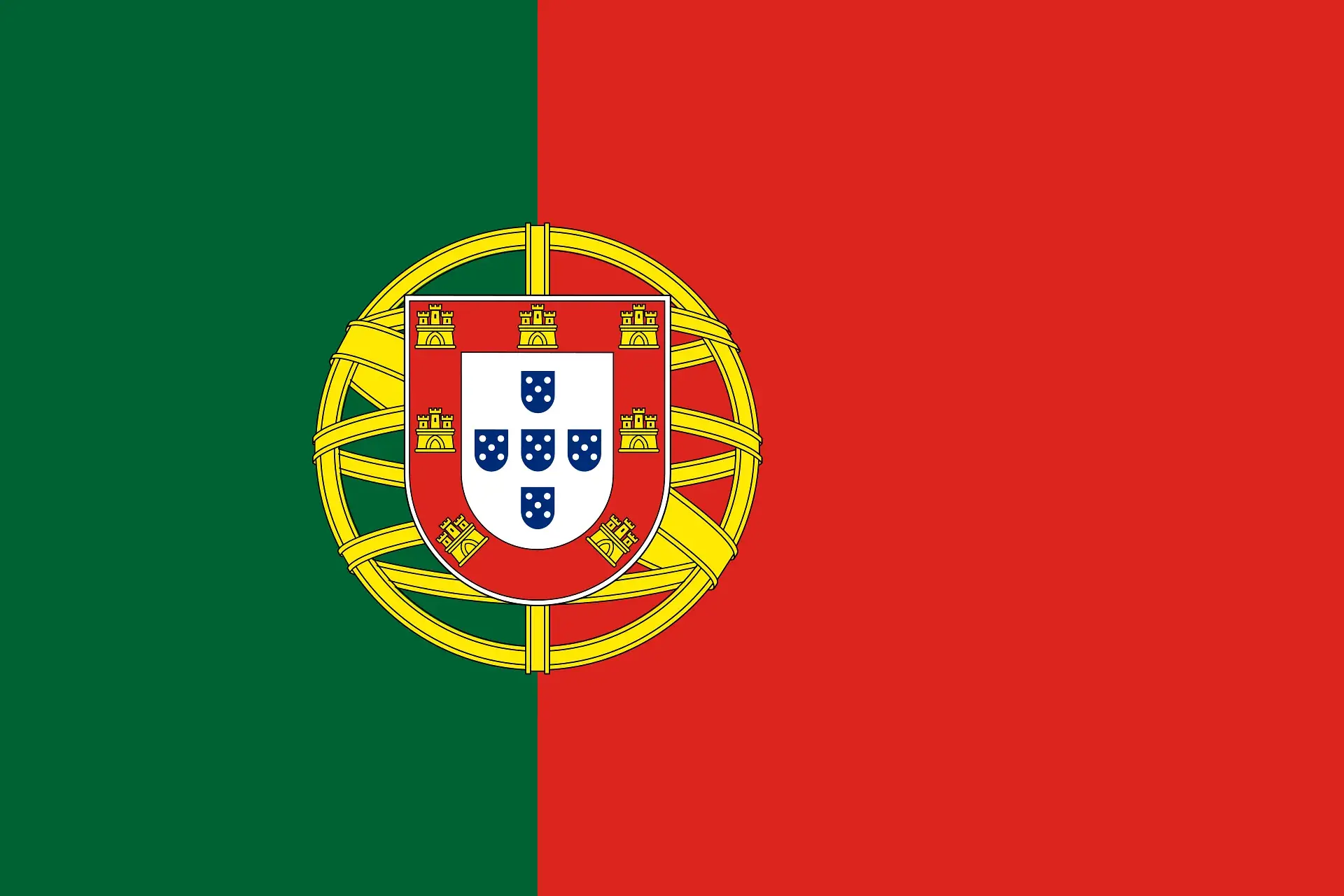
The flag of Portugal is green and red with the Portuguese coat of arms positioned where the two colors meet. It was first presented on December 1, 1910, after the revolution that led to the formation of the First Portuguese Republic, and was officially adopted on June 30, 1911.
In this guide, you’ll learn about the Portuguese flag’s appearance, colors, meaning, symbolism, history, and official adoption, along with interesting facts about Portugal. And if you want to learn even more about Portugal or its flag, ask Quillbot’s AI Chat.
Key takeaways
- The flag of Portugal is a rectangular green-and-red bicolor with the Portuguese coat of arms centered where the two colors meet. It has represented Portugal since 1911, following the establishment of the First Portuguese Republic.
- Every element of the flag has meaning, from the green and red fields to the coat of arms and armillary sphere, reflecting Portugal’s history, maritime achievements, and national identity.
- Discover how the Portuguese flag evolved over more than 800 years, from medieval royal symbols to the modern design adopted after the 1910 revolution.
- Explore fascinating facts about Portugal and its flag, including its unique design, global influence, and remarkable historical firsts.
Quick facts about the flag of Portugal
Learn the key info about the national flag of Portugal, like its proportion, colors, names, and adoption date.
| Feature | Details |
|---|---|
| Official name | Flag of the Portuguese Republic |
| Other names | Bandeira das Quinas (Flag of the Fives)
Bandeira Verde-Rubra (Green-Red Flag) |
| Use | National flag and ensign (maritime flag) |
| Adopted | June 30, 1911 (after its initial presentation in December 1910) |
| Proportion | 2:3 |
| Colors | Green and red vertical bands with a coat of arms where they meet |
| Symbols | Portuguese coat of arms on an armillary sphere |
| Designed by | Special commission including painter Columbano Bordalo Pinheiro |
| Inspired by | The colors of the Portuguese Republican Party |
Portugal flag appearance
The Portuguese flag features two vertical bands of unequal width: a green one on the “hoist” (left) side, and a wider red one on the “fly” (right) side. The green band takes up two-fifths and the red one takes up three-fifths of the flag.
Centered where the two colors meet is the Portuguese coat of arms. It features a white shield containing five blue shields with dots and a red shield with seven yellow castles. The coat of arms is superimposed over a yellow armillary sphere, a type of astronomical instrument.
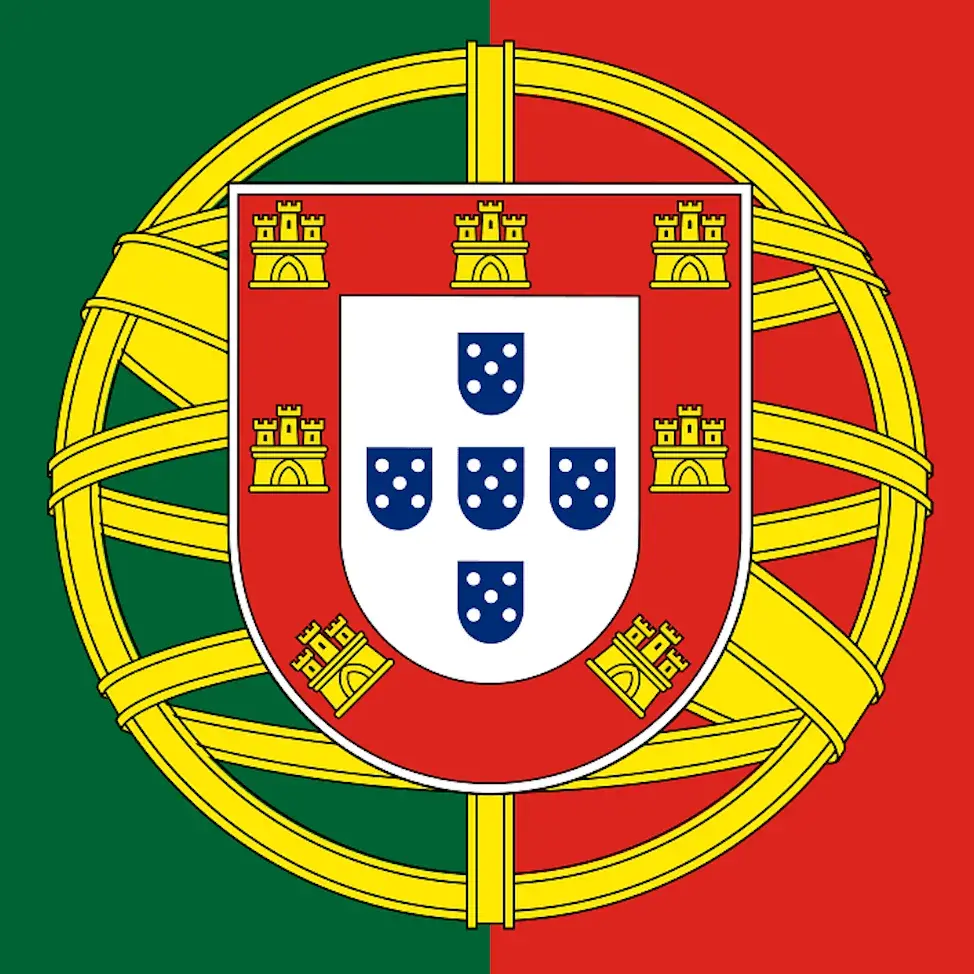
The flag has an official 2:3 aspect ratio, meaning its length is 1.5 times as long as its height. This is the most popular proportion for world flags.
Colors of the Portuguese flag
Want to use the colors of the Portuguese flag in a design of your own? You can easily copy/paste their color codes using the table below. Color names and codes may vary slightly depending on the source or color standard used.
| Element | Color name | Hex code | RGB code |
|---|---|---|---|
| Colored bands | Dark green | #046A38 | 4, 106, 56 |
| Vivid red | #DA291C | 218, 41, 28 | |
| Coat of arms | Golden yellow | #FFE900 | 255, 233, 0 |
| Dark blue | #002D72 | 0, 45, 114 | |
| White | #FFFFFF | 255, 255, 255 |
Flag of Portugal meaning and symbolism
The flag of Portugal has a rich meaning behind it, drawing on Portuguese history, culture, and legend:
- Green represents the hope of the nation and links to the revolutionary movement that led to the 1910 revolution.
- Red signifies the blood, courage, and sacrifice of the people who died defending Portugal.
- The white shield with five blue shields symbolizes the first king of Portugal Afonso I’s decisive victory over the Moors at Ourique in 1139, during which he allegedly struck five shields from the hands of five Moorish kings. Each of the blue shields bears five white dots, representing the five wounds of Christ at his death. According to tradition, Christ appeared to Afonso before the battle to declare his impending success.
- The red shield with seven golden castles represents the Moorish fortresses that were conquered by Afonso III during the Portuguese Reconquista of the Algarve region that ended in 1249. Another theory suggests that this red shield symbolizes Afonso III’s ties (through his mother and his wife) to the Spanish region of Castile, whose arms were a gold castle on a red field.
- The armillary sphere celebrates Portuguese exploration. The armillary sphere was an important astronomical and navigational instrument for Portuguese mariners during the Age of Discovery in the 15th and 16th centuries. During this era, Portugal played a major role in exploring the planet and sailed to places like Brazil, Africa, India, and Japan.
So, to sum up, you could say Portugal’s flag symbolizes the hope and sacrifice of the Portuguese people, the founding of the nation, and the country’s maritime achievements.
History of the Portuguese flag
The Portuguese flag as known today dates to the 20th century, but its different elements have evolved over more than 800 years. Here’s a brief overview of the history of the Portuguese flag:
- 12th century: Afonso I’s coat of arms featured a white field with a blue cross, on which appeared silver dots. This became the first representation of the new Kingdom of Portugal.
- 13th–15th centuries: Successive monarchs added elements to the royal arms, namely the five blue shields and the red border with gold castles.
- 15th–16th centuries: Manuel I, who ruled during the Age of Discovery, adopted the armillary sphere as his personal emblem.
- 1830: Portugal adopted a blue-and-white flag bearing the royal coat of arms. This served as the national flag during the constitutional monarchy.
- October 5, 1910: The Portuguese Republican Party overthrew the monarchy. They later appointed a commission to design a new national flag that reflected the ideals of the new Portuguese Republic.
- December 1, 1910: The commission presented its design of the new Portuguese flag, now red and green, the colors of the Republican Party.
- June 30, 1911: Portugal officially adopted its current green-and-red flag with the historic coat of arms centered on a yellow armillary sphere. This remains the country’s national flag today.
Fun facts about Portugal and its flag
Want to learn some interesting trivia about Portugal and its flag? Here are some fun facts:
- The Portuguese flag has an unusual color layout. Unlike most vertical bicolor flags, Portugal’s green and red sections are not equal in size.
- The flag of Portugal is the only world flag to feature an astronomical device, the armillary sphere.
- Portugal’s penal code allows for two-year prison sentences for infractions of disrespect against the flag.
- Portugal is one of the world’s oldest countries. It was founded in 1143 and its borders have remained mostly unchanged since the 13th century.
- Portuguese is the fifth-most spoken language in the world, with about 252 million native speakers. It’s an official language in nine countries: Portugal, Brazil, Angola, Cape Verde, Timor-Leste, Equatorial Guinea, Guinea-Bissau, Mozambique, and São Tomé and Príncipe. It’s also an official language of the Chinese region of Macau, a former Portuguese colony.
- Portugal has the world’s oldest continuously operating bookstore: the Livraria Bertrand in Lisbon, which has been operating since 1732.
- Portugal produces about 50% of the world’s cork. A cork tree needs about 25 years before it can be harvested, and the country’s cork forests are strictly protected.
- Countries like China, India, and Thailand can thank Portugal for their spicy cuisines. The Portuguese introduced chili peppers into Asia after they encountered them in the New World.
- Portugal and England share the longest-running diplomatic alliance in recorded history. The two nations signed the Treaty of Windsor in 1387, when John I married English noblewoman Philippa of Lancaster.
- Portugal also holds a world record in surfing. The largest wave ever surfed was at Praia do Norte in Nazaré, north of Lisbon. Sebastian Steudtner surfed the 86-foot wave in 2020.
Frequently asked questions about flag of Portugal
- What is the old flag of Portugal?
-
The old flag of Portugal is a blue and white flag used by Portugal’s constitutional monarchy from 1830 to 1910.
It was a blue and white vertical bicolour bearing the national coat of arms in the centre. The coat of arms on this flag was different from the Portuguese coat of arms that appears on the country’s current flag.
To learn more about the old flag of Portugal, ask Quillbot’s AI Chat.
- What flag is green, yellow, and red?
-
There are many flags that are green, yellow, and red, and most of them come from Africa, as these are the Pan-African colors. Examples include the flags of Burkina Faso, Cameroon, Ethiopia, Ghana, Mali, Senegal, and Togo.
The flag of Portugal, flag of Bolivia, and flag of Lithuania are a few examples of non-African flags that are also red, green, and yellow.
Quillbot’s AI Chat can provide lists of flags that match the characteristics you’re looking for, like color combinations, symbols, or proportions.
- When is Portugal independence day?
-
Portugal doesn’t have a strict independence day. Instead, it celebrates two key dates:
- Restoration of Independence Day on December 1, which celebrates the 1640 coup that restored Portuguese independence from Spain
- Portugal National Day on June 10, which commemorates the death of national poet Luís de Camões and celebrates Portuguese communities around the world
People celebrate these days with civic ceremonies (like raising the flag of Portugal), traditional food, and cultural events. Learn more about these celebrations by asking Quillbot’s AI Chat.
Other interesting articles
If you want to know more about colors, letters, or the meaning of emojis, make sure to check out some of our other articles with explanations and examples.