
Scottish Flag | Meaning, History & Fun Facts
The Scottish flag is the national flag of Scotland, one of the four countries that make up the United Kingdom. It features a white X-shaped cross, or “Saint Andrew’s Cross,” on a blue field. The flag was standardized in 2003, although according to legend, it dates back to 832.
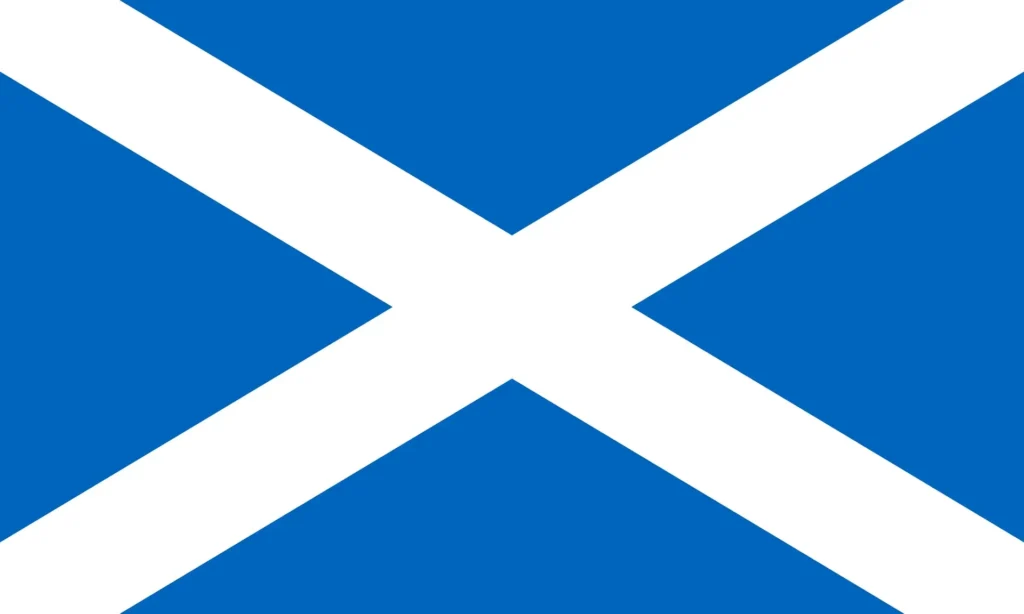
This article outlines the design, symbolism, and history of the Scottish flag and shares some fun facts about Scotland, which has its own unique history and culture apart from that of the U.K.
To learn more about the flag of Scotland or the country itself, ask Quillbot’s AI Chat.
Key takeaways
- The Scottish flag, also known as the Saltire or Saint Andrew’s Cross, features a white X-shaped cross on a blue field and is one of Europe’s oldest national flags.
- The flag’s design is closely connected to Saint Andrew, Scotland’s patron saint, and a legend dating back to a battle in 832.
- Learn how the Saltire developed into Scotland’s national flag, from its earliest recorded uses to its incorporation into the Union Jack.
- Discover fun facts about Scotland and its flag, including the country’s national animal, languages, islands, and the meaning behind the Scottish flag emoji.
Quick facts about the Scottish flag
The table below offers key information about the Scottish flag.
| Feature | Detail |
|---|---|
| Official name | Flag of Scotland bratach na h-Alba in Scottish Gaelic Banner o Scotland in Scots |
| Other names | The Saltire
Saint Andrew’s Cross |
| Use | National flag |
| Adopted | 832 according to legend
1542 according to its earliest confirmed depiction 2003 according to official standardization |
| Proportion | 3:5 |
| Colors | Blue and white |
| Symbols | Saltire |
What does the Scottish flag look like?
The Scottish flag consists of a white X-shaped diagonal cross on a dark blue background. The X-shaped cross is known as a “saltire” or “Saint Andrew’s Cross,” both of which are also unofficial names for the flag of Scotland. The proportions of the flag aren’t strictly fixed, but 3:5 is the most commonly used ratio.
Scotland colors
Find the color names and codes used in the Scottish flag below. Color names are orientative, as they often vary based on the color system used. For example, the blue on the flag of Scotland may be called “Celtic blue,” “bright blue,”or “navy blue” in different systems.
| Element | Color | Hex code | RGB code | Pantone code |
|---|---|---|---|---|
| Background | Celtic blue | #005EB8 | 0, 94, 184 | 300 C |
| Saltire | White | #FFFFFF | 255, 255, 255 | N/A |
Scotland flag meaning
The flag of Scotland is closely connected to Saint Andrew, one of Jesus’s Twelve Apostles and Scotland’s patron saint. Saint Andrew is said to have been martyred by crucifixion in 60 AD. Tradition says he felt unworthy of being crucified on the same type of cross as Jesus had been, so he asked to die on an X-shaped cross instead.
So what does this have to do with Scotland? According to legend, in 832 AD, King Angus MacFergus was preparing his combined forces of Picts and Scots for a battle against Angles and Saxons at Athelstaneford in East Lothian. Outnumbered and surrounded, Angus prayed for deliverance on the eve of the battle. Saint Andrew’s Cross then appeared as a cloud formation in the sky. Angus vowed that if the saint helped him win the battle, he would make Andrew the patron saint of Scotland.
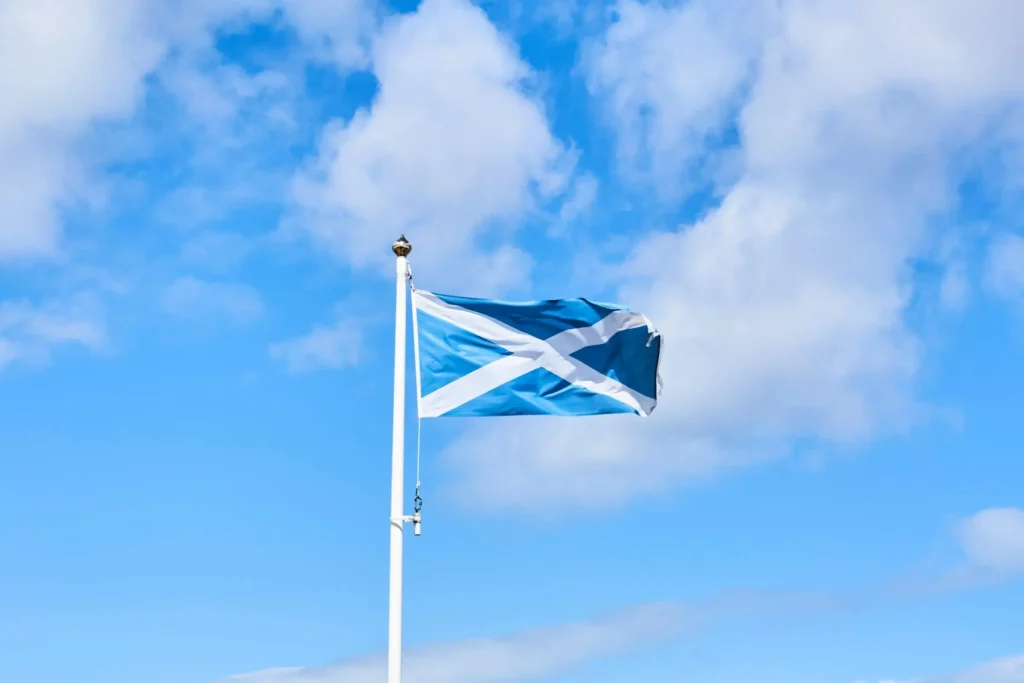
Angus won, Saint Andrew became the country’s patron saint, and the flag of Scotland was born: a blue sky with the white cross that appeared in the clouds.
Scotland flag history
The Scottish flag has been a symbol of Scotland for centuries, and many consider it to be the oldest flag in Europe. Here’s a brief history of the flag of Scotland:
- 832: According to legend, King Angus led an army against the Angles and Saxons near the present-day village of Athelstaneford. Before the battle, Angus saw a cloud formation shaped like an X-shaped cross, which he interpreted as a sign from Saint Andrew. Angus won the battle, and this symbol became associated with Scotland.
- 1286: The seal of the Guardians of Scotland (regents of the Kingdom of Scotland) depicted Saint Andrew on his cross, showing that he had become an important national symbol.
- 1385: The Parliament of Scotland orders all Scottish soldiers to wear a white Saint Andrew’s Cross to distinguish them during military campaigns against England. At this point, the cross’s background didn’t have to be blue.
- 1388: James Douglas, 2nd Earl of Douglas, used a flag with a saltire at the Battle of Otterburn against England.
- 1507: The saltire appeared on the naval flag used by the Great Michael, a ship from the Royal Scottish Navy.
- 1542: Sir David Lyndsay of the Mount, a Scottish knight and herald, illustrated an armorial (a collection of heraldic designs) that included the white saltire on a blue field. This is the earliest confirmed, surviving drawing of the modern Scottish flag.
- March 24, 1603: James VI of Scotland inherited the English throne after the death of his cousin, Elizabeth I, and became James I of England. This moment is known as “the Union of the Crowns,” although Scotland and England remained separate countries.
- April 12, 1606: James VI and I introduced the first Union Flag, which combined the crosses of Saint Andrew (Scotland) and Saint George (England). Despite this, the Saltire continued to be used as the national flag of Scotland.
- 1672: The Public Register of All Arms and Bearings in Scotland was established, and the Saltire was formally recorded as the national badge of the country.
- 1707: The Acts of Union unite the Kingdoms of Scotland and England to form the Kingdom of Great Britain under Queen Anne. The Saltire is incorporated into the Union Jack but also remains a symbol of Scotland.
- 2003: A Scottish Parliament committee met to standardize the blue shade used in the flag and chose Pantone 300.
Today, the blue-and-white Saltire remains the national flag of Scotland and is widely used alongside the Union Flag and other Scottish symbols.
Scottish lion flag
People sometimes confuse the Saltire with the “Scottish lion flag,” which is officially called the “Royal Banner of the Royal Arms of Scotland” or the “Lion Rampant of Scotland.” It shows a red, “rampant” (i.e., upright) lion on a yellow background with a red floral border.
This flag has historically been the royal standard of the Kingdom of Scotland. Today, this flag technically belongs to the British monarch, and its official use is restricted to Scottish royal residences and designated representatives.

Fun facts about Scotland and its flag
These fun facts about Scotland and the Scottish flag can help you out when creating a quiz, playing trivia, or just looking to learn something new:
- Although its actual date of origin is unclear, the flag of Scotland is generally considered to be the oldest flag in Europe and one of the oldest in the world.
- Four national flags feature a saltire: Scotland, the United Kingdom, Jamaica, and Burundi.
- Scotland has three official languages: English, Scots, and Scottish Gaelic. Scots is a West Germanic language, like English, and Scottish Gaelic is a Celtic language.
- St. Andrew’s Day is Scotland’s official national day. Celebrated on November 30, it honors Scotland’s patron saint and is marked with music, dancing, traditional attire, food, and other Scottish traditions.
- The unicorn has been associated with Scottish royalty since the late Middle Ages. It became Scotland’s national animal in the 15th century. Scotland celebrates National Unicorn Day on April 9.
- Scotland has about 900 offshore islands, and 90–94 of them are inhabited. The largest groups include the Hebrides, Orkney, and Shetland.
- Loch Ness holds around 7.4 trillion gallons of fresh water. It holds more water than all the lakes, reservoirs, and rivers of England and Wales combined.
- Golf was invented in Scotland in the 15th century.
- The first municipal fire brigade was founded in Edinburgh in 1824. The Edinburgh Fire Engine Establishment predates London’s fire brigade, founded in 1832.
Scotland flag emoji
The Scotland flag emoji shows the blue-and-white Saltire. It’s typically used in messages, social media captions, and other content related to Scotland or Scottish culture. Note that flag emojis often don’t appear on Windows devices, so if you’re using one, you may see the letters “XS” or nothing at all.
Frequently asked questions about flag of Scotland
- Is Scotland a country?
-
Yes, Scotland is a country. However, it is not an independent sovereign state. Scotland is one of the four countries that form the United Kingdom.
While it is a part of the U.K., Scotland retains its own cultural identity, legal system, and devolved parliament. For example, the blue-and-white Scottish flag represents the country, while the Union Jack represents the entire U.K. Or when it comes to language, Scottish people speak English, but they may also speak Scots or Scottish Gaelic.
If you’d like to learn more about Scotland, its history, and its culture, Quillbot’s AI Chat can help.
- What’s the national animal of Scotland?
-
The national animal of Scotland is the unicorn. It has represented the country since around the 1200s, when it was added to the King of Scotland’s coat of arms.
Celtic mythology views the unicorn as a symbol of purity, power, and bravery, with legends saying that it would rather die than be captured. On the coat of arms, it’s often shown in golden chains, symbolizing the power of the Scottish kings to tame the animal.
Although the unicorn is used to symbolize Scotland, it doesn’t appear on the Scottish flag, which instead features a St. Andrew’s Cross.
To learn more about the heraldry and flag of Scotland, ask Quillbot’s AI Chat.
- What is the Scottish flag called?
-
The Scottish flag is called “the Saltire” or “Saint Andrew’s Cross.” Both of these names refer to the X-shaped diagonal cross used on the flag.
The name “Saltire” originally comes from French. “Saint Andrew’s Cross” references the martyr Saint Andrew, who was crucified on an X-shaped cross because he felt unworthy to die in the same manner as Jesus.
To learn more about these names or about the flag of Scotland, ask Quillbot’s AI Chat.
- What is the Scotland unicorn flag?
-
There is no official Scotland unicorn flag. The unicorn is the national animal of Scotland, but it does not appear on the official Scottish flag. However, there may be unofficial flags that bear the unicorn.
This phrase may also refer to the Royal Banner of Scotland, called the “Lion Rampart,” but that flag features a lion, not a unicorn.
To learn more about the flags of Scotland, ask Quillbot’s AI Chat.
Other interesting articles
If you want to know more about colors, letters, or the meaning of emojis, make sure to check out some of our other articles with explanations and examples.