
North Korea Flag | Meaning, History, & Interesting Facts
North Korea—officially known as the Democratic People’s Republic of North Korea—is a country in East Asia that was established in 1948. Once unified with South Korea, it split away in the wake of World War II as it became more ideologically aligned with the Soviet Union. Due to official state policy as well as geopolitical relations, North Korea is one of the most secluded countries on earth.
In this guide, we’ll cover the meaning, history, and symbolism behind the flag of North Korea. You’ll also discover some unique facts about North Korean society and culture.
Try Quillbot’s free Image Generator to create custom graphics of your favorite country flags.
Key takeaways
- Understand the North Korean flag’s design and symbolism: Its central red panel, white and blue stripes, and red star represent revolutionary traditions, purity and dignity, peace and sovereignty, and socialism.
- Explore the flag’s history: Officially adopted on September 8, 1948, it replaced the Taegukgi used in Korea before the peninsula’s division.
- Learn surprising facts about North Korean society and culture, including the Juche calendar, restricted internet access, and state-approved hairstyles.
North Korea flag overview
Below you’ll learn the basics about the flag of North Korea—including the year it was adopted, its colors, and what inspired it.
| Feature | Details |
|---|---|
| Official name | Flag of the Democratic People’s Republic of Korea |
| Use | National flag and ensign |
| Adopted | 8 September 1948 |
| Proportion | 20:33 |
| Colors | White, blue, and red |
| Coat of arms | None |
| Inspired by | USSR, socialist symbols |
North Korea flag meaning and symbolism
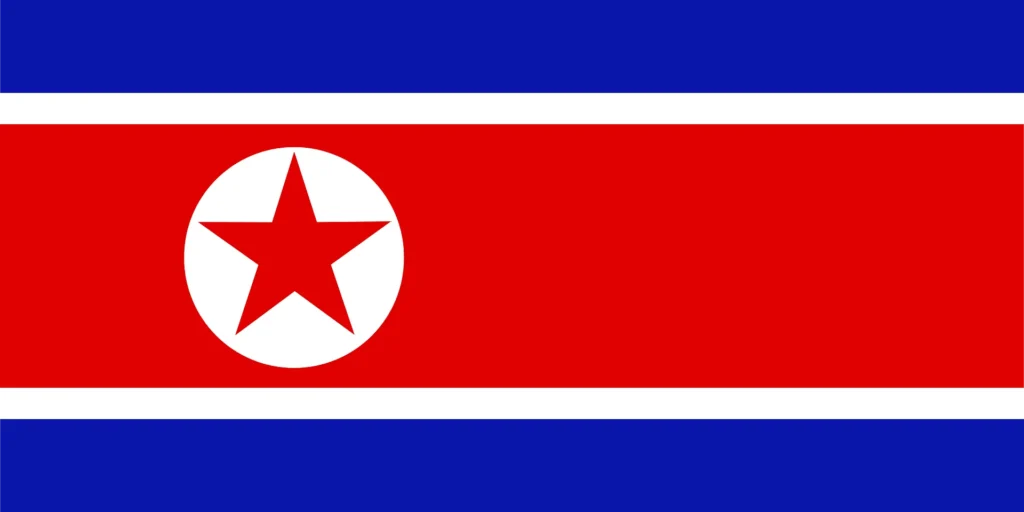
The flag of North Korea consists of a central red panel, bordered above and below by a thin white stripe and a thicker blue stripe. On the left side of the red panel sits a red star enclosed in a white circle.
Here’s what each element symbolizes:
- Red panel: Represents North Korea’s revolutionary traditions.
- White stripes: Symbolize purity, dignity, and strength.
- Blue stripes: Signify peace, friendship, and sovereignty.
- Red star: Stands for socialism.
It is important to note that different sources list different meanings for the symbols embedded in the North Korean flag’s design. The above are according to the CIA World Factbook.
North Korea flag history
The flag of North Korea is also known as the “Ramhongsaek Konghwagukgi,” which means, “red-colored flag of the republic.” It was officially adopted on September 8th, 1948—along with the country’s first constitution.
Following Japan’s defeat in World War II, it was forced to relinquish control of Korea. The country was then divided along north and south into two occupation zones, controlled by the Soviet Union and United States respectively. While both sides initially used the same flag, in 1947 the Soviet Union began to propose that their North Korean allies use a distinct design.
North Korea credits its founder and first leader, Kim Il Sung with coming up with the flag’s design. However, some sources note that it was actually the artist Kim Chu-gyong who created it. Still others point to the Soviet Union.
Unique facts about North Korea
Discover some interesting facts about North Korean daily life and society.
- Men and women must choose from a list of about 15 state-approved haircuts. The options are illustrated in guides posted in hair salons, and civilians who deviate from these choices are subject to interrogations.
- North Korea operates on a different calendar from anywhere else in the world, known as the Juche calendar. It begins in 1912, with the birth year of Kim Il-sung—the founder of North Korea.
- North Korea has its own intranet, and only a few websites and TV channels are permitted.
- Citizens of North Korea are not allowed to wear blue jeans due to their association with Western nations like the United States.
- North Korea has its own official basketball scoring system, attributed to its leader Kim Jong-il in the 1990s. For example, slam dunks are worth three points instead of the standard two points. Today, however, it mostly adheres to the same rules as the rest of the world.
Frequently asked question about the flag of North Korea
- What are some places that start with P?
-
Places that start with P include several countries and many cities.
- Countries that start with P: Pakistan, Palau, Palestine, Panama, Papua New Guinea, Paraguay, Peru, Philippines, Poland, Portugal
- Cities that start with P: Puyang (China), Pyongyang (North Korea), Pune (India), Paris (France), Perth (Australia), Patna (India), Phnom Penh (Cambodia), Philadelphia (US), Phoenix (US), Port-au-Prince (Haiti), Prague (Czechia)
Quillbot’s AI Chat can show you even more words that start with P, and it’s completely free to try.
- Why do North and South Korea have different flags?
-
North and South Korea have different flags because they split into two separate countries after World War II.
Previously, the two countries used versions of the traditional Korean Taegeukgi flag. However, in 1948, North Korea adopted a different design that aligned with its socialist ideology and the influences of the Soviet Union.
Create personalized graphics of your favorite country flags using Quillbot’s free Image Generator.
Other interesting articles
If you want to know more about colors, letters, or the meaning of emojis, make sure to check out some of our other articles with explanations and examples.