
Uncanny Valley | An Accessible Guide to the Effect
Have you ever felt a flicker of unease while watching a CGI character in a movie or a “person” in an AI-generated video? The face looks almost right, their movements seem almost natural, and their emotional reactions seem almost genuine. Turns out that “almost” may be exactly the reason you feel weirded out.
The uncanny valley is a human reaction of unease, eeriness, or aversion to humanlike robots, animated characters, synthetic voices, or AI-generated content that look or sound nearly, but not quite, human.
The hypothesis originated in the 1970s during a transformative decade for robotics, but today, the uncanny valley also applies to media and pop culture. Many people can’t express exactly why they feel unsettled when encountering the uncanny valley, and research still debates whether the effect is indeed real and, if so, why exactly it occurs.
This article outlines what the uncanny valley is, who came up with it, how it works, why it may happen, and if it’s even real. You’ll also get examples of how it manifests, or is intentionally used, in animation, film and TV, and AI-generated content.
Key takeaways
- The uncanny valley describes the unease people may feel when something looks, sounds, or behaves almost, but not quite, human.
- The concept was introduced by Japanese roboticist Masahiro Mori in the 1970s and now applies to everything from humanoid robots and CGI characters to video games and AI-generated content.
- Researchers have proposed several explanations for the uncanny valley, including perceptual mismatch, category uncertainty, disease avoidance, and threat-related responses, but there is no single widely accepted explanation.
- The uncanny valley remains a hypothesis rather than a settled scientific fact. Research has produced conflicting results, and individual responses can vary depending on the person, technology, and context.


Table of contents
- What is the uncanny valley?
- Where the term comes from
- How does the uncanny valley work?
- What does the uncanny valley feel like?
- Why does the uncanny valley happen?
- Uncanny valley examples
- Intentional uncanny valley in pop culture
- The textual uncanny valley
- How to avoid the uncanny valley
- Is the uncanny valley even real?
- Frequently asked questions about the uncanny valley
- Other interesting articles
What is the uncanny valley?
The uncanny valley is a hypothesized psychological phenomenon in which people feel uncomfortable or uneasy when something looks, acts, or sounds almost human. As something becomes more human-like, people generally find it familiar and appealing. But just before it becomes fully convincing, that appeal drops sharply, producing feelings of eeriness or revulsion instead.
For example, the robot WALL-E, from Pixar’s 2008 eponymous film, avoids the uncanny valley. He has some humanlike features—expressive eyes, arms, and hands—but he still very much looks like an industrial machine, and most people view him as a cute, nonthreatening, somewhat anthropomorphized robot.
On the other hand, a robot like Engineered Arts’ Ameca, which has silicon skin and a face capable of realistic micro-movements—but which may also experience the slightest mechanical delays—gets too close to human likeness without being exact and may therefore leave some people feeling unsettled.
Where the term comes from
The uncanny valley concept was first introduced by Japanese robotics professor Masahiro Mori in his 1970 article Bukimi No Tani Genshō (romanized from the Japanese “不気味の谷現象”). In 1978, British art critic and curator Jasia Reichardt translated Mori’s concept as “the uncanny valley” in her book Robots: Fact, Fiction, and Prediction.
In the original essay, Mori proposed that human emotional responses to robots generally become more positive as they become more humanlike, but that this response becomes negative when robots appear nearly human without exactly replicating human appearance or behavior. Once a robot becomes sufficiently humanlike, the theory suggests that human reaction may swing positive once again.
In this translated excerpt, Mori explains the uncanny valley using the example of prosthetic hands:
“One might say that the prosthetic hand has achieved a degree of resemblance to the human form, perhaps on a par with false teeth. However, when we realize the hand, which at first site [sic] looked real, is in fact artificial, we experience an eerie sensation. For example, we could be startled during a handshake by its limp boneless grip together with its texture and coldness. When this happens, we lose our sense of affinity, and the hand becomes uncanny.”
For Freud, the uncanny was located in “the strangeness of the ordinary.” Mori has said that this association was unintended and he made his observation independently of Jentsch and Freud. Regardless of intention, the two concepts became intertwined in their analysis of things that feel simultaneously familiar and unfamiliar.
How does the uncanny valley work?
This concept is perhaps best illustrated with a graph, a version of which was included in Mori’s original article. The graph has “human likeness” on one axis and “affinity” on the other. In simplest terms, the uncanny valley effect works like this:
- Something becomes more humanlike.
- Human affinity generally increases.
- The thing becomes almost indistinguishable from a human.
- Small inconsistencies become more noticeable.
- Affinity can suddenly decline.
- At sufficiently high realism, affinity may increase again.
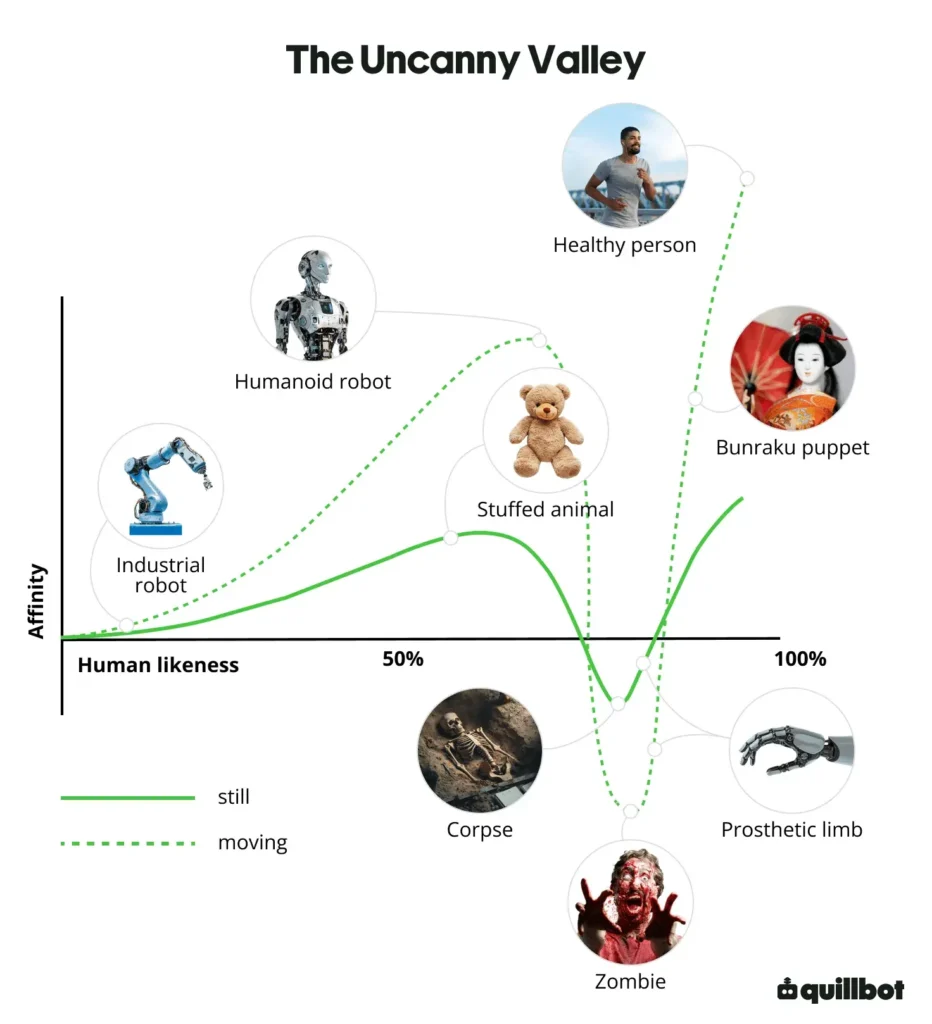
The graph gives various examples. An industrial robot has little human likeness, so it doesn’t unnerve people but also doesn’t provoke warm and fuzzy feelings (i.e., affinity). A stuffed animal or humanoid robot has greater human likeness and tends to be viewed as more attractive or relatable, until, in the case of robots, they appear too similar to humans. Entities like corpses, zombies, and bunraku puppets are also a bit too similar to humans for comfort and therefore provoke uneasiness. The same often goes for prosthetic limbs, as mentioned by Mori himself. The trough in the graph where the “almost human” examples are plotted is where the “valley” part of the term “uncanny valley” comes from.
As technology evolves, the uncanny valley may shift, and many designers also now take it into account. For example, Mori discussed prosthetic limbs in the 1970s, but the design and production of prosthetics have changed greatly since then. In fact, many manufacturers have shifted away from trying to create hyper-realistic prosthetics, opting for more evidently mechanical ones, in order to avoid the uncanny valley in the first place.
What does the uncanny valley feel like?
“Uncanny” generally describes something that feels strange, unfamiliar, or unsettling in a difficult-to-explain way. The uncanny valley can elicit different feelings based on each person and context. Some emotion nouns used to describe the effect are “uneasiness,” “eeriness,” “creepiness,” “discomfort,” “fear,” “distrust,” and “confusion.”
The uncanny valley can be scary because it combines familiarity with something that seems abnormal, with the defining reaction being a sense that something is not quite right. The feeling does not necessarily mean that someone is literally afraid, though fear may occur when that unsettling feeling is interpreted as a potential threat. But generally speaking, the uncanny response is usually more nuanced than pure fear.
Why does the uncanny valley happen?
There is no single, widely accepted psychological explanation about why people may experience the uncanny valley effect. There are a number of proposed theories, some biological and others cultural, a few of which are outlined below.
Perceptual mismatch
Perceptual mismatch occurs when an entity or situation presents mismatched expectations between what is anticipated and what is perceived. The human brain combines different cues (such as a person’s face, eyes, skin, voice, and movements) to form a complete picture of what it’s seeing, and when these cues don’t align as expected, it can cause cognitive dissonance, which leads to mental discomfort.
When applied to the uncanny valley phenomenon specifically, perceptual mismatch may arise when people notice an inconsistency between the human likeness of different sensory cues. For example, a robot may have a face that looks human but eyes that glint or move unnaturally. Or an AI-generated voice may sound human in tone and pitch but apply uneven or unusual pacing.
Category uncertainty
One of the brain’s computational strategies to make sense of a complex world is to constantly categorize information, and “human” and “nonhuman” represent two distinct categories. Another theory as to why people may experience the uncanny valley is because they are unable to categorize objects and entities that span these two categories.
This inability to categorize leads to longer mental processing times and can trigger psychological discomfort. People tend to feel uncomfortable when they have conflicting beliefs. For example, a clearly artificial robot and a real person are easy to distinguish and categorize. One is not human, and the other is human, and there is no doubt about these beliefs. But an extremely realistic humanoid robot can appear artificial and human, making it more difficult for the viewer to categorize and creating disparate beliefs that lead to a feeling of unease.
Disease avoidance
One possible biological explanation for the uncanny valley effect is that it is part of the “programming” that keeps humans healthy. Early humans needed to stay away from sick tribe members and corpses in order to avoid deadly pathogens and parasites. The uncanny valley may have helped them to recognize this danger by setting off a “biological alarm” when they saw someone exhibiting stiff or unusual movements, a blank stare, discolored skin, or unusual facial features.
Competition with other species
Homo sapiens once shared the planet with other archaic human species, like Neanderthals and Denisovans, who looked similar—but not the same—as them. These other species were competition for food, resources, and territory, and some evolutionary psychologists have proposed that the uncanny valley may have developed as a warning system to help early modern humans avoid conflict, defend their tribes, protect their genetic evolution, and strengthen bonds among members of their own species.
Mortality salience
Mortality salience is the awareness that death is inevitable and any and all attempts to avoid it forever will always be futile. When something looks almost but not completely human, it may trigger this awareness and a conscious or unconscious fear of death, injury, or annihilation.
There are a few proposed reasons for this. Robots with human exteriors and mechanical interiors may trigger an existential fear that humans are all just soulless machines. Entities that appear human, but that really aren’t, may also be perceived as doppelgangers and provoke a primal fear of being replaced. Or a robot’s erratic movements may be unsettling because they elicit anxiety about losing control of one’s body.
Uncanny valley examples
The uncanny valley isn’t limited to one type of technology and it can manifest in many contexts, especially as technology continues to evolve and develop new capabilities.
Robotics
Robotics was the field in which Masahiro Mori originally applied his uncanny valley theory. Robots designed with human-like faces, bodies, or movements can become unsettling when their artificial characteristics, like movements or materials, remain noticeable. Likewise, a highly detailed robot face may create stronger expectations of natural human behavior and therefore cause unusual features or expressions to stand out more.
Some examples of humanoid robots are:
- Engineered Arts’ Ameca
- Hanson Robotics’ Sophia
- Hiroshi Ishiguro’s Telenoid
- Hiroshi Ishiguro’s Geminoid HI-1
- University of California San Diego’s Diego-san
If you look at images or watch videos of these robots, what do you feel? Do you experience the uncanny valley? If so, which robots make you feel more unsettled and why do you think that is?
Movies and TV
CGI has come a long way in how it renders digital humans and characters that look almost human. But when these characters have subtle differences in their faces, expressions, movements, or voices, they can sometimes produce an uncanny valley effect in viewers.
Movies that people have discussed online as having provoked an uncanny reaction include:
- Final Fantasy: The Spirits Within (2001)
- The Polar Express (2004)
- Beowulf (2007)
- The Adventures of Tintin (2011)
- Cats (2019)
Have you watched any of these movies? Did they make you feel uneasy? Keep in mind that release year and subject matter may affect how different people perceive the uncanny valley (or not).
Video games
Similarly, the uncanny valley effect can appear in video games when developers try to make human characters look and behave realistically. The effect is not limited to visual graphics; a character can look realistic but still feel unnatural because of the way it moves, speaks, reacts, or even interacts with the player.
Some people have mentioned feeling the uncanny valley effect while playing the following games:
- The Elder Scrolls IV: Oblivion (2006)
- Mass Effect: Andromeda (2007)
- Fallout 3 (2008)
- The Sims 3 (2009)
- L.A. Noire (2011)
If you’ve played any of these games, did you notice the uncanny valley? And if you felt a sense of eeriness, what was it that made you feel that way—faces, voices, movements, or something else?
AI-generated content
Thanks to AI, it’s possible to create increasingly realistic AI avatars, virtual influencers, digital “humans,” and deepfakes. These can appear uncanny for the same reasons as CGI characters. In AI videos, slight changes in appearance from frame to frame can also potentially elicit an uncanny reaction.
Not every AI-generated person produces an uncanny response, as not all humans react the same way to external stimuli. Some people may find a particular image or avatar realistic and convincing, while others may notice inconsistencies and find it creepy, strange, or unsettling. The response depends on the level of realism, the type of content, and the viewer’s expectations.

This image was created with Quillbot’s AI Image Generator. What do you feel when you look at it? Is it uncanny, nonthreatening, or something else?
Intentional uncanny valley in pop culture
Sometimes, designers and directors intentionally harness the uncanny valley to unsettle their audiences. Its combination of familiarity and abnormality, especially when exaggerated, can trigger an instinctual sense of dread.
Uncanny valley in horror media
The uncanny valley is useful in horror because something that is almost human can be more unsettling than something that is obviously monstrous. It’s easier to recognize an unfamiliar creature as something fictional, but a nearly human face creates uncertainty.
This may go back to the category uncertainty proposed as one reason for the uncanny valley. When the human brain encounters a clear monster, like a vampire or werewolf, it can easily categorize that entity as a clear, non-human threat, triggering fear and the fight or flight response. However, when the brain comes across an uncanny entity, like a shapeshifter or lifelike mannequin, it cannot easily categorize it, leading to revulsion, paranoia, and dread.
Horror films, shows, games, and online media can exploit this effect by blending realism with slight distortions. Here are a few examples of horror media and how they play up the uncanny valley:
- Twin Peaks (1990–1991, 2017): David Lynch’s TV show has been lauded as a groundbreaking example of surreal horror on television. The uncanny valley manifests most often in the show’s Black Lodge, where characters speak backwards, and have jerky, almost mechanical movements.
- Silent Hill 2 (2001): Konami’s entire Silent Hill game series employs the uncanny valley, but the second title is perhaps the best example of it. Dreamlike logic and enemies that have distorted bodies or no faces create an uncanny effect.
- M3GAN (2022): Dolls have been a horror staple for years, but Gerard Johnstone’s film takes it a bit further by making the titular character an artificially intelligent one. The film uses a mix of animatronics, CGI, a real child actor, and layered voice acting to make M3GAN feel familiar, but not 100% right.
- Obsession (2025): Curry Barker used practical uncanny effects in his film to create the disturbing character of Nikki. Actress Inde Navarette wore “uncanny valley makeup” and exaggerated her facial expressions and vocal performance, making her character come across as something that appears human but may not fully be.
Uncanny valley makeup trend
One of the clearest proofs that the uncanny valley has entered mainstream culture is the uncanny valley makeup viral trend across social media. Beauty creators on Instagram, TikTok, and YouTube show how to transform natural features into eerie, synthetic-looking faces.
To achieve the uncanny valley makeup look, creators generally:
- Hide human depth and warmth: Heavy foundation and concealer help eliminate natural face contours, skin texture, and blemishes or uneven tone. This creates a flat, plastic-like complexion similar to that of a robot or doll.
- Exaggerate features: Dramatic contouring can make the human face look unrealistic, sick, or just “off.” Creators may greatly exaggerate their cheek and brow bones, add shadows beneath the eyes and nostrils, extend the lips and jawline, and even sometimes paint fake teeth over their lips to create uncanny features.
- Use unnatural movements: Creators often combine their uncanny makeup with unblinking stares, wide grimaces, rigid posture, and jerky movements reminiscent of an animatronic or glitching video game character.
The resulting images and videos can feel uncanny because the faces, while unmistakably human, are stripped of organic warmth and microexpressions that signal safety and emotional connection.
The textual uncanny valley
Can written words trigger an uncanny response? Some people believe so. The rapid rise of generative AI and chatbots has expanded the phenomenon into text. The textual uncanny valley occurs when AI-generated content mimics human grammar and vocabulary without organic rhythm, emotional depth, and/or idiomatic nuance.
Some common triggers of “uncanny text” are:
- Symmetrical and repetitive structures: Generative AI often relies on predictable sentence patterns. It often defaults to uniform sentence and paragraph lengths and uses symmetrical clause structures and transition phrases (e.g., “In conclusion” or “Furthermore”).
- Extreme neutrality: AI writing often strips away human quirks, slang words, and personal anecdotes and can end up feeling corporate, sterile, or emotionally detached.
- Semantic emptiness: AI may produce paragraphs that sound authoritative but that do not convey true unique insight. This is sometimes called “polished fluff.” It may also use sentences that are either too vague or that overexplain a simple concept (e.g., “In today’s fast-paced digital world, time management has become increasingly important for professionals looking to succeed in their careers”).
- Unnatural buzzwords: AI commonly uses certain words that human writers wouldn’t necessarily choose, which can leave text feeling lofty and unnatural. Some examples are “delve,” “tapestry,” realm,” “leverage,” “transformative,” “crucial,” and “embark.”
For some readers, these attributes can create cognitive friction because the writing looks complete, but it feels hollow. While the resulting effect may not be as pronounced as when dealing with visuals—and in fact may not affect people at all—it could lead some people to feel uneasy.
How to avoid the uncanny valley
Unless you intentionally want to elicit the uncanny valley effect, there are some design principles you can follow for avoiding the uncanny valley:
- Choose stylized over realistic design: If you lean into illustrated, cartoonish, or clearly artificial design, people won’t expect human perfection. This is why, for example, Disney or Pixar films don’t usually provoke the uncanny valley; each studio has its own unique style, and neither strives for hyperrealism. It’s also why a clearly mechanical prosthetic limb feels less creepy than one that tries to mimic the real thing.
- Add neotenous aspects: Some experts believe the uncanny valley effect can be eliminated by adding neotenous (i.e., childlike or juvenile) elements to a design. This plays off the idea that people find characters more appealing when they’re reminiscent of young humans or animals.
- Match facial expressions, body language, and speech: Humans generally express emotions in various ways simultaneously. A character or robot whose face conveys an emotion but whose voice and body language do not risk entering the uncanny valley. Designers should pay extra attention to the eyes, forehead, and mouth, three parts of the face that communicate emotional complexities.
- Make eyes look alive: Avoid bloodshot tones, make sure the whites of the eyes are bright, and add realistic reflections and movements like subtle blinking or darting pupils.
- Synchronize movements: A character or robot’s physical actions, including breathing and facial reactions, should match real-world physics and the emotional tone of the moment.
- Only use realistic skin texture and facial proportions together: Correct facial proportions demand photorealistic skin texture and vice versa. Using one without the other can create an eerie response among viewers.
- Stay away from harsh lighting: Whenever possible, use multi-source lighting to give skin, hair, and clothes natural depth. Harsh lighting can create a flat look, which could potentially lead to the uncanny valley effect.
As for writing, there are some ways to avoid the textual uncanny valley, even when working with AI:
- Use AI to brainstorm ideas, organize ideas, and polish up text, but not to generate entire texts. Quillbot’s AI Chat can help you with all of these tasks.
- Use a dedicated proofreading tool, like Quillbot’s Grammar Checker, to find and fix errors instead of asking a chatbot to do it for you. This gives you more control over your edits and helps you understand what mistakes you made while writing.
- If working with AI-generated text, use a tool like Quillbot’s AI Detector to see which parts read as AI-generated. Once you identify the parts that need rewriting, you can use a tool like Quillbot’s AI Humanizer to help you edit it so it sounds more human. Add personal anecdotes and insights and edit text to match your voice in order to achieve a great result.
- Read a text aloud before submitting it. Does it sound like you? If not, look for ways to inject even more of your voice.
Is the uncanny valley even real?
Masahiro Mori has said that he never intended to present his uncanny valley theory as a scientific statement. Rather, he intended it as advice for people designing robots. Since the theory emerged, researchers have produced conflicting results about whether and why an uncanny valley actually exists.
Several explanations have been proposed, but no single one has been accepted as universal proof that the uncanny valley exists. Likewise, studies have found different, conflicting patterns, with some people exhibiting no uncanny response. Some researchers have also proposed the idea that the effect looks more like a sharp cliff than a valley.
On top of that, human responses change as technology becomes more widespread and familiar. As people get more used to robots, avatars, AI-generated content, and realistic CGI characters, things once deemed uncanny may become more commonplace.
Ultimately, there’s a lot of ambiguity around the uncanny valley, which is best understood as a theory that continues to be investigated rather than a settled scientific fact. But the concept remains useful for understanding and describing the discomfort some feel when technology produces things that look almost, but not quite, human.
Frequently asked questions about the uncanny valley
- What’s the meaning of uncanny?
-
The meaning of the adjective “uncanny” is “strange, mysterious, unnatural, or difficult to explain.” A few synonyms for “uncanny” are “weird,” “eerie,” and “inexplicable.”
“Uncanny” may be used to discuss something that’s strangely familiar (e.g., two people having an uncanny resemblance), unexplainable (e.g., someone having an uncanny talent), or frightening (e.g., an uncanny figure).
For example, the uncanny valley is a proposed psychological phenomenon in which people feel unsettled or uneasy when viewing something that looks almost human but isn’t really.
Quillbot’s Grammar Checker can make sure you use words correctly in context.
- What is an uncanny face?
-
An uncanny face is a face that looks nearly real but also provokes an unsettling, eerie, or strange feeling in viewers. This reaction is called the uncanny valley effect.
This effect may happen because the human brain has difficulty categorizing a face that looks almost human but not quite. This can cause cognitive dissonance, which makes people feel uncomfortable.
You can use Quillbot’s AI Image Generator to test out the uncanny valley effect by yourself by creating images of faces with varying levels of realism and seeing how you feel while looking at each.
- Who was Masahiro Mori?
-
Masahiro Mori was a Japanese roboticist and engineering professor. He is perhaps best known for first proposing the uncanny valley effect in 1970.
Mori proposed that people react more positively to robots as they become more humanlike, but that this response turns negative when robots appear nearly human without exactly copying human appearance and behavior.
His theory has since been applied to other areas, like CGI characters and AI-generated content.
If you want to learn more about Masahiro Mori or the uncanny valley, ask Quillbot’s AI Chat.
Other interesting articles
If you want to know more about colors, letters, or the meaning of emojis, make sure to check out some of our other articles with explanations and examples.