Job Interview Questions and Answers
As part of your job interview preparation, one strategy is to think about how you might answer some of the most common interview questions. This will help ensure that useful examples from your work experience are fresh in your mind when you need them to answer behavioral interview questions. It will also help you identify what you need to research about the company and remind you of the key aspects of the role, so you can focus your answers on the skills and experience the employer is looking for.
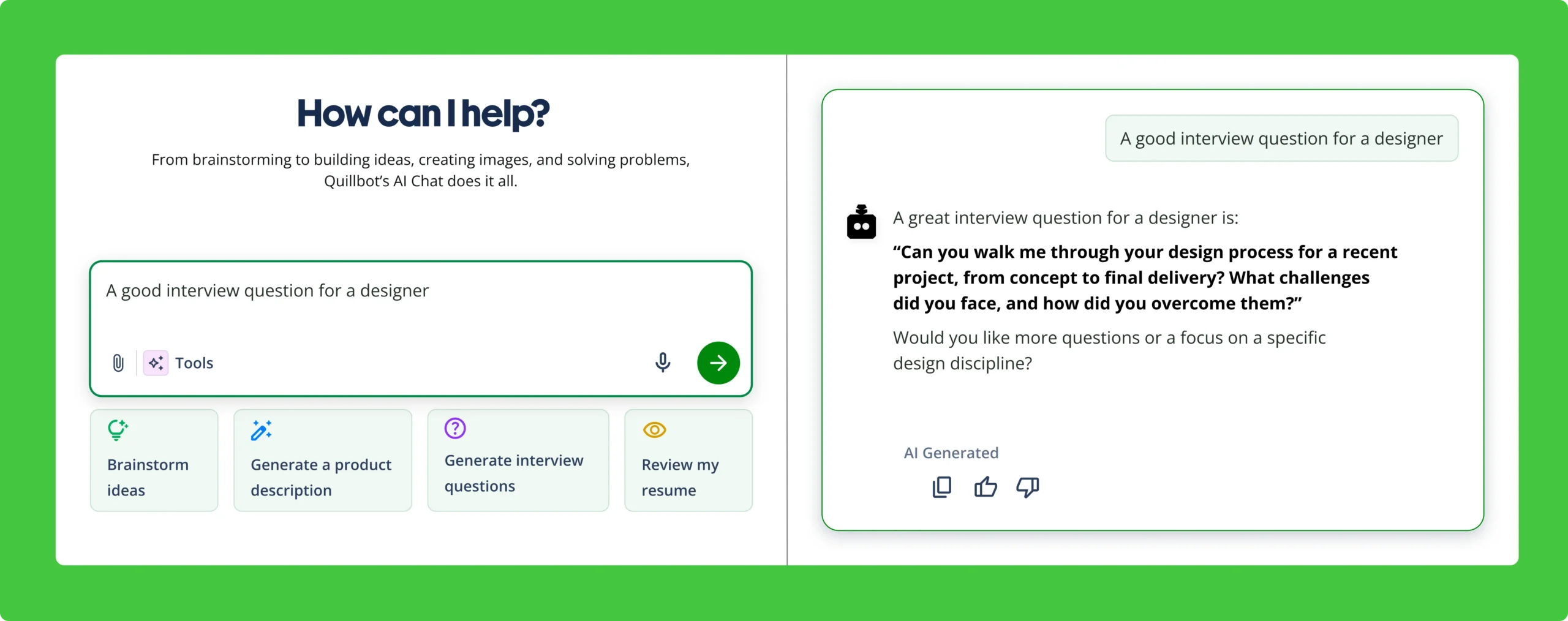
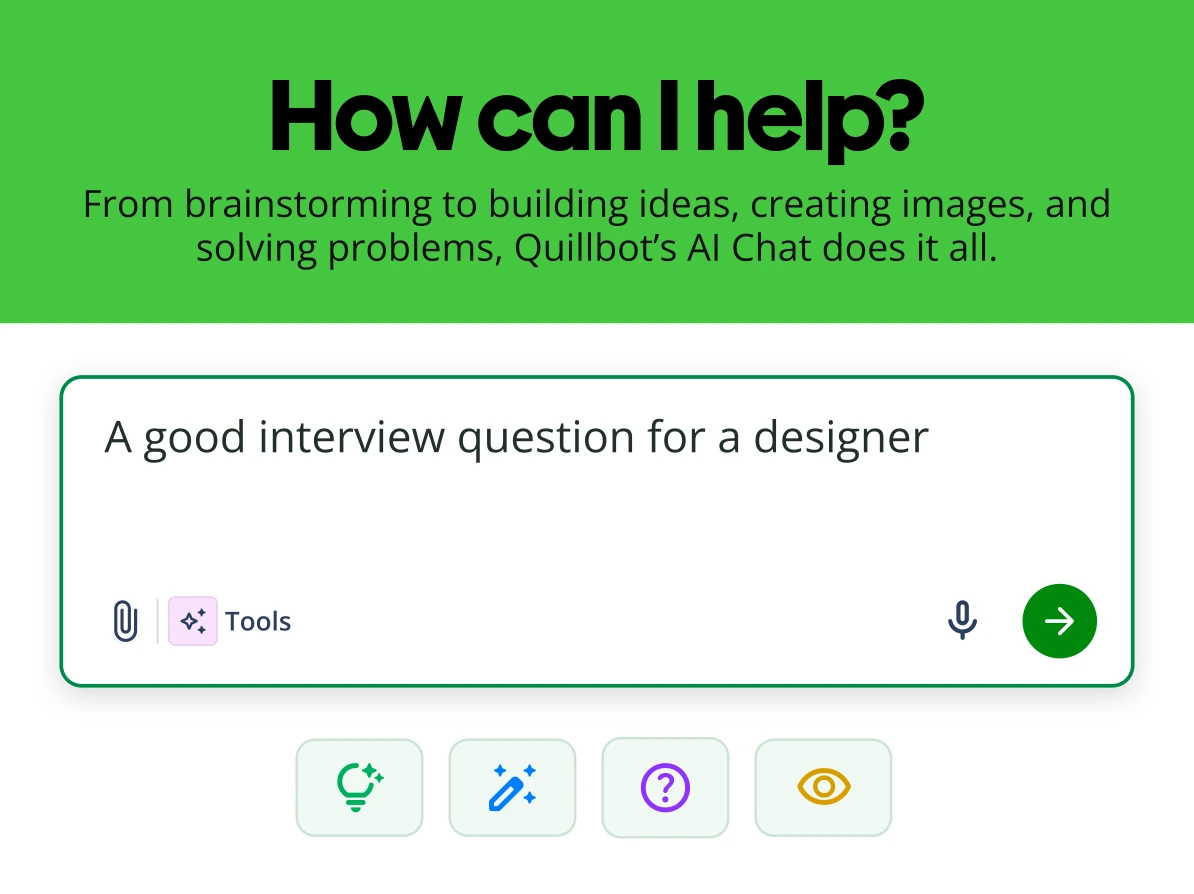
Use the 20 job interview questions and answers in this article to help you prepare for your next interview. Quillbot’s free AI Chat can also give you feedback on your ideas for answering them.

Key takeaways
- Preparing for common interview questions can help you recall relevant examples and tailor your answers to the role.
- Strong answers connect your skills, experience, goals, and working style to what the employer is looking for.
- For behavioral interview questions, briefly describe the situation, then focus on what you did, the skills you used, and the outcome.
- When answering “Tell me about yourself,” focus on your relevant education, experience, and qualifications rather than your personal life.
Job interview questions
For each of the 20 job interview questions below, you’ll find tips for giving a strong response and an example answer. They cover common themes such as your motivation, working style, career goals, and soft skills.
Why do you want to work for us?
- Show that you’ve researched the employer.
- Explain why the role makes sense in terms of your career development.
What kind of work environment do you thrive in?
- Research the company so you can describe an environment that matches the workplace you’re applying to.
- Focus on conditions that help you do your best work, such as teamwork, clear communication, or independence.
Where do you see yourself in five years?
- Show that you have realistic career goals.
- Explain how the role could help you develop relevant skills and experience.
- Avoid suggesting that you expect to move on quickly or are only using the job as a stepping stone.
Why do you think we should hire you?
- Focus on the skills and experience that are most relevant to the role.
- Give a specific reason you would be able to perform the job well.
- Avoid vague claims such as “I’m a hard worker” unless you support them with evidence.
What do you think your colleagues value most about working with you?
- Choose qualities that are relevant to working effectively with others.
- Support your answer with a brief example.
- Say how your qualities would benefit the team.
Why do you want to move on from your current job?
- Focus on what you’re looking for next rather than criticizing your current employer.
- Give a positive, forward-looking reason, such as greater responsibility, new challenges, or better opportunities to develop.
What matters most to you in your next job?
- Focus on priorities that are relevant to the role you’re interviewing for (e.g., professional development, responsibility, teamwork, or meaningful work).
- Show that you’ve thought about what will help you stay motivated and perform well.
- Avoid focusing mainly on salary, benefits, or convenience.
What would your manager say you need to improve?
- Choose a genuine area for improvement that is not a core requirement of the role.
- Show self-awareness without being overly negative.
- Explain what you’re doing to improve.
Can you give an example of how you’ve used AI at work?
- Give a specific example of a task where AI helped you work more efficiently or effectively.
- Explain how you reviewed or adapted the AI-generated output rather than relying on it uncritically.
- Show that you understand appropriate limits, such as protecting confidential information.
Do you have any questions you’d like to ask us?
- Prepare two or three thoughtful questions in advance.
- Avoid asking only about salary, benefits, or time off at this stage.
- Don’t ask questions that are already answered clearly in the job description or on the company website.
“Tell me about a time when” questions
Questions that ask you to describe how you handled a specific situation in the past are called “behavioral interview questions” or STAR method interview questions.
Employers typically use these questions to assess soft skills such as communication, teamwork, problem-solving, and adaptability. When answering, avoid spending too much time describing the situation. Briefly set the scene, then focus on what you did, the skills you used, and the outcome.
Tell me about a time you worked with someone who had a very different working style from yours.
- Avoid criticizing the other person or their working style.
- Explain how you adapted so you could work effectively together.
- Show how you used communication skills to manage your differences.
- Mention what you learned from working with someone with a different approach.
Tell me about a time when you helped resolve a disagreement within a team.
- Avoid assigning blame.
- Describe what you did to help each person feel heard.
- Show how you used communication or problem-solving skills to move the discussion forward.
Tell me about a time when you had to deliver difficult feedback.
- Show that you communicated the feedback clearly and respectfully.
- Mention how you helped the other person respond constructively or improve.
Tell me about a time you helped an unsatisfied customer.
- Show that you listened carefully and remained calm and professional.
Tell me about a time when you were given an unrealistic deadline.
- Try not to sound negative about the person who set the deadline.
- Describe how you prioritized the work and identified what was realistically achievable.
- Show how you communicated about constraints, trade-offs, or support you needed.
Tell me about yourself …
If the interviewer asks you to tell them about yourself at the start of the interview:
- Focus on your education, work experience, and other relevant qualifications rather than your personal life.
- Use your answer as an opportunity to highlight the skills and experience that make you a strong candidate for the role.
“I studied marketing at university and have spent the last three years working as a marketing assistant for a retail company. In that role, I’ve helped coordinate email and social media campaigns, track performance data, and work with designers and copywriters on promotional materials. I’m now looking to take on more responsibility for planning and managing campaigns, which is what attracted me to this marketing coordinator position.”
Software developer:
“I studied computer science and have spent the last four years working as a junior developer, mainly using JavaScript and Python. In my current role, I’ve worked on internal tools, fixed bugs, and helped develop new features as part of an agile team. I’m now looking for a position where I can take on more complex development work and continue building my backend skills, which is what interested me about this role.”
Customer service supervisor:
“I’ve spent the last two years working in customer service for an online retailer, where I handle customer questions, resolve order and delivery issues, and help manage complaints. I’ve developed strong communication and problem-solving skills, particularly when dealing with difficult situations. I’m now looking for a role where I can build on that experience and take on more responsibility.”
Accountant:
“I studied accounting and have spent the last three years working as an accounts assistant for a manufacturing company. My responsibilities include preparing invoices, reconciling accounts, and assisting with monthly financial reports. I’ve developed strong attention to detail and confidence working with financial data, and I’m now looking for a role where I can take on more responsibility and continue developing my accounting skills.”
Project manager:
“I’ve spent the last five years working in project coordination and project management roles, mainly in the technology sector. I’ve managed schedules, budgets, and cross-functional teams and have helped deliver several large projects on time and within budget. I’m now looking for a role where I can take ownership of larger projects and work more closely with clients and senior stakeholders.”
Frequently asked questions about job interview questions and answers
- What are the most common STAR interview questions?
-
STAR interview questions are among the most common interview questions.
Common STAR method interview questions (aka behavioral interview questions) include questions about:
- Working with others (e.g., “Tell me about a time when you had to deal with a colleague who you thought was being unreasonable.”)
- Solving problems (e.g., “Describe a situation where you identified and solved a problem.”)
- Leadership and responsibility (e.g., “Give me an example of a time when you took responsibility for something that was not going to plan.”)
- Learning or growth (e.g., “Tell me about a time when you used feedback to help you improve your work.”)
Use Quillbot’s free AI Paraphrasing Tool to help you strike the right tone in your cover letters.
- What is the STAR technique?
-
The STAR technique is another name for the STAR interviewing method.
STAR method interview questions prompt you to talk about a Situation or Task from your work experience, the Action you took to manage the situation or complete the task, and the Result of your actions (e.g., “Tell me about a time when you acted quickly to solve a problem”).
Quillbot’s free AI Chat can help you brainstorm the kind of STAR questions you might be asked in an interview.
- How long should my answer to Tell me about yourself be?
-
A strong answer to the interview question “Tell me about yourself” will usually be around a minute long.
It’s an opening question that functions as an icebreaker, so you don’t need to give a comprehensive overview of your whole career.
If you go into too much detail, your answer could come across as rambling.
Quillbot’s free AI Chat can help you brainstorm how to answer Tell me about yourself.
Other interesting articles
If you want to know more about colors, letters, or the meaning of emojis, make sure to check out some of our other articles with explanations and examples.