How to Prepare for Marketing Interview Questions
You can’t predict exactly which marketing interview questions you’ll be asked, but you can prepare thoroughly to answer a wide range of questions effectively. The key is to anticipate what the employer might want to know and go into the interview with examples fresh in your mind that demonstrate the marketing skills, knowledge, and experience they’re looking for.
This guide includes sample marketing interview questions and answers you can use in your interview preparation. It also offers practical tips to help you identify what to emphasize in your answers and how to make a convincing case for your suitability for the role.
Quickly create a professional-looking resume to take along to a marketing interview using Quillbot’s free resume templates.
Key takeaways
- Tailor your preparation to the role. Review the job description to anticipate marketing interview questions about the skills, experience, and knowledge the employer is looking for.
- Prepare specific examples from your experience. Draw on previous jobs, internships, or college projects to demonstrate your marketing expertise, problem-solving abilities, and analytical skills. Use the STAR method to structure your answers where appropriate.
- Be ready to demonstrate your soft skills. Prepare examples that show how you communicate, collaborate with others, manage competing priorities, and adapt to changing circumstances.
- Make the most of your education and training. Identify relevant knowledge and skills gained through marketing qualifications, coursework, or practical assignments that you can refer to in your answers.
- Research the company’s marketing. Familiarize yourself with its products, target audiences, marketing channels, and campaigns so you can offer informed observations and explain how you could contribute.
Marketing interview question tips
The following tips and example marketing interview questions and answers will help you focus your preparation on the specific role you’re applying for, as well as identify which aspects of your experience, knowledge, and skills to draw on to formulate convincing responses.
Prepare with the job description in mind
You probably studied the job description in detail when you wrote your cover letter and tailored your resume to the role. This means you’ve already been through some of the thought processes that will help you prepare for answering the marketing interview questions effectively.
Now it’s time to refresh your memory and revisit the job description. You need to go into the interview knowing:
- Which marketing activities you’d be responsible for
- What skills and experience the employer is looking for
- What they want the person in the role to achieve
This will help you frame your answers around the employer’s requirements to emphasize that you’re the right choice.
Reread your application
Go through the cover letter and resume you submitted and consider what the interviewer might ask you to clarify or expand on. For example, did you mention any particularly relevant projects, achievements, or software tools that they might want to know more about? Prepare to discuss these in greater detail and give specific examples that support the claims you made in your application.
If you didn’t meet one of the requirements in the job description but argued that you had transferable skills that would make up for this, think about how you could explain that argument more fully.
Your application made the case for why you’re suitable for the role; the interview is your chance to expand on it.
Can you tell me more about the [product launch marketing campaign] you mentioned in your cover letter?
You said you increased [website traffic by 30%] in your previous role. How did you achieve that?
I see you’ve worked with [Google Analytics]. What have you used it for?
Ground your answers in experience
Prepare to give specific examples that demonstrate the marketing knowledge and skills the employer is looking for. For example, if the job posting mentions “A/B testing,” be ready to talk about how you’ve used it in the past.
Ideally, your examples will come from your work experience, but you could also draw on a college project or internship.
One useful way to structure answers to interview questions is the STAR method:
- Situation: Briefly describe the background to the marketing activity or project you’re going to discuss.
- Task: Explain the marketing task you needed to complete or the goal you were trying to achieve.
- Action: Describe what you did and why you chose that approach.
- Result: Explain the outcome, including any measurable results and what you learned from the experience.
You don’t need to follow this framework rigidly for every answer, but grounding your answers in your real-world experience can help you demonstrate practical understanding, rather than just theoretical knowledge.
Answer: At my previous company, we ran an email marketing campaign promoting a free webinar, and I was responsible for monitoring its performance. I started by reviewing the results of similar past campaigns to establish benchmarks. The open rate was disappointing in comparison, but the click-to-open rate was very good. This suggested that the email content was engaging, but the subject line might not have been compelling enough. Based on this, we decided to A/B test different subject lines in our next webinar campaign to see if we could improve the open rate.
Question: Tell me about a project where you had to identify the target audience for a new product.
Answer: For a college marketing project, we had to develop a marketing plan for a new fitness app. My group started by researching competing apps and looking at the needs and characteristics of their users. We also conducted a small survey to learn about people’s fitness habits and motivations. Based on our findings, we identified busy young professionals who wanted short, flexible workouts as our primary target audience.
Question: Can you think of a time when you decided to prioritize one marketing activity over another?
Answer: At my previous company, the sales team wanted us to organize a series of in-person events to generate leads for a new product. However, we had a limited marketing budget, and I was concerned about the cost.
I estimated the likely cost per lead based on the expenses involved and the number of leads we could realistically expect. I then compared this with the cost per lead we’d achieved through previous email and digital advertising campaigns.
The figures suggested that we could generate significantly more leads for the same budget using digital channels. I presented my analysis to my manager, who supported my recommendation to prioritize those activities instead of the events.
Question: Describe a situation where you used data to improve marketing performance.
Answer: During an internship, I worked alongside a colleague who was trying to improve the conversion rate of a landing page. I helped compile the campaign performance data, and my colleague showed me how they used it to identify where visitors were dropping out of the conversion process. They then tested a shorter form to see whether it would encourage more visitors to complete it. Although I wasn’t responsible for deciding on the changes, being involved helped me understand how marketers can use performance data to identify problems, develop hypotheses, and test potential improvements.
Demonstrate your soft skills
Review the job description for clues about the soft skills and personal qualities the role requires. These might include the ability to:
- Manage competing priorities
- Work under pressure
- Meet deadlines
- Collaborate with colleagues
- Adapt to changing circumstances
- Stay focused on business objectives
Prepare examples of situations where you’ve demonstrated the soft skills you think the employer will be looking for.
For instance, if the job involves managing several campaigns simultaneously, think of a time when you had to balance competing deadlines and be ready to explain how you prioritized to ensure that the most important tasks received sufficient attention.
Tell me about a time when you had to work under pressure.
How would you explain a marketing strategy to colleagues who don’t have a marketing background?
Describe a situation where you had to change your priorities unexpectedly.
Emphasize the relevance of your qualifications
If you have a marketing degree, professional certifications, or other relevant formal training, prepare to explain how they’ve equipped you for the role. This is especially important if you have limited work experience that’s directly relevant to the position.
Don’t assume that the interviewer will automatically understand the relevance of a qualification. Identify the specific marketing knowledge and skills you’ve gained and consider how you could apply them to the responsibilities of the job.
Think about any relevant assignments or practical projects you completed during your studies that could help demonstrate your suitability. The aim is to be ready to draw on your education and training when answering a wide range of marketing interview questions, not just questions specifically about your qualifications.
| Example marketing interview question | Examples you could draw on from your education and training |
|---|---|
| How would you identify the target audience for [name of one of the company’s products or services]? | A market research assignment in which you used surveys and demographic data to identify potential customer segments. |
| How would you go about developing a marketing strategy for [name of one of the company’s products or services]? | A marketing strategy project in which you researched a product, analyzed its competitive environment, and developed a marketing plan. |
| What factors would you consider when choosing marketing channels for a new campaign? | Coursework covering the strengths and weaknesses of different marketing channels and how to select them based on campaign objectives, target audiences, and budgets. |
| How would you research the marketing activities of our main competitors? | A competitive analysis assignment in which you examined competitors’ positioning, marketing messages, and promotional activities. |
| How would you measure the success of a marketing campaign? | Training in marketing analytics covering the selection of KPIs, performance measurement, and return on investment (ROI). |
| What would you do if a campaign wasn’t achieving its objectives? | A case study in which you analyzed an underperforming campaign, identified possible reasons for its poor results, and recommended improvements. |
| How would you use customer data to improve a marketing campaign? | Coursework covering customer segmentation, purchasing behavior, and the use of data to personalize marketing messages. |
| How would you decide whether an A/B test had produced a meaningful result? | Training in A/B testing, including statistical significance, sample sizes, and interpreting test results. |
| How would you approach creating a content marketing plan? | A content marketing assignment in which you developed audience personas, identified content topics, and created a content calendar. |
| What steps would you take to improve the conversion rate of a landing page? | A digital marketing course covering conversion rate optimization (CRO), landing page design principles, and testing methods. |
| How would you optimize an email marketing campaign? | A practical exercise during a digital marketing certification in which you analyzed email performance metrics and proposed improvements to subject lines, content, or audience targeting. |
| How would you develop a social media strategy for a new product? | A social media marketing project in which you selected platforms, developed content ideas, and established objectives and performance metrics. |
Research the company’s marketing
Researching examples of the prospective employer’s marketing is an important part of preparing to answer marketing interview questions.
- Explore the company’s website, products or services, target audiences, marketing channels, and campaigns. Consider how the business positions itself against competitors and what its marketing appears to be trying to achieve.
- Identify specific examples you can discuss during the interview. You might have noticed an effective email campaign, an interesting social media approach, or an opportunity to improve the company’s website content.
- Think about these examples in relation to the role you’re applying for. If the position involves content marketing, concentrate on the company’s content. If it’s an email marketing role, pay particular attention to how the business uses email.
- Prepare thoughtful observations, but avoid making sweeping criticisms or assuming you know why the company has made particular marketing decisions.
- Think about how your particular experience, knowledge, and skills could help the company market its products or services more effectively.
Who would you say our main target audience is?
How would you improve our website’s marketing performance?
What would your priorities be during your first three months in this role?
Frequently asked questions about marketing interview questions
- What are some product marketing manager interview questions?
-
Alongside general common interview questions, prepare to answer product marketing manager interview questions about important areas of product marketing like:
- Customer and competitor research (e.g., “How would you identify unmet customer needs that our product could address?”)
- Product positioning and messaging (e.g., “How would you differentiate our product from competing products?”)
- Sales enablement (e.g., “How would you help our sales team communicate the value of a new product to potential customers?”)
- Product launches (e.g., “How would you develop and implement a go-to-market strategy for a new product?”)
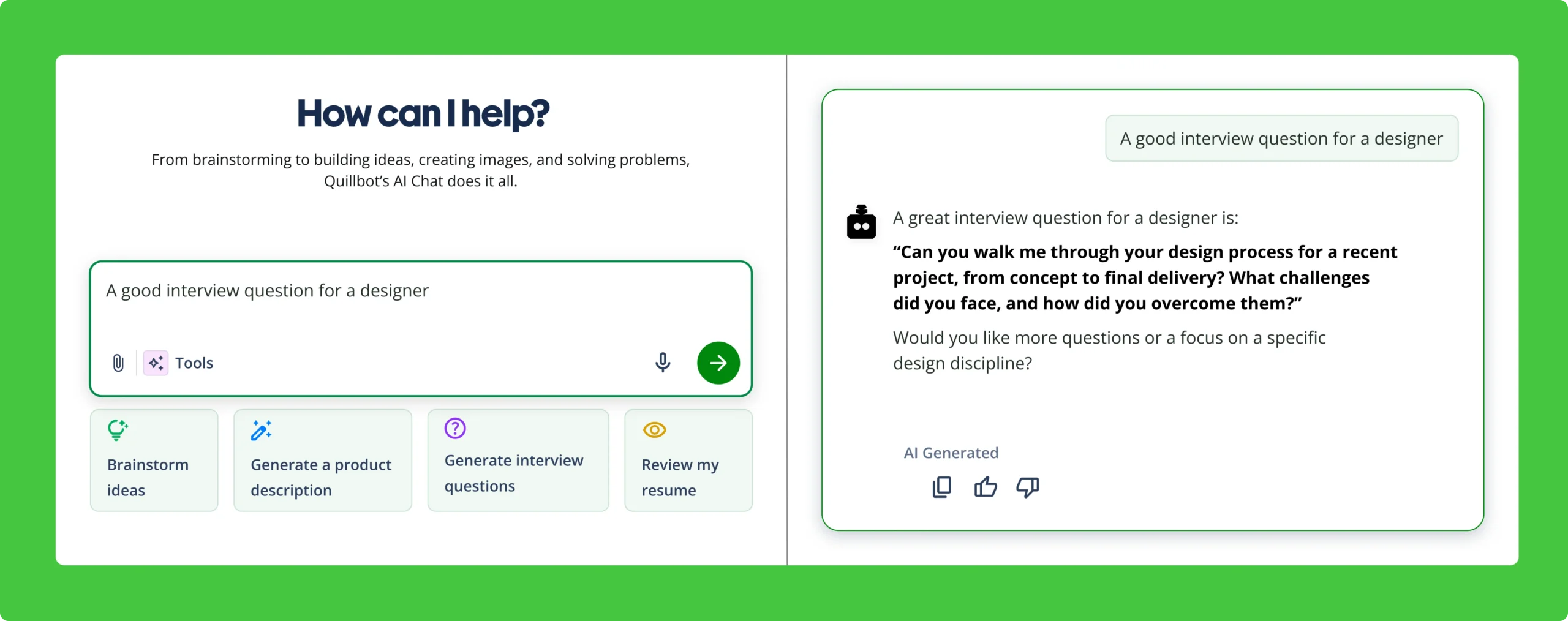
Quillbot’s free AI Chat can help you anticipate marketing interview questions based on the job description and information you provide about your experience and qualifications.
- What are some content marketing interview questions?
-
As well as general common interview questions, prepare to answer content marketing interview questions about important areas of content marketing like:
- Audience research and content strategy (e.g., “How would you identify content topics that would appeal to our target audience?”)
- Content creation and planning (e.g., “How would you plan and manage a content calendar to ensure we publish consistently?”)
- Search engine optimization (SEO) (e.g., “How would you optimize a blog post to improve its visibility in search engine results?”)
- Content performance measurement (e.g., “How would you measure the success of a content marketing campaign?”)
Quillbot’s free AI Chat can help you practice answering marketing interview questions.
- What are some common digital marketing interview questions?
-
When preparing to answer digital marketing interview questions, in addition to general common interview questions, consider how you’d respond to questions about key areas of digital marketing such as:
- Search engine optimization (SEO) (e.g., “What steps would you take to increase organic traffic to our website?”)
- Paid digital advertising (e.g., “How would you plan a paid advertising campaign with a limited budget?”)
- Social media and email marketing (e.g., “How would you decide which digital channels to use to reach a particular target audience?”)
- Analytics and campaign optimization (e.g., “How would you use performance data to improve the results of a digital marketing campaign?”)
Revamp your resume using one of Quillbot’s free resume templates.
- What are some common marketing manager interview questions?
-
Alongside general common interview questions and marketing interview questions, marketing manager interview questions often assess both your marketing expertise and the soft skills needed to manage people, projects, and competing priorities.
Prepare to answer questions about areas such as:
- Marketing strategy and budget management (e.g., “How would you prioritize marketing activities when working with a limited budget?”)
- Campaign performance and decision-making (e.g., “Tell me about a time when you used performance data to improve a marketing campaign.”)
- Team leadership and delegation (e.g., “How do you delegate tasks and keep your team motivated when working to tight deadlines?”)
- Communication and collaboration (e.g., “How would you handle a disagreement with the sales team about marketing priorities?”)
Give your resume a lift with one of Quillbot’s free resume templates.
Other interesting articles
If you want to know more about colors, letters, or the meaning of emojis, make sure to check out some of our other articles with explanations and examples.